Cabinet Approves 46-km Railway Multitracking Across Karnataka, Andhra Pradesh
Synopsis
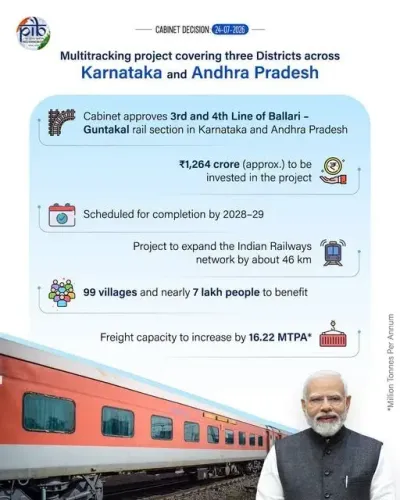
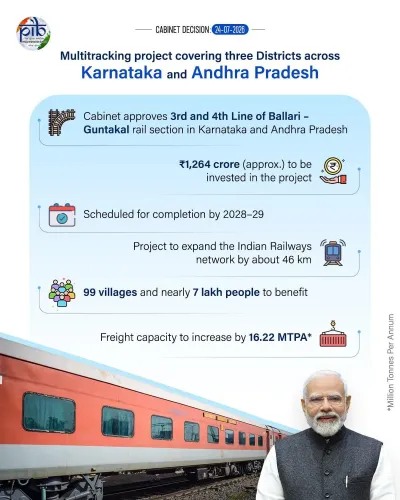
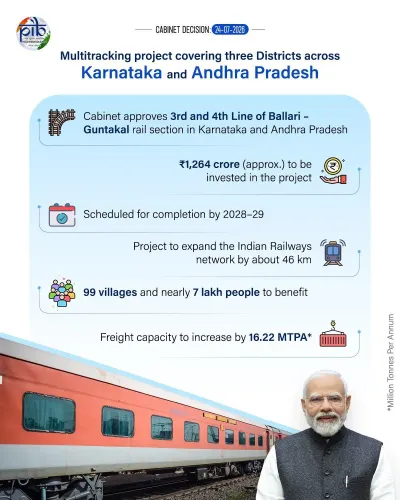
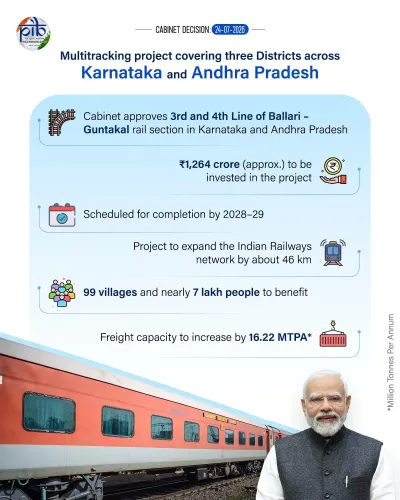
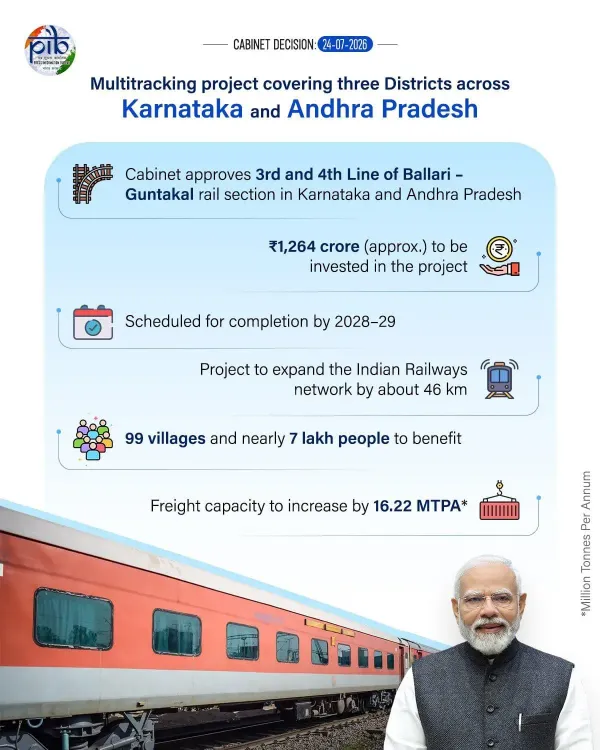
The Union Cabinet, chaired by PM Narendra Modi, has approved a multitracking railway project covering three districts across Karnataka and Andhra Pradesh, expanding the Indian Railways network by about 46 km. The decision advances the government's long-running push to raise rail capacity on southern inter-state corridors.
Key Takeaways
The Union Cabinet chaired by PM Narendra Modi approved one multitracking railway project on 25 July 2026 .
The project spans three districts across Karnataka and Andhra Pradesh .
It will add approximately 46 kilometres to the existing Indian Railways network.
Multitracking adds parallel tracks to existing alignments, limiting the need for large-scale fresh land acquisition.
The approval aligns with the government's National Infrastructure Pipeline focus on southern rail-capacity expansion since 2019.
Freight operators and rail passengers on the southern inter-state corridor are the primary beneficiaries.
Union Minister of Ports, Shipping and Waterways Sarbananda Sonowal announced on Friday, 25 July 2026 that the Union Cabinet, chaired by Prime Minister Narendra Modi, has approved a multitracking railway project spanning three districts across Karnataka and Andhra Pradesh, adding approximately 46 kilometres to the existing Indian Railways network.
Context
The Cabinet decision was shared by Sonowal under the hashtag #CabinetDecisions, a routine practice by Union Ministers to publicise collective decisions taken at Cabinet meetings presided over by the Prime Minister. The approved project involves multitracking — the addition of one or more parallel tracks to an existing railway line — across three districts straddling the Karnataka–Andhra Pradesh border in southern India.
Multitracking projects are distinct from greenfield corridors: they expand capacity on established alignments, typically requiring less land acquisition and enabling faster execution. The 46-km addition will incrementally expand the total route length of Indian Railways, the world's fourth-largest rail network.
Policy Backdrop
The approval fits within a sustained central-government push to augment rail infrastructure in southern India. Since 2014, successive Union Cabinets have cleared dozens of track-doubling and multitracking proposals across states, with the objective of reducing freight logistics costs and easing passenger congestion on high-density corridors.
The National Infrastructure Pipeline, launched in 2019, explicitly identified Indian Railways capacity expansion — including multitracking on busy inter-state sections — as a priority investment area. Southern corridors linking Karnataka and Andhra Pradesh handle significant freight volumes, including agricultural produce, steel, and cement, making additional track capacity commercially and strategically important.
Stakeholders and Impact
Rail passengers travelling between the two states stand to benefit from reduced congestion and improved punctuality once the additional tracks are commissioned. Freight operators — particularly those moving bulk commodities through the southern corridor — are expected to gain from higher line capacity and more reliable scheduling.
The three districts covered by the project will see direct infrastructure investment, with construction activity likely to generate local employment during the execution phase. Because the project follows an existing alignment, large-scale fresh land acquisition is not anticipated, which typically smooths the path to faster ground-level implementation.
What's Next
The project now moves to the tendering and detailed project-report stage under the Ministry of Railways. Progress on land clearances in the three districts and the award of civil contracts will be the near-term milestones to watch. Funding timelines and any additional southern multitracking proposals are likely to feature in forthcoming railway capital-expenditure announcements or the next Union Budget.
With the Cabinet's stamp of approval secured, the project joins a growing pipeline of southern rail-capacity investments that collectively signal the government's intent to modernise inter-state connectivity in the region before the end of the decade.
Point of View
The government keeps infrastructure momentum visible while managing execution risk. The Karnataka–Andhra Pradesh corridor choice also reflects the strategic importance of southern freight flows to national logistics-cost reduction targets. Cumulatively, such approvals build a record of infrastructure delivery that the ruling dispensation has consistently leveraged as a political and economic credential.
NationPress
24 Jul 2026
Frequently Asked Questions
What did the Union Cabinet approve for Indian Railways on 25 July 2026?
The Union Cabinet, chaired by PM Narendra Modi, approved one multitracking railway project covering three districts across Karnataka and Andhra Pradesh, adding about 46 km to the existing Indian Railways network.
What is a multitracking project in Indian Railways?
A multitracking project involves laying one or more additional parallel tracks alongside an existing railway line to increase line capacity, reduce congestion, and improve train frequency without building an entirely new route.
Which states benefit from the new railway multitracking project?
Karnataka and Andhra Pradesh are the two states benefiting from the project, with the three districts involved straddling the border between the two southern states.
How does this railway project fit into India's infrastructure policy?
The project is part of the government's sustained push under the National Infrastructure Pipeline, launched in 2019, to expand Indian Railways capacity, particularly on high-traffic inter-state corridors in southern India.
When will the new 46-km railway track be ready?
A commissioning date has not been announced. The project must first go through tendering, detailed project-report preparation, and land clearances in the three districts before construction can begin.