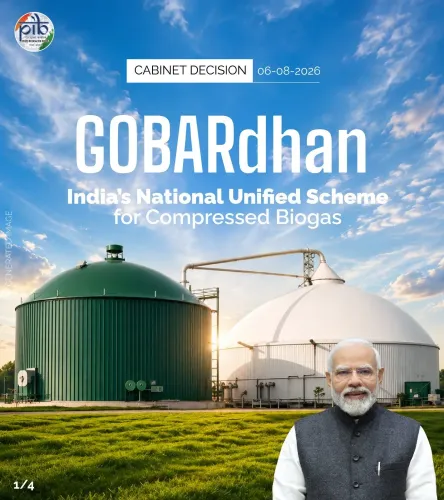
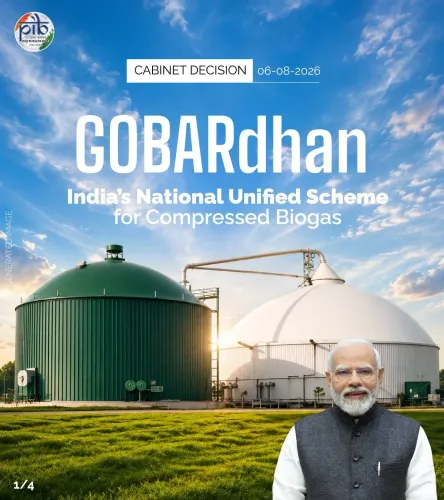
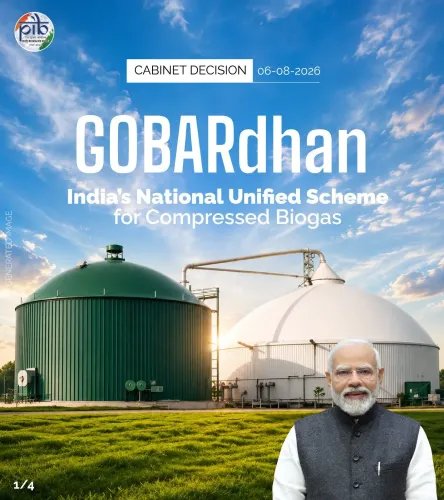
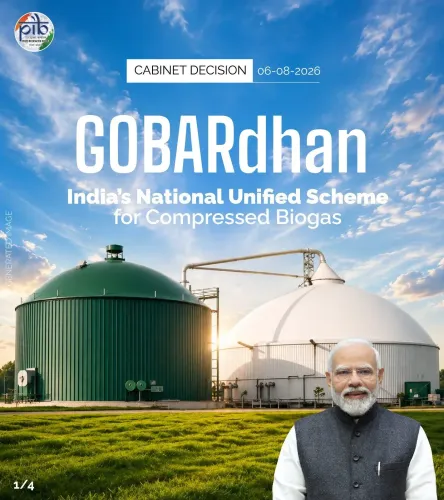
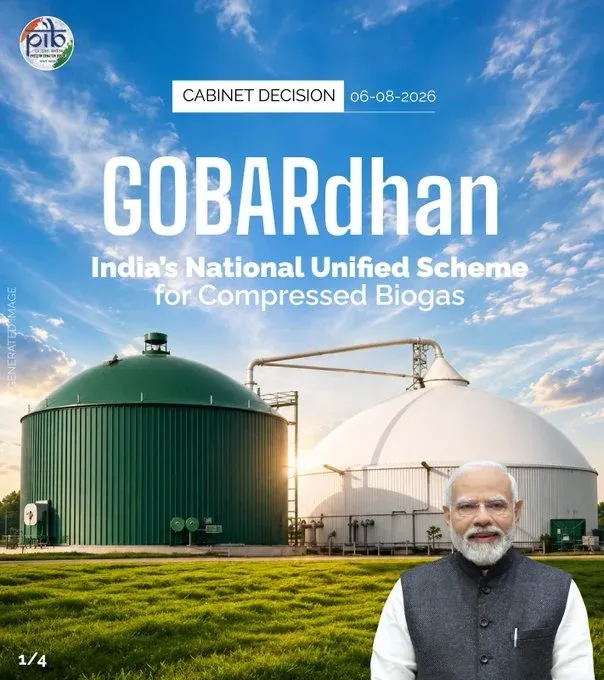
Cabinet Approves GOBARdhan Scheme With ₹23,731 Cr Outlay
Synopsis
India's Union Cabinet has approved GOBARdhan — the National Unified Scheme for Compressed Biogas — with a ₹23,731 crore outlay. The scheme converts cattle dung, crop residue, and urban organic waste into CBG, offering farmers new income streams while cutting India's dependence on imported natural gas and LPG.
Key Takeaways
The Union Cabinet approved the GOBARdhan National Unified Scheme for Compressed Biogas (CBG) with a total outlay of ₹23,731 crore .
The scheme converts cattle dung, agricultural residue, municipal organic waste, and other biomass into Compressed Biogas, a substitute for LPG and CNG.
Support mechanisms include assured offtake, stable pricing, capital assistance, pipeline connectivity, and credit support for CBG producers.
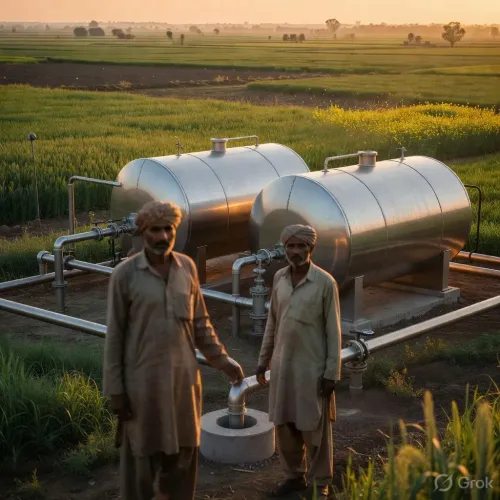
Farmers and rural entrepreneurs are direct beneficiaries, gaining income from selling organic waste feedstock and organic fertiliser from plant slurry.
GOBARdhan integrates with Swachh Bharat Mission and the SATAT initiative, linking waste management to national fuel distribution infrastructure.
The scheme advances the government's Atmanirbhar Bharat and Viksit Bharat goals by reducing dependence on imported fossil fuels.
India's Union Cabinet has cleared GOBARdhan — the National Unified Scheme for Compressed Biogas (CBG) — with a total outlay of ₹23,731 crore, turning cattle dung, crop stubble, and municipal organic waste into a strategic energy asset. Union Coal and Mines Minister G. Kishan Reddy announced the Cabinet decision on Thursday, 6 August 2026, calling it a major step in India's clean energy transition.
Waste into watts: what GOBARdhan actually does
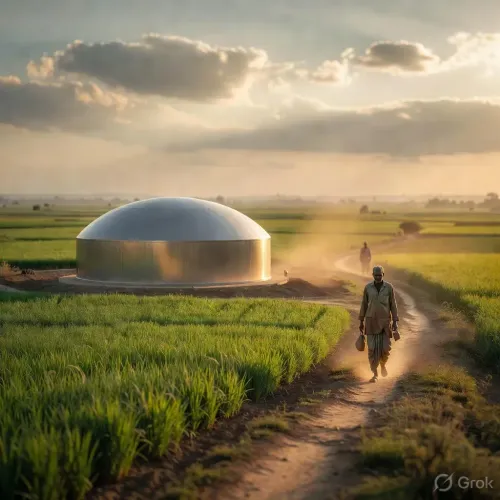
The scheme's logic is elegantly circular. Agricultural residue that farmers once burned in fields, cattle dung that went nowhere, and urban organic waste that clogged landfills — all of it becomes feedstock for Compressed Biogas plants. The CBG produced is a direct substitute for CNG and LPG, fuels India currently imports at significant cost. The Cabinet approval bundles together assured offtake guarantees, stable pricing mechanisms, capital assistance, pipeline connectivity, and credit support — the full stack a producer needs to actually build and run a plant.
GOBARdhan is not a new name in Indian policy. It was first announced in the 2018-19 Union Budget as a rural livelihood and waste-management initiative. This Cabinet approval marks a significant scaling-up — a unified national scheme with a defined outlay and an integrated framework that ties together waste management, energy security, and farmer income in one structure.
The rural income angle that separates this from a plain energy scheme
The scheme explicitly targets farmers and rural entrepreneurs as beneficiaries — not just as feedstock suppliers, but as participants in the CBG economy. Cattle dung and crop residue become monetisable commodities. The spent slurry from biogas plants doubles as organic fertiliser, cutting input costs for farmers who sell back into the same agricultural cycle. That loop — waste in, energy and fertiliser out, income at both ends — is the political and economic case the government is making.
The approval also slots directly into two existing flagship frameworks: Swachh Bharat Mission on the waste-management side, and the SATAT (Sustainable Alternative Towards Affordable Transportation) initiative on the fuel-distribution side. Pipeline connectivity support in the new outlay is designed to bridge the gap between rural CBG plants and the national gas grid.
Energy security arithmetic: cutting the import bill
India's dependence on imported natural gas and LPG is a persistent pressure on the current account. Scaling domestic CBG production attacks that bill directly. The combination of assured offtake — meaning a guaranteed buyer for every unit produced — and stable pricing is specifically designed to de-risk private investment in CBG infrastructure, a segment that has historically struggled to attract capital without certainty on returns.
Minister Reddy framed the approval within Prime Minister Narendra Modi's broader vision of Atmanirbhar Bharat (self-reliant India) and Viksit Bharat (developed India by 2047), positioning GOBARdhan as a proof point that energy self-reliance and rural prosperity can be engineered simultaneously.
The next test is execution: how quickly CBG plants are commissioned, whether the assured pricing mechanism holds for producers, and how effectively multiple ministries coordinate on the ground. The outlay is approved — the build starts now.
Point of View
But a nationally unified scheme with a five-figure crore outlay. The bundling of assured offtake and stable pricing signals a deliberate attempt to solve the private-investment problem that stalled earlier biogas ambitions. Politically, it lets the BJP simultaneously speak to clean energy credentials, farmer income, and the 'waste-to-wealth' framing of Swachh Bharat — a trifecta that is difficult for the opposition to contest on principle. The real test of whether this is transformative or another well-funded scheme on paper will come in the commissioning numbers over the next two years.
NationPress
6 Aug 2026
Frequently Asked Questions
What is the GOBARdhan scheme approved by the Cabinet?
GOBARdhan — Galvanising Organic Bio-Agro Resources Dhan — is India's National Unified Scheme for Compressed Biogas (CBG), approved by the Union Cabinet with a ₹23,731 crore outlay. It converts cattle dung, agricultural residue, and municipal organic waste into CBG, which can substitute for LPG and CNG.
How much money has the government allocated for GOBARdhan?
The Union Cabinet has approved a total outlay of ₹23,731 crore for the GOBARdhan scheme, covering capital assistance, assured offtake mechanisms, stable pricing, pipeline connectivity, and credit support for CBG producers.
How will GOBARdhan benefit farmers?
Farmers benefit in two ways: they can sell cattle dung and crop residue as feedstock to CBG plants, generating additional income, and they receive organic fertiliser — the spent slurry from biogas processing — which reduces their agricultural input costs.
What is the difference between GOBARdhan and SATAT?
SATAT (Sustainable Alternative Towards Affordable Transportation) is an existing initiative focused on the procurement and distribution of CBG as a transport fuel. GOBARdhan is the broader national scheme that integrates production support, waste management, rural income, and pipeline infrastructure — with SATAT operating as part of the distribution framework within it.
When was GOBARdhan first launched in India?
GOBARdhan was first announced in the 2018-19 Union Budget as a rural livelihood and waste-management initiative. The 2026 Cabinet approval marks a major scaling-up into a unified national scheme with a large defined outlay and comprehensive producer-support mechanisms.