Cabinet Clears ₹1,264 Cr Rail Line Between Ballari and Guntakal
Synopsis
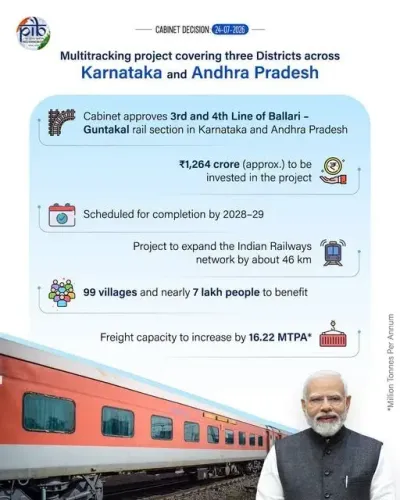
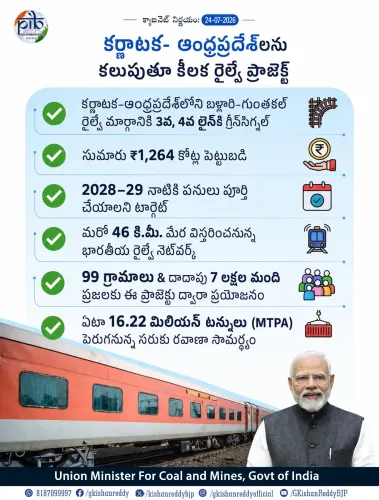
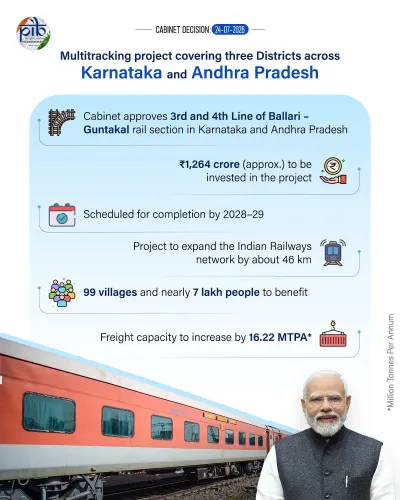
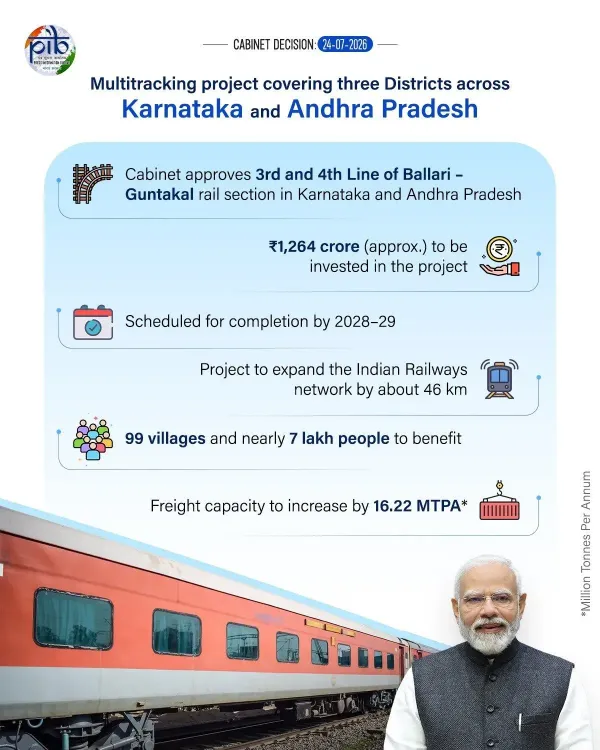
The Union Cabinet has approved a ₹1,264 crore project to build the 3rd and 4th rail lines between Ballari in Karnataka and Guntakal in Andhra Pradesh under PM GatiShakti, benefiting nearly 7 lakh people across 99 villages and boosting passenger and freight movement in the southern corridor.
Key Takeaways
The Union Cabinet, chaired by Prime Minister Narendra Modi , approved the 3rd and 4th rail lines between Ballari and Guntakal on 24 July 2026 .
The project is valued at ₹1,264 crore and falls under the PM GatiShakti National Master Plan for Multi-modal Connectivity.
The corridor spans two states — Karnataka and Andhra Pradesh — connecting a major mining hub to a critical southern railway junction.
An estimated 7 lakh people across 99 villages are expected to benefit from improved passenger and freight connectivity.
The approval follows a broader pattern of multi-tracking investments in India's southern and western rail corridors to ease congestion and support industrial logistics.
Union Education Minister and senior BJP leader Dharmendra Pradhan on Friday, 24 July 2026, highlighted a Union Cabinet decision to approve the construction of the 3rd and 4th rail lines between Ballari (Karnataka) and Guntakal (Andhra Pradesh), at a project cost of ₹1,264 crore, under the PM GatiShakti National Master Plan for Multi-modal Connectivity.
Context
The Union Cabinet, chaired by Prime Minister Narendra Modi, approved the multi-tracking project that aims to improve rail connectivity for nearly 7 lakh people across 99 villages in the two southern states. Pradhan described the move as 'another significant step towards building a modern and efficient railway network,' and said it would 'strengthen rail infrastructure and enhance both passenger and freight movement.'
The Ballari–Guntakal corridor is a critical link in India's southern rail network. Ballari is a major hub for mining and industrial freight in Karnataka, while Guntakal in Andhra Pradesh functions as one of the busiest railway junctions in the south, connecting multiple trunk routes.
Policy Backdrop
PM GatiShakti, launched in October 2021, is the central government's National Master Plan for Multi-modal Connectivity. It seeks to integrate planning across ministries and state governments to reduce logistics costs and eliminate bottlenecks that have historically delayed large infrastructure projects.
Multi-tracking — adding third and fourth lines to existing rail corridors — has been a recurring theme in recent cabinet approvals, reflecting the Indian Railways' effort to separate passenger and freight traffic and increase line capacity on saturated routes. The southern and western corridors have received particular attention given the density of industrial activity and port traffic in those regions.
Stakeholders and Impact
The project's primary beneficiaries are the residents of 99 villages along the corridor, who are expected to gain improved access to passenger rail services. Freight operators moving goods — particularly iron ore, steel, and agricultural produce — between Karnataka and Andhra Pradesh stand to benefit from reduced congestion and faster transit times once the additional lines are commissioned.
The approval also carries significance for the broader Dedicated Freight Corridor ecosystem and industrial clusters in the region, where reliable rail links are a key input for competitiveness. State governments of Karnataka and Andhra Pradesh will be stakeholders in land acquisition and coordination during execution.
What's Next
The project now moves into the implementation phase, which will involve land acquisition, environmental clearances, tendering, and construction. Progress on each of these stages — particularly land acquisition across two states — will determine the actual commissioning timeline.
Observers will watch for further cabinet approvals for similar multi-tracking projects in the southern corridor, as the government signals continued investment in rail capacity expansion aligned with India's industrial and logistics growth targets.
Point of View
The cabinet reinforces that infrastructure decisions are being made within an integrated planning architecture rather than as ad hoc approvals. The cross-state nature of the project — spanning Karnataka and Andhra Pradesh, both politically significant states — also reflects the BJP-led government's effort to demonstrate equitable infrastructure outreach in the south. How quickly land acquisition proceeds across two state administrations will be the real test of GatiShakti's coordination promise.
NationPress
24 Jul 2026
Frequently Asked Questions
What is the Ballari to Guntakal rail project approved by the Union Cabinet?
The Union Cabinet approved the construction of the 3rd and 4th rail lines between Ballari in Karnataka and Guntakal in Andhra Pradesh at a cost of ₹1,264 crore under the PM GatiShakti National Master Plan, aimed at boosting passenger and freight movement in the southern corridor.
How much will the Ballari–Guntakal rail line project cost?
The approved project cost is ₹1,264 crore, as announced following the Union Cabinet meeting chaired by Prime Minister Narendra Modi.
How many people will benefit from the Ballari–Guntakal rail project?
The project is expected to improve connectivity for nearly 7 lakh people living across 99 villages along the Ballari–Guntakal corridor in Karnataka and Andhra Pradesh.
What is PM GatiShakti and how does it relate to this rail project?
PM GatiShakti is India's National Master Plan for Multi-modal Connectivity, launched in October 2021, to integrate infrastructure planning across ministries and reduce logistics costs. The Ballari–Guntakal rail line is among the projects approved under this framework.
Why is Guntakal important for Indian Railways?
Guntakal in Andhra Pradesh is one of the most significant railway junctions in southern India, connecting multiple trunk routes and serving as a key node for both passenger services and freight movement across the region.