Cabinet Clears ₹14,500 Cr VGF Scheme for Grid-Scale Energy Storage
Synopsis
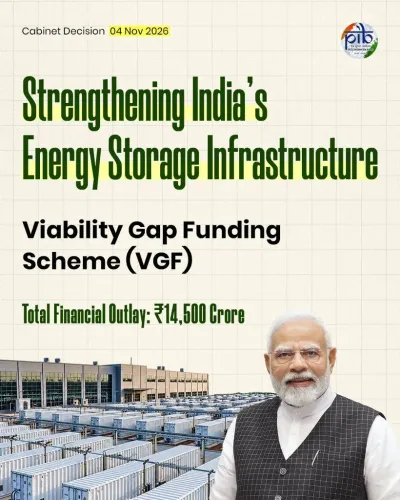
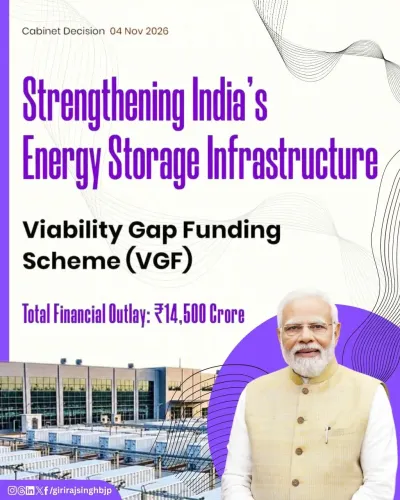
The Union Cabinet approved a ₹14,500 crore Viability Gap Funding scheme to develop 92 GWh of grid-scale energy storage across India over five years from FY2026-27, directly supporting the country's 500 GW non-fossil fuel target by 2030.
Key Takeaways
The Union Cabinet approved a ₹14,500 crore Viability Gap Funding (VGF) scheme for grid-scale energy storage systems on 4 November 2026 .
The scheme targets 92 GWh of new energy storage capacity to be developed nationwide.
Implementation spans five financial years from FY2026-27 to FY2030-31 .
VGF bridges the commercial viability gap, enabling private renewable energy developers and state power utilities to invest in storage infrastructure.
The move directly supports PM Modi's Panchamrit pledge of 500 GW non-fossil fuel capacity by 2030, announced at COP26 in 2021.
Scheme guidelines, bidding documents, and state-level project allocations are the next critical milestones to watch.
India's electricity grid just got a serious upgrade on paper — and now comes the hard work of making it real. Union Agriculture Minister Shivraj Singh Chouhan announced on Wednesday, 4 November 2026 that the Union Cabinet, led by Prime Minister Narendra Modi, has approved a ₹14,500 crore Viability Gap Funding (VGF) scheme to build 92 GWh of grid-scale energy storage capacity across India — a move aimed squarely at solving one of the country's most stubborn clean-energy problems.
The Storage Gap at the Heart of India's Renewable Push
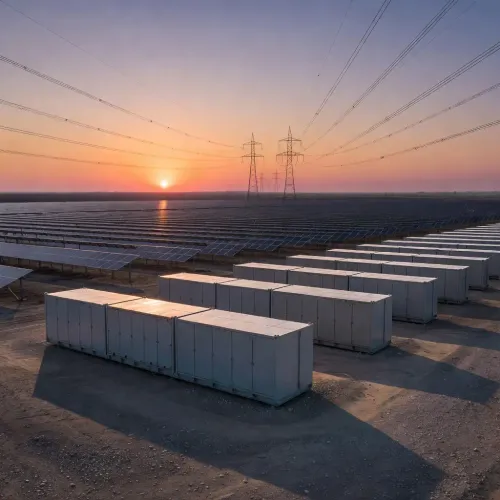
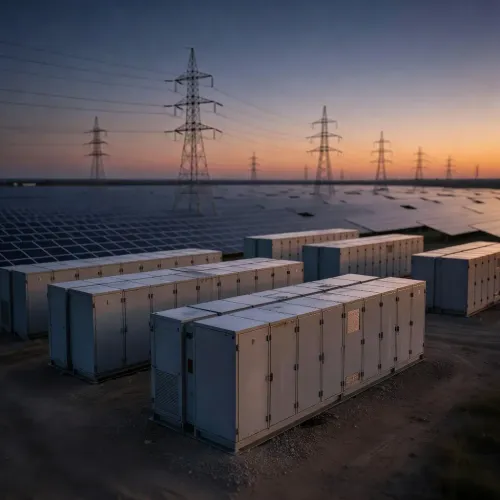
India has sprinted to add solar and wind capacity over the past decade, but intermittency has shadowed every megawatt. The sun does not always shine when demand peaks; the wind does not always blow when the grid needs it most. Grid-scale battery and energy storage systems are the bridge between variable generation and reliable supply — and they have remained stubbornly expensive to build without government support.
That is precisely where VGF steps in. The mechanism — well-tested in Indian infrastructure finance for highways, airports, and urban transit — covers the gap between what a project costs and what the market will pay. By extending it to energy storage, the Cabinet is signalling that storage is now infrastructure, not a luxury.
₹14,500 Crore, Five Years, 92 GWh
The scheme runs from financial year 2026-27 through 2030-31 — a five-year window timed to India's critical 2030 renewable capacity targets. Prime Minister Modi committed India at COP26 in 2021 to the 'Panchamrit' strategy, which includes achieving 500 GW of non-fossil fuel capacity by 2030. Getting to that number without storage would mean curtailing renewable power whenever supply outstrips the grid's ability to absorb it — wasting the very capacity India has spent billions building.
The 92 GWh target is not trivial. It represents a step-change in India's storage ambitions, and the VGF structure is designed to unlock private capital from renewable energy developers and state power utilities who have long cited commercial viability as the barrier to entry.
VGF's Track Record — and What Comes Next
India's VGF playbook has a proven lineage: it transformed airport privatisation, catalysed national highway development, and underpinned the rollout of urban metro systems. Applied to storage, it de-risks the first wave of projects enough to demonstrate bankability — after which private capital typically follows without subsidy. The 2023 National Electricity Plan had already flagged the urgent need for battery storage to integrate variable renewables at scale; this Cabinet decision converts that projection into funded policy.
The immediate watch-items are scheme guidelines, bidding documents, and state-level project allocations — the unglamorous machinery that will determine whether 92 GWh remains a headline or becomes hardware in the ground by 2031.
India has pledged net-zero by 2070 and 500 GW of clean capacity by 2030. Storage was always the missing piece. The Cabinet just wrote the cheque — now the grid has to cash it.
Point of View
Airports, and metros — into energy storage marks a strategic maturation of India's clean-energy policy: the government is no longer just building generation capacity, it is financing the reliability architecture around it. Timed to the 2030 renewable targets, the ₹14,500 crore commitment is as much a signal to private capital markets as it is a grid-planning measure. The five-year window is tight; execution speed on guidelines and state allocations will determine whether this scheme is remembered as a turning point or a missed deadline. If it lands, India's grid story shifts from megawatts to megawatt-hours — a genuinely different conversation.
NationPress
4 Nov 2026
Frequently Asked Questions
What is the Cabinet's new energy storage VGF scheme?
The Union Cabinet approved a ₹14,500 crore Viability Gap Funding scheme to help develop 92 GWh of grid-scale energy storage capacity across India between FY2026-27 and FY2030-31, making storage projects commercially viable for private developers.
What is Viability Gap Funding and how does it work?
Viability Gap Funding is a government mechanism that provides upfront financial support to infrastructure projects that are economically necessary but not commercially profitable on their own, bridging the gap so private investment becomes viable.
Why does India need grid-scale energy storage?
India's rapidly growing solar and wind capacity generates power intermittently — not always when demand is highest. Grid-scale storage systems store surplus renewable energy and release it on demand, stabilising the grid and preventing wasteful curtailment.
How does this scheme relate to India's 2030 renewable energy targets?
PM Modi pledged at COP26 in 2021 to achieve 500 GW of non-fossil fuel capacity by 2030. Without large-scale storage, integrating that much variable renewable power into the grid is impractical; this VGF scheme directly enables that integration.
What happens after the Cabinet approves the VGF scheme?
The next steps are the release of detailed scheme guidelines and bidding documents, followed by state-level project allocations — the administrative process that converts the Cabinet approval into actual storage projects on the ground.