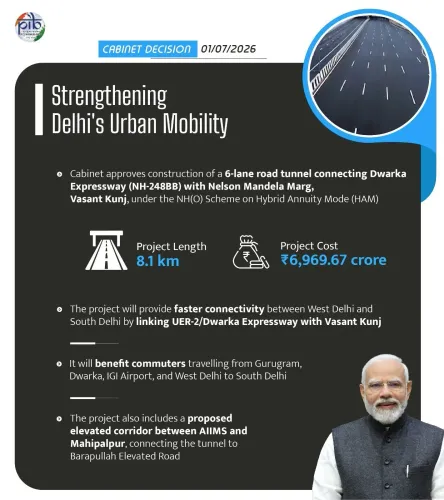
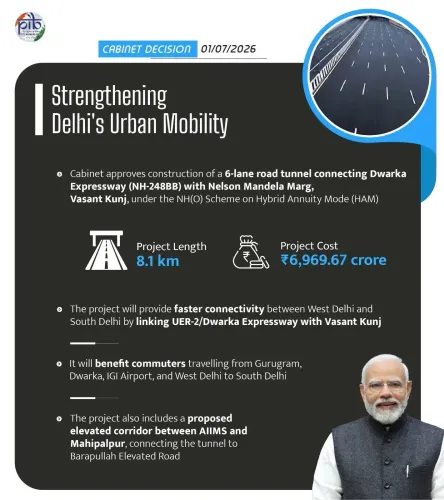
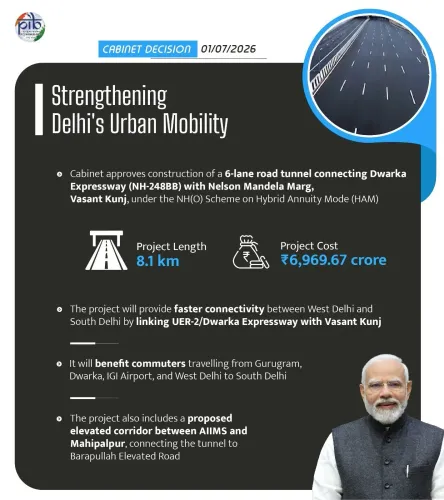
Cabinet Clears ₹6,969 Cr Tunnel Linking Dwarka Expressway to Vasant Kunj
Synopsis
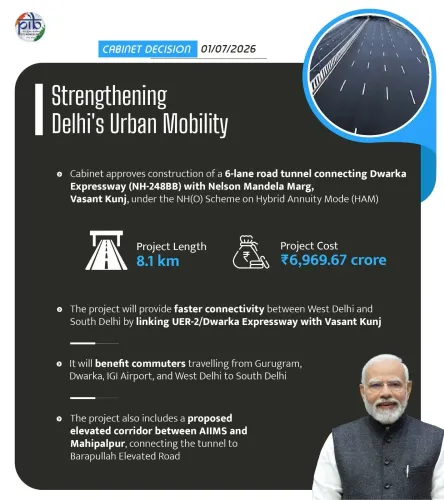
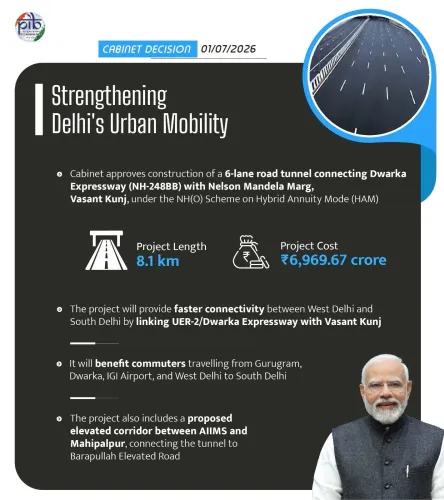
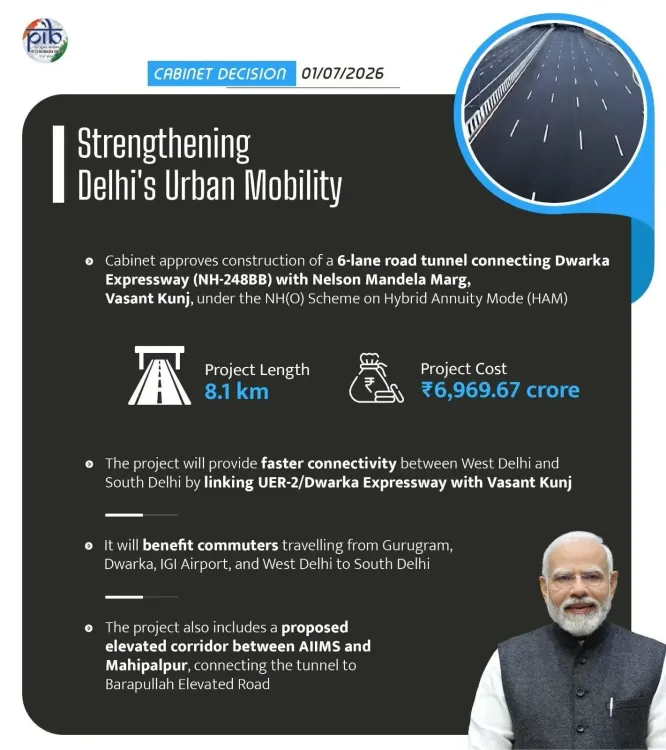
The Union Cabinet has sanctioned a ₹6,969 crore project to build an 8.1-km tunnel linking Dwarka Expressway with Vasant Kunj in Delhi, aiming to decongest the capital and provide faster road access to IGI Airport and south Delhi.
Key Takeaways
The Union Cabinet approved a ₹6,969 crore tunnel project on 1 July 2026 .
The tunnel will be 8.1 kilometres long, connecting Dwarka Expressway to Vasant Kunj .
The project is designed to decongest Delhi and provide faster access to IGI Airport and south Delhi.
IGI Airport handles over 7 crore passengers annually , making improved road access a high-priority national concern.
The decision aligns with the National Infrastructure Pipeline unveiled in 2019 , which prioritised Delhi-NCR urban road investments.
Execution will require detailed project report approval, tendering and land notifications before construction can begin.
Union Education Minister Dharmendra Pradhan on Wednesday, 1 July 2026 announced that the Union Cabinet, under Prime Minister Narendra Modi, has approved a ₹6,969 crore project to construct an 8.1-kilometre tunnel connecting Dwarka Expressway with Vasant Kunj in the national capital, promising faster access to Indira Gandhi International (IGI) Airport and a significant easing of Delhi's chronic traffic congestion.
Context
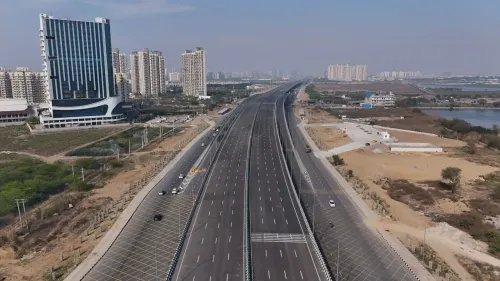
Pradhan shared the Cabinet decision on X, describing it as 'another milestone in building a modern, connected and future-ready National Capital.' The approved tunnel will physically link the western arterial corridor of Dwarka Expressway — a major road project designed to ease west Delhi commutes — with Vasant Kunj, a densely populated residential and commercial zone in south Delhi. The alignment places the tunnel on one of the city's most congested travel axes, directly serving millions of daily commuters and air travellers.
Policy Backdrop
The decision fits within a decade-long federal push to upgrade multi-modal connectivity across the Delhi-NCR region. The National Infrastructure Pipeline, unveiled in 2019, had identified urban road and tunnel investments in the capital as priority projects, recognising the growing strain on surface roads linking the airport belt with southern and western residential corridors. Successive Union Cabinets have approved elevated corridors, expressways and underground routes as part of the broader National Capital Region transport integration plan that weaves together road, metro and expressway networks. The IGI Airport, India's busiest aviation hub handling over 7 crore passengers annually, sits at the centre of this connectivity grid, making last-mile road access a persistent policy concern.
The tunnel project is among the larger single-package urban road investments cleared in recent years, with the ₹6,969 crore outlay reflecting both the engineering complexity of sub-surface construction beneath a built-up metropolitan area and the scale of traffic relief expected. Central funding routed through the Cabinet underscores the government's intent to treat Delhi's congestion as a national infrastructure problem rather than a purely municipal one.
Stakeholders and Impact
Delhi commuters travelling between the western suburbs and south Delhi stand to benefit most directly, as the tunnel is expected to cut travel time on one of the city's most gridlocked corridors. Residents of Vasant Kunj, Dwarka and adjoining sectors — as well as the large volume of passengers heading to and from IGI Airport — are the primary beneficiaries. Beyond individual travel time, reduced surface traffic is expected to lower vehicle emissions along the affected stretch, contributing to air-quality goals that have become an increasingly prominent part of urban planning in the capital.
Real-estate stakeholders in both Dwarka and Vasant Kunj are also likely to watch the project closely, as improved sub-surface connectivity historically influences property values and commercial activity along newly linked corridors.
What's Next
The Cabinet approval marks the sanction stage; execution will require a detailed project report to be cleared by the implementing agency — likely NHAI or the Delhi PWD — followed by land and right-of-way notifications for underground utilities. Observers will track whether linked metro or elevated corridor announcements emerge in the 2026-27 budget cycle to complement the tunnel's capacity. The project's timeline, tendering process and construction commencement date are yet to be officially notified, and those milestones will determine when Delhi commuters see tangible relief on the ground.
Point of View
But it also highlights how infrastructure wins are being amplified across the ruling party's communication machinery. The project sits within a consistent pattern of high-visibility, capital-intensive urban mobility investments timed ahead of electoral cycles in the NCR. Whether the approval translates into on-ground progress will depend on how swiftly land and utility clearances are resolved — historically the most time-consuming phase of Delhi sub-surface projects.
NationPress
1 Jul 2026
Frequently Asked Questions
What is the Delhi tunnel project approved by the Union Cabinet?
The Union Cabinet has approved an 8.1-kilometre underground tunnel connecting Dwarka Expressway in west Delhi with Vasant Kunj in south Delhi at a cost of ₹6,969 crore, aimed at easing traffic congestion and improving access to IGI Airport.
How much will the Dwarka Expressway to Vasant Kunj tunnel cost?
The approved project cost is ₹6,969 crore, sanctioned by the Union Cabinet under Prime Minister Narendra Modi on 1 July 2026.
How will the new Delhi tunnel help commuters reach IGI Airport?
The tunnel will create a direct sub-surface link between Dwarka Expressway — which runs close to IGI Airport — and Vasant Kunj, cutting travel time and reducing surface congestion on one of Delhi's most gridlocked corridors.
Who announced the Delhi tunnel Cabinet approval?
Union Education Minister Dharmendra Pradhan announced the Cabinet decision on X on 1 July 2026, describing it as a milestone in building a modern, connected national capital.
When will the Dwarka Expressway Vasant Kunj tunnel be built?
A construction timeline has not yet been officially notified. The next steps include detailed project report clearance by the implementing agency and land or right-of-way notifications, after which tendering and construction can commence.