Jitendra Singh: Cabinet clears NCRPB scheme to scrap old Delhi-NCR trucks, buses
Synopsis
Union Minister Dr. Jitendra Singh has announced that the Modi Cabinet has approved a two-year scheme routing support through the NCRPB to replace old trucks and buses across Delhi-NCR. The move targets vehicular air pollution and aims to push cleaner mobility in one of the country's most pollution-stressed urban regions, building on earlier clean air and scrappage policies.
Key Takeaways
Union Cabinet has approved a scheme for support to NCRPB to replace old trucks and buses in Delhi-NCR .
Announced by Union Science and Technology Minister Dr.
Jitendra Singh on 3 June 2026 as a Cabinet decision.
Described as a two-year initiative targeting vehicular air pollution and cleaner mobility.
Routed through the National Capital Region Planning Board , a statutory body under the NCRPB Act, 1985.
Builds on the National Clean Air Programme (2019), Vehicle Scrappage Policy (2021-22) and BS-VI norms.
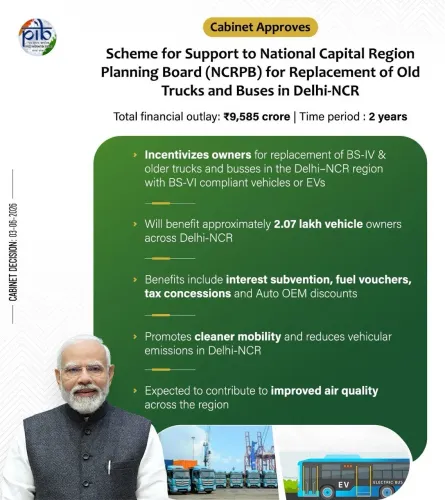
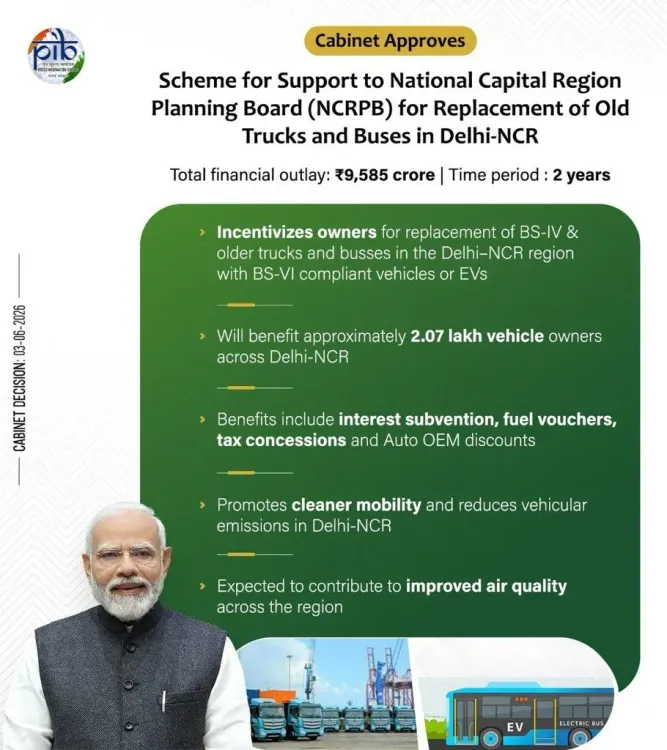
Funding outlay, eligibility and rollout timeline are yet to be detailed publicly.
Union Science and Technology Minister Dr. Jitendra Singh announced on Wednesday that the Union Cabinet, chaired by Prime Minister Narendra Modi, has approved a scheme for support to the National Capital Region Planning Board (NCRPB) for the replacement of old trucks and buses operating in the Delhi-NCR region. The Minister described it as a 'landmark two-year scheme' aimed at curbing vehicular air pollution and promoting cleaner mobility across the National Capital Region. The decision was disclosed under the hashtag '#CabinetDecisions' on the social media platform X.
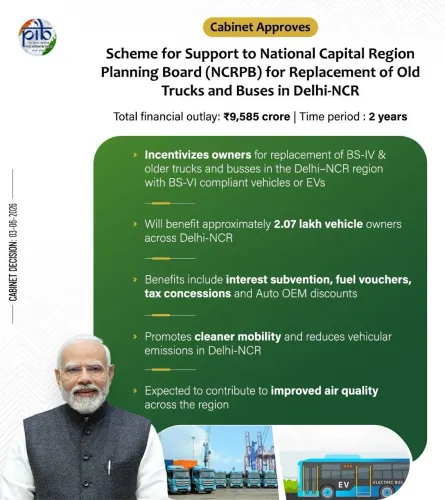
In his post, Dr. Singh wrote that the 'Cabinet under PM Sh @NarendraModi approves Scheme for support to NCRPB for replacement of old trucks and buses in Delhi-NCR area', adding that the initiative 'aims at reducing air pollution in the Delhi–NCR region and promoting cleaner mobility'. The accompanying image flagged the move as a Cabinet decision communicated on 3 June 2026.
Context
The NCRPB is a statutory body constituted under the NCRPB Act, 1985, functioning under the Ministry of Housing and Urban Affairs to coordinate integrated planning across Delhi and adjoining districts of Haryana, Uttar Pradesh and Rajasthan. Routing the replacement scheme through the Board signals an attempt to align fleet modernisation with the wider regional planning architecture, rather than treating it as a Delhi-only intervention.
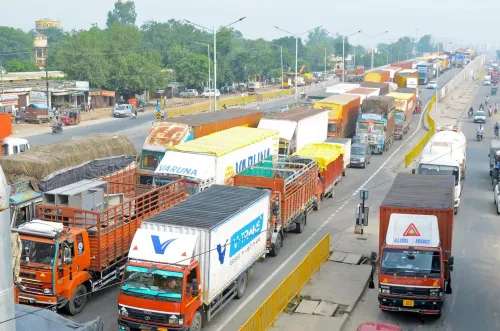
Heavy-duty diesel vehicles — particularly ageing trucks and buses — have long been identified by regulators as a significant contributor to particulate and nitrogen oxide loads in the NCR airshed, especially during the winter inversion months when air quality routinely slips into the 'severe' category.
Policy backdrop
The new scheme builds on a layered policy stack assembled over the past several years. The National Clean Air Programme, launched in 2019, set out to cut particulate pollution across 131 non-attainment cities, including those in the NCR. The Commission for Air Quality Management, first established by ordinance in 2020 and given statutory backing in 2021, was specifically designed to coordinate air pollution control in Delhi-NCR and adjoining areas.
On the vehicular side, the Vehicle Scrappage Policy announced in the Union Budget 2021-22 created incentives for voluntary phasing out of old polluting vehicles, while Bharat Stage-VI emission norms have been in force nationwide since April 2020. The NCRPB-routed support scheme appears to extend this trajectory by directly underwriting the cost of replacing older commercial fleets in the country's most pollution-stressed urban agglomeration.
Stakeholders and impact
The primary beneficiaries identified by the policy logic are Delhi-NCR residents, who bear the public-health burden of poor air quality, and truck and bus operators, for whom upfront replacement costs have historically been a barrier to fleet renewal. State transport undertakings running inter-city and intra-NCR bus services are likely to be among the larger institutional beneficiaries if the support is extended to public fleets.
Goods movement operators, who run a substantial share of older diesel trucks transiting through the NCR, could see both compliance pressure and financial assistance converge under the new framework. The exact funding outlay, eligibility criteria and operational timeline were not detailed in the Minister's post.
What's next
Attention will now shift to the NCRPB's operational guidelines, including tendering processes, per-vehicle assistance and the share of trucks and buses targeted over the two-year window. Periodic air quality data from monitoring agencies will be the most visible yardstick for assessing whether fleet replacement translates into measurable improvements in the NCR's seasonal pollution profile.
For the Modi government, the announcement slots into a broader narrative of marrying urban mobility upgrades with climate and clean-air commitments. The credibility of the scheme will ultimately rest on how quickly old vehicles are taken off NCR roads — and how decisively that shift registers in the region's winter air.
Point of View
Moving from voluntary scrappage incentives to a targeted, region-specific replacement programme anchored in a statutory planning body. By channelling support through the NCRPB rather than a single state government, the Modi administration is signalling that NCR air quality will be treated as a coordinated regional challenge spanning Delhi, Haryana, Uttar Pradesh and Rajasthan. The political payoff hinges on visible winter-season improvements in air quality — historically the most contentious metric for Delhi-NCR governance. Until the funding outlay and eligibility design are public, however, the scheme's actual ambition will remain difficult to benchmark against past clean-air commitments.
NationPress
21 Oct 2026
Frequently Asked Questions
What did the Union Cabinet approve for Delhi-NCR on 3 June 2026?
The Union Cabinet approved a scheme for support to the National Capital Region Planning Board (NCRPB) for the replacement of old trucks and buses in the Delhi-NCR area, as announced by Union Minister Dr. Jitendra Singh. It is structured as a two-year initiative aimed at reducing air pollution and promoting cleaner mobility.
What is the NCRPB and why is it implementing the scheme?
The National Capital Region Planning Board is a statutory body constituted under the NCRPB Act, 1985, functioning under the Ministry of Housing and Urban Affairs. It coordinates integrated planning across Delhi and adjoining districts of Haryana, Uttar Pradesh and Rajasthan, making it the natural vehicle for a regional fleet replacement programme.
How does this scheme connect to India's earlier air pollution measures?
It builds on the National Clean Air Programme launched in 2019, the Commission for Air Quality Management set up for NCR, the Vehicle Scrappage Policy announced in the 2021-22 Union Budget, and BS-VI emission norms in force since April 2020. The new scheme adds a direct replacement-support layer for commercial fleets in the NCR.
Who will benefit from the old truck and bus replacement scheme?
Delhi-NCR residents, who bear the health burden of poor air quality, are the primary intended beneficiaries. Truck and bus operators, including potentially state transport undertakings, stand to gain from financial support that lowers the cost of moving to newer, cleaner vehicles.
What details are still awaited on the scheme?
The exact funding outlay, eligibility criteria for vehicle owners, the share of trucks and buses to be replaced, and the detailed implementation timeline have not been publicly disclosed. These are expected to be specified in subsequent NCRPB operational guidelines.