Sonowal: Cabinet clears NCRPB scheme to scrap old NCR trucks, buses
Synopsis
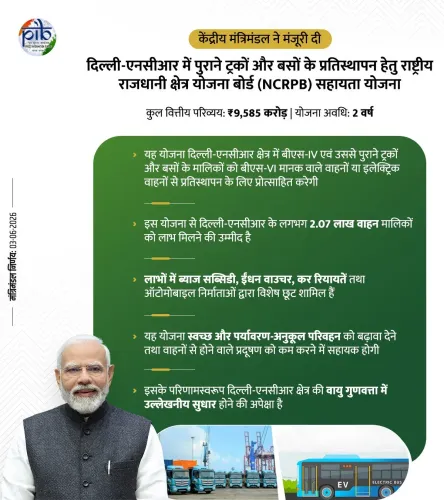
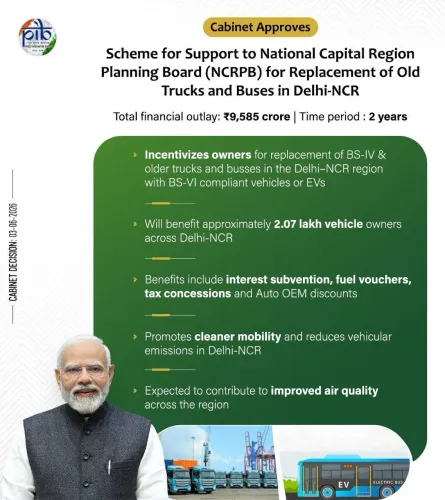
Union Ports and Shipping Minister Sarbananda Sonowal announced that the Union Cabinet, chaired by PM Narendra Modi, has approved a two-year scheme supporting the NCRPB to replace old trucks and buses across Delhi-NCR. The move targets vehicular pollution in the capital region and pushes cleaner mobility, building on India's scrappage policy and clean air programme.
Key Takeaways
Union Cabinet, chaired by PM Narendra Modi, approved a scheme supporting NCRPB to replace old trucks and buses in Delhi-NCR.
Sarbananda Sonowal called it a 'landmark two-year scheme' focused on cutting air pollution and promoting cleaner mobility.
The scheme is routed through the National Capital Region Planning Board, enabling multi-state coordination across NCR.
It builds on the National Clean Air Programme (2019), the CAQM Act (2020) and the 2021 Vehicle Scrappage Policy.
Truck and bus operators, state transport undertakings and NCR residents are the primary stakeholders.
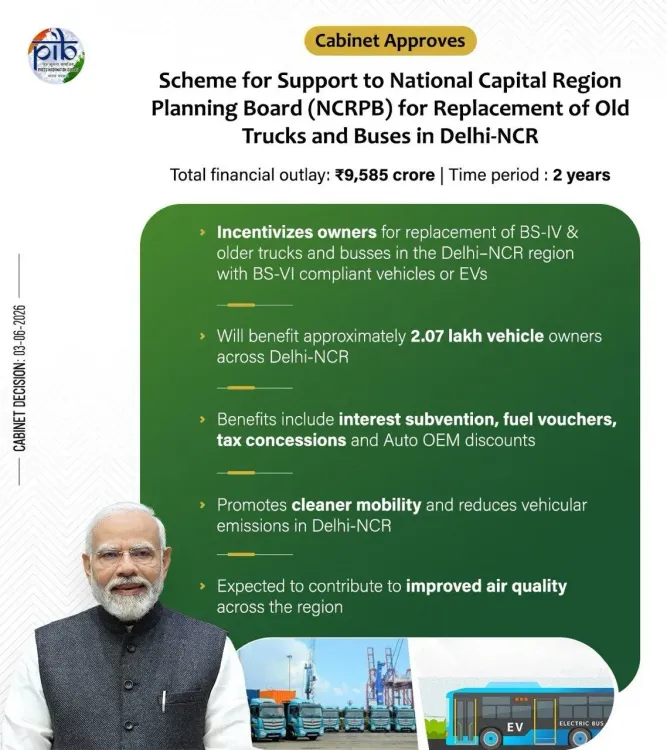
Funding details, eligibility rules and implementation timeline are awaited.
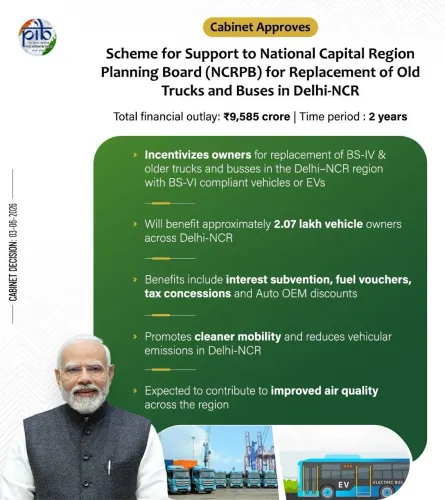
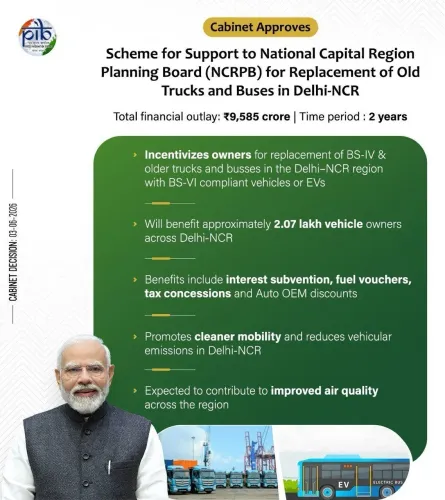
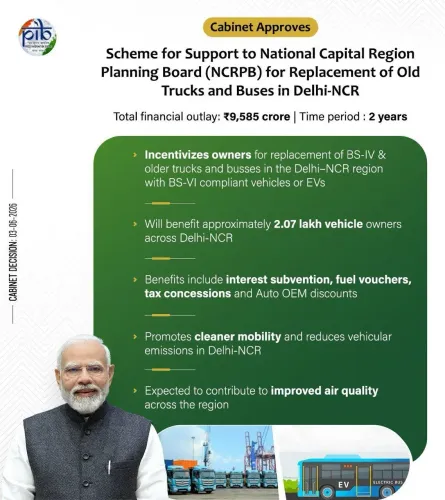
Union Ports and Shipping Minister Sarbananda Sonowal announced on Wednesday that the Union Cabinet, chaired by Prime Minister Narendra Modi, has approved a scheme to support the National Capital Region Planning Board (NCRPB) for the replacement of old trucks and buses across the Delhi-NCR region. Sonowal described it as a 'landmark two-year scheme' aimed at curbing air pollution and accelerating cleaner mobility in one of the world's most polluted urban airsheds.
In his post, Sonowal said the Cabinet 'approves the Scheme for support to NCRPB for replacement of old trucks and buses in the Delhi-NCR area,' adding that the initiative 'aims at reducing air pollution in the Delhi-NCR region and promoting cleaner mobility.' He tagged the announcement with the hashtag #CabinetDecisions, signalling it as part of the day's official decisions taken by the Union Cabinet.
Context
The NCRPB, a statutory body under the Ministry of Housing and Urban Affairs, has historically coordinated balanced regional development across Delhi and its adjoining districts in Haryana, Uttar Pradesh and Rajasthan. Channeling a fleet-modernisation scheme through the board signals an attempt to bring multiple state governments under a single planning umbrella for transport-linked pollution control.
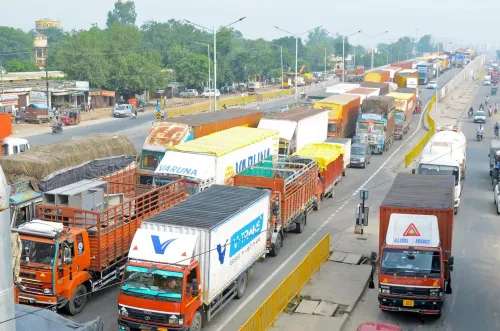
Heavy-duty diesel trucks and ageing buses are among the largest contributors to particulate emissions in the National Capital Region, particularly during the winter inversion months when air quality routinely slips into the 'severe' band. Replacement of older vehicles, especially those built before BS-IV norms, has long been flagged as a high-impact lever for emissions reduction.
Policy backdrop
The scheme builds on a layered regulatory architecture the Centre has assembled over the past several years. The National Clean Air Programme, launched in 2019, set particulate-reduction targets for 131 non-attainment cities, including Delhi. The Commission for Air Quality Management in NCR and Adjoining Areas Act of 2020 created a unified body to coordinate pollution-control measures across NCR's state boundaries.
India's Vehicle Scrappage Policy, approved in 2021, formalised a framework for phasing out end-of-life vehicles through automated fitness testing and incentives for owners who scrap and replace older models. The new NCRPB-routed scheme is expected to dovetail with that policy, channelling fiscal support specifically toward commercial fleets operating in the capital region.
Stakeholders and impact
The most directly affected groups are truck operators and bus operators, many of them small businesses running older diesel fleets that are increasingly restricted from entering Delhi under court-mandated and Commission for Air Quality Management directives. Financial support for replacement could ease the transition cost, which has been a recurring sticking point in earlier scrappage rounds.
For NCR residents, the public-health stakes are significant. The Delhi-NCR airshed sees annual PM2.5 averages well above World Health Organization safe limits, with vehicular sources estimated to contribute a substantial share alongside crop-residue burning, construction dust and industrial emissions. State transport undertakings running older bus fleets may also tap the scheme to accelerate electric or CNG fleet induction.
What's next
Attention will now turn to the scheme's fine print, including the funding envelope, eligibility criteria for vehicle owners and operators, the mix of incentives and the implementation timeline over the two-year window flagged by Sonowal. Coordination meetings between the NCRPB, the Commission for Air Quality Management and the transport departments of Delhi, Haryana, Uttar Pradesh and Rajasthan will determine how quickly the rollout reaches operators on the ground.
If implemented at scale, the scheme could mark one of the more concrete fiscal interventions yet against vehicular pollution in the capital region, and a test case for how India aligns urban transport policy with its broader air-quality and climate commitments.
Point of View
Moving from regulatory bans on older vehicles to active financial support for fleet replacement. Routing it through the NCRPB is significant: it leverages a regional planning body to bind Delhi, Haryana, Uttar Pradesh and Rajasthan into a common scrappage push, sidestepping the usual fragmentation of state transport policy. It also aligns commercial-vehicle modernisation with India's broader climate commitments. The real test will be uptake by small operators, who have historically resisted scrappage on cost grounds.
NationPress
18 Oct 2026
Frequently Asked Questions
What has the Union Cabinet approved for Delhi-NCR pollution?
The Union Cabinet has approved a scheme to support the National Capital Region Planning Board (NCRPB) for replacing old trucks and buses across Delhi-NCR. Union Minister Sarbananda Sonowal described it as a two-year initiative aimed at reducing air pollution and promoting cleaner mobility.
What is NCRPB and why is it implementing the vehicle replacement scheme?
The National Capital Region Planning Board is a statutory body that coordinates planning across Delhi and adjoining districts in Haryana, Uttar Pradesh and Rajasthan. Routing the scheme through NCRPB enables unified, multi-state implementation of fleet replacement in the capital region.
How long will the NCR old trucks and buses replacement scheme run?
According to Union Minister Sarbananda Sonowal, it is a two-year scheme. Detailed funding, eligibility and rollout timelines are expected to follow from the relevant ministries and the NCRPB.
How does this scheme connect to India's vehicle scrappage policy?
It builds on the 2021 Vehicle Scrappage Policy, which created a framework for phasing out end-of-life vehicles through automated fitness testing and incentives. The new scheme channels targeted support to commercial fleets operating in Delhi-NCR.
Who will benefit from the NCR truck and bus replacement scheme?
Truck operators, bus operators, including state transport undertakings, and NCR residents are the primary stakeholders. Operators get support to replace ageing vehicles, while residents stand to benefit from lower vehicular emissions in the region.