Cabinet Clears ₹2,814 Cr Scheme to Process Critical Minerals
Synopsis
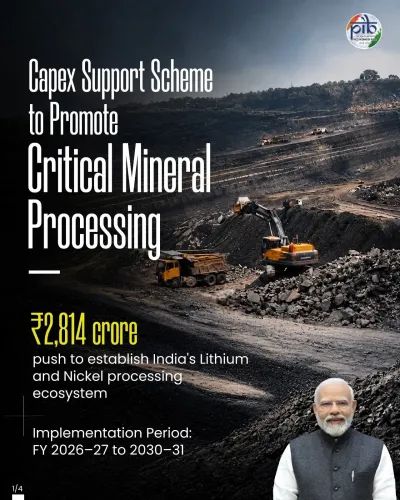
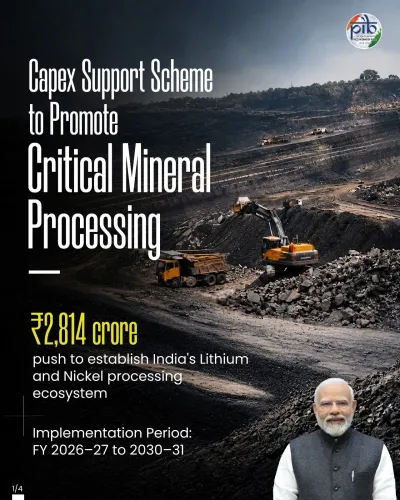
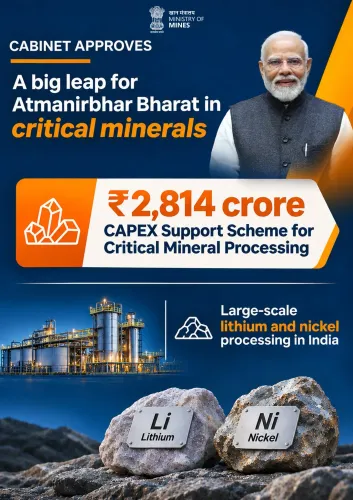
The Union Cabinet has approved a ₹2,814 crore Capex Support Scheme over five years to promote domestic processing of lithium and nickel, reduce import dependence, and strengthen India's EV, energy storage, electronics and defence supply chains under the Atmanirbhar Bharat framework.
Key Takeaways
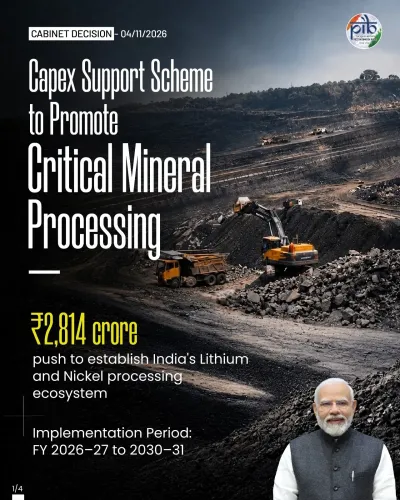
The Union Cabinet , chaired by PM Narendra Modi , approved the Capex Support Scheme to Promote Critical Mineral Processing on 4 November 2026 .
The scheme carries a total outlay of ₹2,814 crore spread over five years .
It targets domestic processing and value addition of lithium and nickel — the two metals most critical to EV batteries and energy storage.
The scheme builds on earlier steps including the 2023 MMDR Act amendment listing 30 critical minerals and the 2021 ACC PLI scheme for battery components.
Key beneficiaries include EV manufacturers , battery producers , the defence industry , and India's energy storage sector .
Actual impact hinges on the speed of project selection and commissioning of processing facilities over the five-year window.
India's bid to build a homegrown battery and EV supply chain moved from ambition to allocation on Wednesday, 4 November 2026, when the Union Cabinet, chaired by Prime Minister Narendra Modi, approved a ₹2,814 crore Capex Support Scheme to Promote Critical Mineral Processing — anchoring five years of government-backed investment in lithium and nickel refining on Indian soil. Union Health Minister J. P. Nadda, also the BJP national president, announced the decision on X.
Nadda described the scheme as 'a significant step towards Atmanirbhar Bharat, strengthening strategic sectors such as electric mobility, energy storage, electronics and defence.' The Cabinet's formal approval puts a rupee figure — and a five-year clock — behind what has until now been largely a directional commitment.
Why lithium and nickel, and why now
The global supply chain for critical minerals is dangerously concentrated. A handful of countries control the overwhelming share of lithium and nickel refining capacity, leaving import-dependent economies exposed to price shocks, export restrictions, and diplomatic leverage. India is acutely aware of this vulnerability: its electric vehicle targets, its energy storage ambitions, and its defence electronics programmes all trace back, ultimately, to these two metals. The new scheme targets exactly that chokepoint — not mining, but processing and value addition. Raw or partially processed ore is cheap; refined, battery-grade material commands a premium and underpins entire industrial ecosystems. By incentivising domestic processing capacity through capital expenditure support, the government is betting that Indian facilities can climb that value ladder within the scheme's five-year window.A policy lineage years in the making
This approval does not arrive in a vacuum. In 2023, the government amended the Mines and Minerals (Development and Regulation) Act to formally designate 30 critical minerals and open them to exploration and auction — giving the ecosystem a legal scaffolding. Before that, the Production Linked Incentive scheme for Advanced Chemistry Cells, cleared in 2021, began nudging domestic manufacturers toward lithium-ion battery component production. The capex support scheme now layers financial muscle onto that scaffolding, completing a three-stage architecture: designate, incentivise production, and now fund the processing infrastructure itself. The Atmanirbhar Bharat framework, launched in 2020, provides the broader political and economic logic — a push to convert India from a commodity importer and assembler into a nation that processes strategic inputs at home and captures the value that creates.Who stands to gain — and what to watch
The clearest beneficiaries are EV manufacturers hungry for domestically sourced battery cells, battery producers seeking reliable refined-material inputs, the defence industry requiring domestically processed nickel for alloys and electronics, and the broader energy storage sector as India scales renewable capacity. Reduced import dependence also carries a balance-of-payments benefit that compounds quietly over time. The critical question now is execution. Project selection under the scheme, the speed at which processing facilities are actually commissioned, and any follow-up policy on mineral recycling or overseas sourcing agreements will determine whether the ₹2,814 crore translates into genuine industrial capacity or simply capital deployed. The five-year horizon means accountability checkpoints are built in — but the pressure to show results will begin almost immediately. India has laid the groundwork, written the cheque, and set the timer. The refining begins now.Point of View
Not just mining rights, control supply chains. The scheme's five-year horizon aligns with India's EV penetration targets and positions domestic processors as strategic assets rather than commercial afterthoughts. Whether this investment translates into genuine industrial capacity will depend heavily on the pace of project commissioning — a metric that will define the scheme's legacy.
NationPress
4 Nov 2026
Frequently Asked Questions
What is the Capex Support Scheme for Critical Mineral Processing?
It is a Union Cabinet-approved scheme with an outlay of ₹2,814 crore over five years to fund domestic processing and value addition of critical minerals, particularly lithium and nickel, to reduce India's import dependence.
Which minerals does the scheme focus on?
The scheme primarily targets lithium and nickel — the two minerals most essential for EV batteries, energy storage systems, and defence electronics manufacturing.
How does this scheme connect to Atmanirbhar Bharat?
Atmanirbhar Bharat, launched in 2020, is India's national self-reliance initiative. The critical mineral processing scheme directly advances that goal by building domestic refining capacity instead of relying on imports from a handful of foreign suppliers.
What earlier policies led up to this scheme?
The 2023 amendment to the Mines and Minerals (Development and Regulation) Act designated 30 critical minerals and opened them to auction, while the 2021 ACC PLI scheme incentivised domestic battery cell manufacturing. The new capex scheme adds processing infrastructure funding on top of those foundations.
Who benefits from the critical mineral processing scheme?
The primary beneficiaries are EV manufacturers needing domestically sourced battery inputs, battery producers, the defence industry, energy storage companies, and the broader electronics manufacturing ecosystem in India.