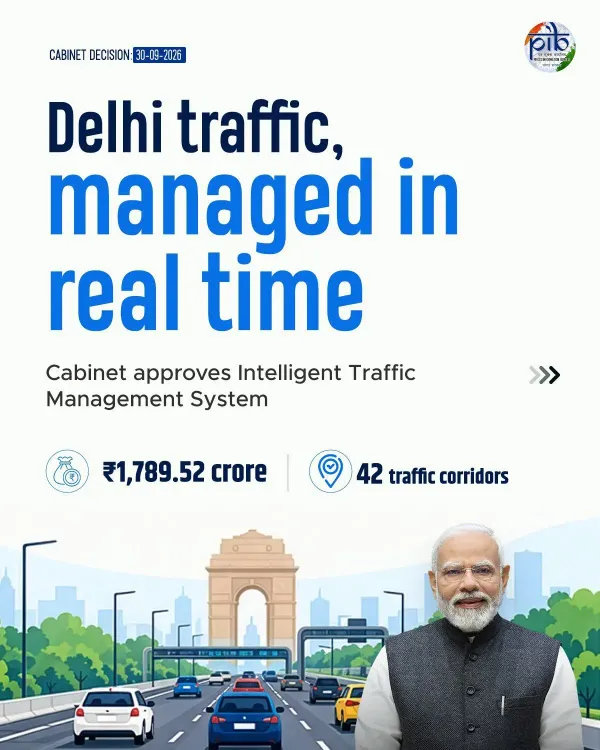
Cabinet Approves ITMS Across 42 Traffic Corridors
Synopsis
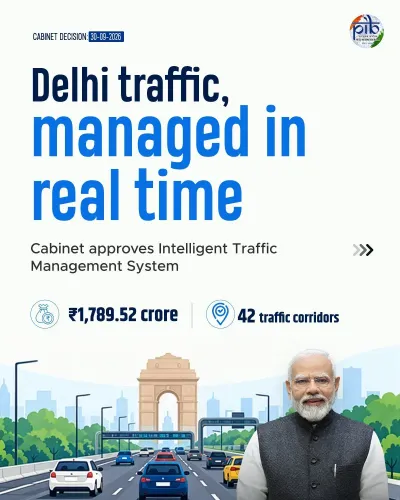
The Union Cabinet chaired by PM Narendra Modi has approved the Intelligent Traffic Management System covering 42 traffic corridors, to be rolled out in three phases over 24 months with a five-year operation and maintenance period, Union Minister Dr. Jitendra Singh announced.
Key Takeaways
The Union Cabinet under PM Narendra Modi approved the Intelligent Traffic Management System (ITMS) on September 30, 2026 .
The project will cover 42 identified traffic corridors across India.
Implementation will proceed in three phases over 24 months .
A five-year operation and maintenance period follows project completion, ensuring sustained performance.
The approval builds on India's Smart Cities Mission (launched 2015), which embedded intelligent transport systems in urban mobility planning.
The next critical step is the tendering process and formal corridor-by-corridor prioritisation by the nodal ministry.
India's urban roads are about to get a technological overhaul. The Union Cabinet, chaired by Prime Minister Narendra Modi, has approved the implementation of an Intelligent Traffic Management System (ITMS) — a structured, phased rollout that will target 42 identified traffic corridors across the country, Union Minister Dr. Jitendra Singh announced on Wednesday, September 30, 2026.
42 Corridors, Three Phases, One Long-Term Plan
The Cabinet decision lays out a precise execution roadmap. The ITMS will be rolled out in three phases over 24 months, after which the system enters a five-year operation and maintenance window — a structure designed to ensure the technology does not simply get installed and forgotten. That long O&M tail is significant: it signals a commitment to sustained performance, not just ribbon-cutting.
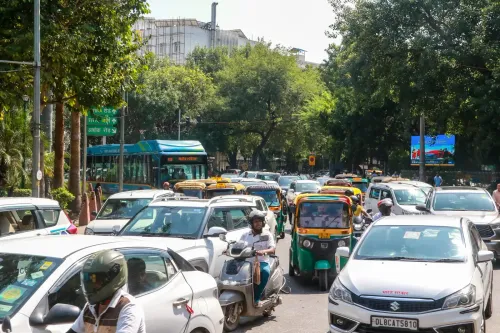
The 42 traffic corridors targeted by the project are those already identified as high-priority — typically high-congestion stretches in urban centres where signal failures, bottlenecks, and unmanaged intersections cost commuters hours every week. Intelligent traffic management systems typically integrate adaptive signal control, surveillance cameras, incident detection, and real-time data analytics to optimise traffic flow dynamically.
Where ITMS Fits in India's Smart Infrastructure Push
This approval is not happening in a vacuum. India's Smart Cities Mission, launched in 2015, embedded intelligent transport systems as a foundational component of urban mobility planning in select cities. The ITMS Cabinet nod represents a scaling of that logic — moving from mission-specific pilots toward a broader, corridor-based national framework.
Successive governments have pursued technology-enabled urban traffic solutions, but the challenge has always been execution: tendering delays, inter-agency coordination gaps, and maintenance lapses after project handover. The explicit five-year O&M clause in this approval appears calibrated to address that last failure mode directly.
What Happens Next: Tenders and Corridor Selection
The immediate watch-point is the tendering process for all three implementation phases and the formal identification of which specific corridors among the 42 will be prioritised first. Municipal bodies and central agencies will be key players in that sequencing. Urban commuters in high-congestion cities stand to be the most direct beneficiaries — but only once the procurement machinery moves at pace.
A Cabinet decision is a starting gun, not a finish line. The credibility of this approval will be tested in the months ahead by how quickly contracts are awarded and ground-level deployment begins.
Point of View
Moving intelligent transport from Smart Cities Mission pilots to a structured national corridor framework. The explicit five-year O&M clause is a policy design choice that addresses a chronic weakness in Indian infrastructure projects — systems that are built but not sustained. Politically, it hands the Modi government a tangible urban-quality-of-life deliverable ahead of what remains a competitive municipal and state electoral calendar. The real test, however, will be procurement speed: India's urban infrastructure approvals have historically struggled with the gap between Cabinet sanction and on-ground execution.
NationPress
30 Sept 2026
Frequently Asked Questions
What is the Intelligent Traffic Management System approved by the Cabinet?
The ITMS is a technology-enabled traffic control project approved by the Union Cabinet that will cover 42 identified high-priority traffic corridors in India, using adaptive signals, surveillance, and real-time data to manage traffic flow.
How many corridors will the ITMS cover and over what timeline?
The ITMS will cover 42 traffic corridors and will be implemented in three phases over 24 months, followed by a five-year operation and maintenance period.
Which ministry announced the ITMS Cabinet approval?
Union Minister of State (Independent Charge) for Science and Technology Dr. Jitendra Singh announced the Cabinet decision on September 30, 2026.
How does ITMS relate to India's Smart Cities Mission?
India's Smart Cities Mission, launched in 2015, incorporated intelligent transport systems as a core urban mobility component. The ITMS Cabinet approval scales that approach to a broader, corridor-based national framework.
What happens after the ITMS is built?
After the 24-month implementation period, the system enters a five-year operation and maintenance phase to ensure sustained performance and avoid the post-installation neglect that has affected past infrastructure projects.