Cabinet Clears ₹1,789 Cr Smart Traffic System for Delhi
Synopsis
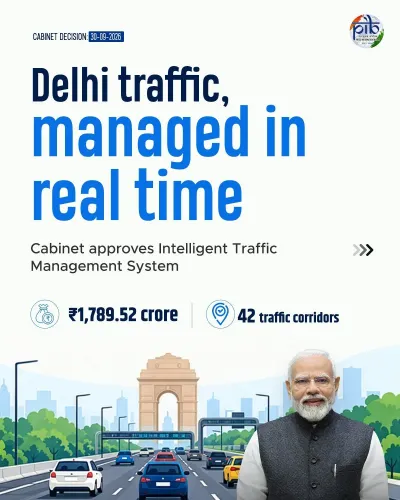
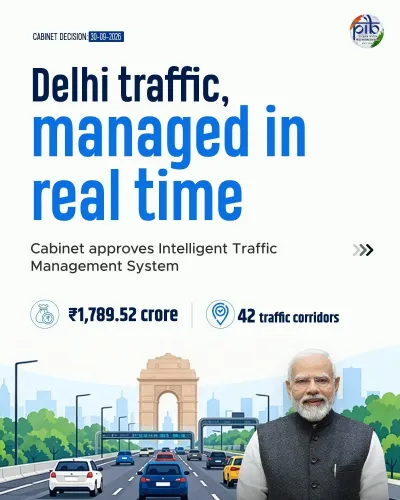
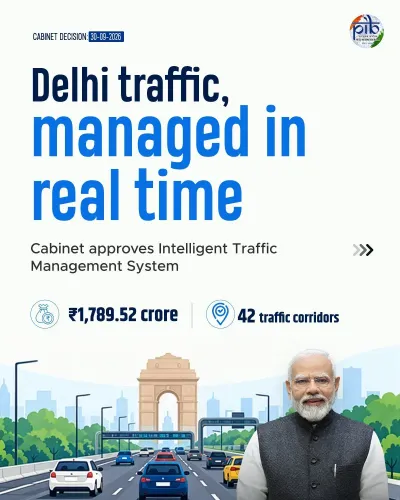
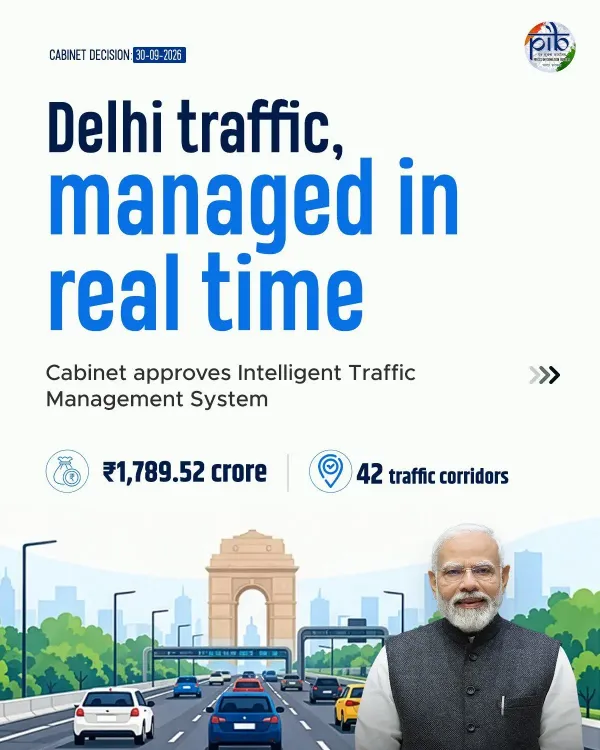
The Cabinet Committee on Economic Affairs, chaired by PM Narendra Modi, has approved a ₹1,789.52 crore Intelligent Traffic Management System for Delhi Police. The project covers 42 traffic corridors and will deploy adaptive signals, automated enforcement and integrated command-and-control centres across the national capital.
Key Takeaways
The CCEA , chaired by PM Narendra Modi , approved the ITMS project on 30 September 2026 .
Estimated project cost: ₹1,789.52 crore , one of Delhi's largest traffic-tech investments.
The system will cover 42 traffic corridors across the national capital.
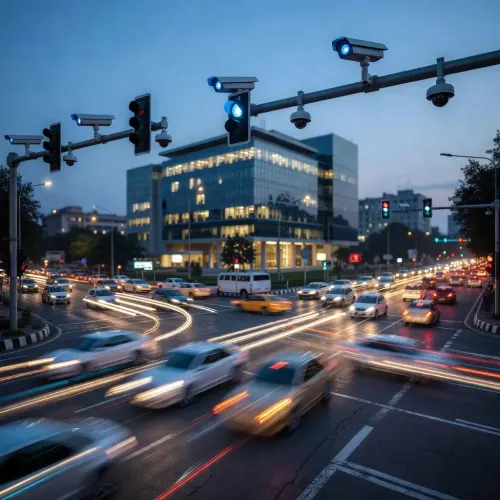
Key features include real-time traffic data, adaptive signals, automated enforcement cameras, and integrated command-and-control centres.
Objectives span smoother commutes, faster emergency response, and better citizen travel information.
Funding goes directly to Delhi Police , which operates under the Union Home Ministry.
Delhi's notoriously gridlocked streets are about to meet their match. The Cabinet Committee on Economic Affairs (CCEA), chaired by Prime Minister Narendra Modi, on Wednesday, 30 September 2026 approved the Intelligent Traffic Management System (ITMS) project for Delhi Police at an estimated cost of ₹1,789.52 crore — one of the largest technology-driven traffic infrastructure investments the national capital has ever seen.
What the ₹1,789.52 Crore System Will Actually Do
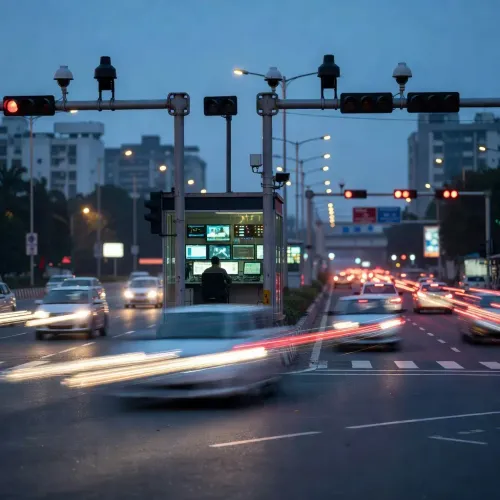
The ITMS is not a single gadget but an end-to-end urban nervous system. Spread across 42 traffic corridors in Delhi, it will deploy real-time traffic data analytics, adaptive signal controls that respond to live congestion, automated enforcement cameras, and integrated command-and-control centres where operators can see and manage the entire network from one screen.
The practical payoffs are threefold: smoother movement for daily commuters, faster response times for ambulances and fire tenders navigating peak-hour snarls, and richer, more accurate travel information pushed directly to citizens. Union Health and Chemicals Minister J. P. Nadda, announcing the decision on X, described the project as enabling 'technology-based enforcement' and helping Delhi make 'more efficient use of its existing road network.'
From Smart Cities to the National Capital
The approval builds on a policy lineage stretching back to the Smart Cities Mission of 2015, which first seeded intelligent transport components across Indian metros. Since then, the Central government has steadily scaled up data-driven urban mobility investments, routing them through the CCEA for large state police and transport agencies. Delhi, as the National Capital Territory, has long been a test-bed for such initiatives — and with an estimated 11 million vehicles on its roads, the pressure to modernise enforcement and flow management has never been greater.
Funding flows directly from the Centre to Delhi Police, which operates under the Union Home Ministry rather than the Delhi state government — a jurisdictional detail that makes the CCEA route both logical and politically straightforward.
The 42-Corridor Rollout: What to Watch
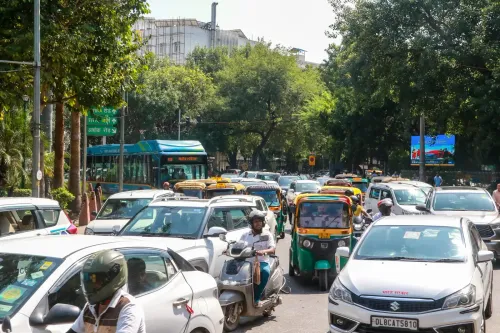
The ambition is clear; the timeline is still the key variable. Phased deployment across 42 corridors will test Delhi Police's capacity to integrate new hardware and software with its existing traffic control infrastructure. How quickly adaptive signals can be calibrated to Delhi's uniquely chaotic traffic mix — a blend of private cars, auto-rickshaws, buses, and two-wheelers — will determine how soon commuters actually feel the difference.
Automated enforcement, too, will be closely watched. Camera-based penalty systems have historically generated both efficiency gains and litigation in Indian cities; Delhi's experience with the ITMS could set a template for other congested metros from Mumbai to Bengaluru.
Nearly ₹1,800 crore is now committed. The next chapter belongs to the engineers, the traffic cops, and the commuters stuck at a red light waiting to see if the promise holds.
Point of View
789.52 crore ITMS signals that the Centre is treating urban traffic congestion as a national infrastructure priority, not merely a state-level headache. Routing the investment through Delhi Police — a Union-controlled body — lets the Centre own both the credit and the accountability for one of India's most high-visibility urban challenges. The project fits neatly into the broader Digital India and Smart Cities arc, but its real test will be execution speed: large tech-heavy public infrastructure projects in India have a chequered record of slippage. If Delhi's 42-corridor rollout delivers measurable results, it could accelerate similar Central approvals for Mumbai, Bengaluru and Chennai, reshaping how the Union government intervenes in metro traffic governance.
NationPress
30 Sept 2026
Frequently Asked Questions
What is the Intelligent Traffic Management System approved for Delhi?
The ITMS is a technology-driven traffic platform covering 42 corridors across Delhi that uses real-time data, adaptive signals, automated enforcement cameras and integrated command-and-control centres to ease congestion and improve emergency response.
How much will the Delhi ITMS project cost?
The Cabinet Committee on Economic Affairs has approved the project at an estimated cost of ₹1,789.52 crore.
Who approved the Delhi traffic management project?
The Cabinet Committee on Economic Affairs (CCEA), chaired by Prime Minister Narendra Modi, approved the project on 30 September 2026.
Which agency will implement the ITMS in Delhi?
Delhi Police, which operates under the Union Home Ministry, is the designated agency for the project.
How many traffic corridors will the Delhi ITMS cover?
The system will be deployed across 42 traffic corridors in the national capital.