Chhattisgarh Cabinet Approves CG-CBG Policy 2026
Synopsis
The Chhattisgarh cabinet has approved the draft CG-CBG Policy 2026, a state framework to convert agricultural residue, municipal solid waste and livestock waste into compressed biogas, aligning with the central government's SATAT initiative and national biofuel goals.
Key Takeaways
The Chhattisgarh cabinet approved the draft CG-CBG Policy 2026 on 23 June 2026 .
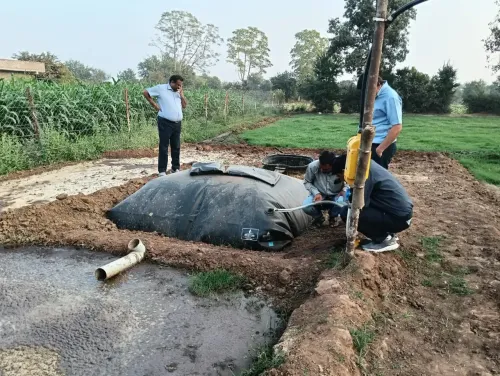
The policy targets conversion of agricultural residue, urban solid waste and livestock waste into compressed biogas.
It aligns with the central government's SATAT initiative , which aims for 5,000 CBG plants across India.
Farmers, urban local bodies and biogas developers are the primary stakeholder groups.
The draft must still be gazette-notified before it acquires legal force.
Chhattisgarh joins several Indian states that have framed state-level CBG policies to complement national biofuel targets.
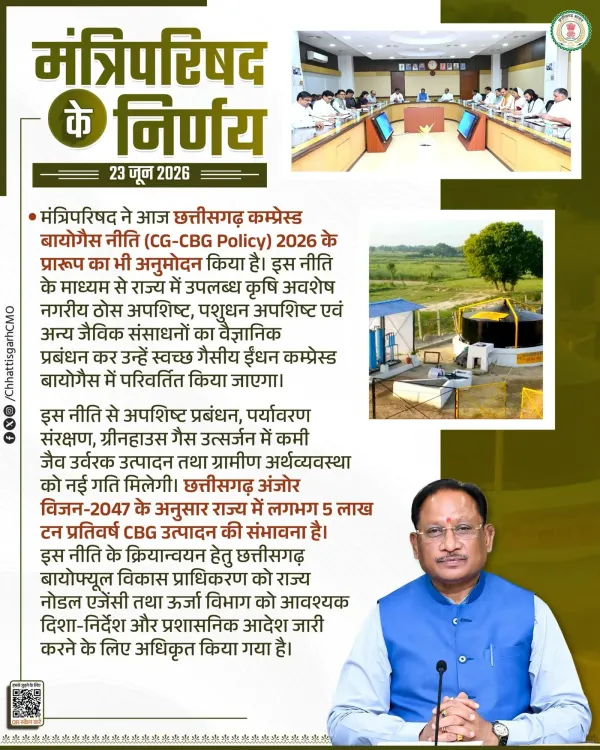
The Chief Minister's Office of Chhattisgarh announced on Tuesday, 23 June 2026 that the state cabinet has approved the draft of the Chhattisgarh Compressed Biogas Policy (CG-CBG Policy), 2026, a framework aimed at converting agricultural residue, municipal solid waste, and livestock waste into clean compressed biogas.
Context
The cabinet communique, shared in Hindi, states that the policy will enable scientific management of organic resources available across the state — including agricultural residue (kृषि अवशेष), urban solid waste (nगरीय ठोस अपशिष्ट), and livestock waste (pशुधन अपशिष्ट) — and convert them into clean energy. The announcement forms part of a broader set of cabinet decisions unveiled the same day.
Policy Backdrop
The CG-CBG Policy 2026 sits within a well-established national policy architecture. The central government's SATAT (Sustainable Alternative Towards Affordable Transportation) initiative, launched in October 2018 by the Ministry of Petroleum and Natural Gas, set a target of 5,000 compressed biogas plants across India, using organic feedstock to produce CBG for transport and industrial use. The National Policy on Biofuels was revised in 2018 to widen the range of permissible feedstocks, creating a regulatory foundation on which state-level frameworks like Chhattisgarh's can now be built.
Several Indian states with large agricultural and livestock sectors have framed their own compressed biogas policies in recent years, seeking to reduce open burning of crop residue, cut greenhouse gas emissions from organic waste, and create new rural income streams. Chhattisgarh's move follows this broader pattern and aligns with circular-economy goals articulated at the national level.
Stakeholders and Impact
Farmers stand to benefit directly: agricultural residue that is currently burned in fields — a major source of air pollution — can instead be monetised as feedstock for CBG plants. Urban local bodies managing municipal solid waste could channel waste streams into biogas production, easing landfill pressure in cities such as Raipur and Bilaspur. Biogas developers and private investors are the third key stakeholder group, as the policy is expected to open expression-of-interest rounds for plant commissioning, potentially supported by central viability gap funding under SATAT.
Livestock-rich districts of Chhattisgarh — a state with a significant rural economy — could see new decentralised energy infrastructure emerge if the policy translates into on-ground plant approvals.
What's Next
The cabinet has approved only the draft of the policy; the final gazette notification is the next procedural step before it acquires legal force. Observers will watch for the launch of formal expression-of-interest rounds for CBG plant developers, the identification of feedstock aggregation mechanisms, and the state's linkage with central viability gap funding available under the SATAT framework. The speed of implementation will determine whether the policy delivers on its clean-energy and waste-management ambitions.
Point of View
The policy offers a dual dividend: reducing crop-residue burning and creating a new feedstock economy for rural producers. The move also positions the state government to access central viability gap funding, making it as much a fiscal strategy as an environmental one. Whether the draft translates into operational plants will depend on the speed of gazette notification and the attractiveness of the investment framework offered to private developers.
NationPress
23 Jun 2026
Frequently Asked Questions
What is the CG-CBG Policy 2026?
The CG-CBG Policy 2026 is a draft state policy approved by the Chhattisgarh cabinet on 23 June 2026 that aims to convert agricultural residue, municipal solid waste and livestock waste into compressed biogas through scientifically managed plants across the state.
What is compressed biogas and how is it used?
Compressed biogas (CBG) is purified biogas compressed to high pressure, similar in composition to CNG. It can be used as a clean fuel for transport vehicles and industrial applications, reducing dependence on fossil fuels.
How does the CG-CBG Policy relate to the central government's SATAT scheme?
The SATAT scheme, launched in October 2018 by the Ministry of Petroleum and Natural Gas, set a national target of 5,000 CBG plants. State policies like Chhattisgarh's CG-CBG Policy 2026 create the local regulatory framework and investor environment needed to meet those central targets.
Who benefits from the Chhattisgarh compressed biogas policy?
Farmers can earn from selling agricultural residue as feedstock instead of burning it; urban local bodies can divert municipal solid waste to productive use; and private biogas developers gain a policy framework to commission plants, potentially with central viability gap funding.
Is the CG-CBG Policy 2026 already in effect?
No. The cabinet has approved only the draft of the policy. It must be gazette-notified by the state government before it becomes legally enforceable.