Chhattisgarh CMO promotes Nano Urea, Nano DAP for farmers
Synopsis
The Chief Minister's Office of Chhattisgarh has highlighted Nano Urea and Nano DAP as tools to lower fertiliser costs, boost yields, and preserve soil health for the state's smallholder farmers, reinforcing India's national push for nano fertiliser adoption since 2021.
Key Takeaways
The Chief Minister's Office of Chhattisgarh promoted Nano Urea and Nano DAP adoption on June 1, 2026 via its official X account.
Nano Urea was commercially launched by IFFCO in 2021 and is approved under central fertiliser subsidy schemes.
Chhattisgarh began pilot distribution of Nano Urea in 2022-23 as part of state agriculture extension programmes.
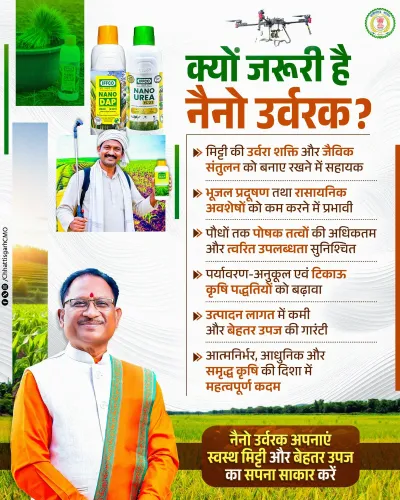
The technology is designed to reduce fertiliser input costs for smallholder farmers while improving nutrient uptake and protecting soil fertility.
The initiative aligns with the national Atmanirbhar Bharat goal of reducing import dependence on conventional urea and DAP.
Outcomes from the kharif 2026 season will be a key indicator of ground-level adoption across the state.
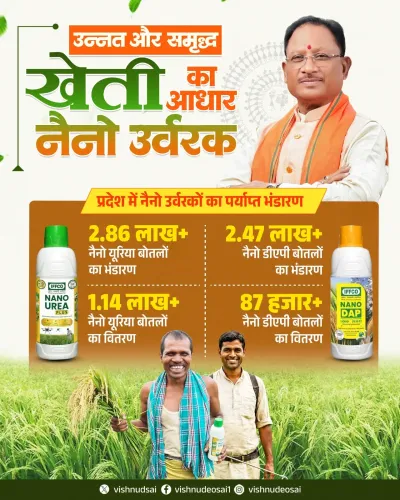
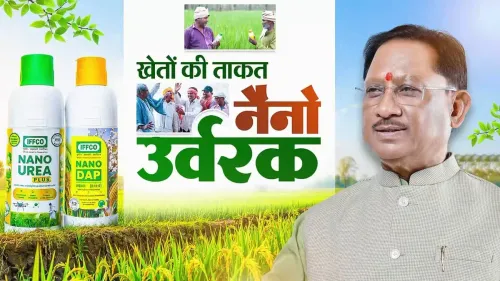
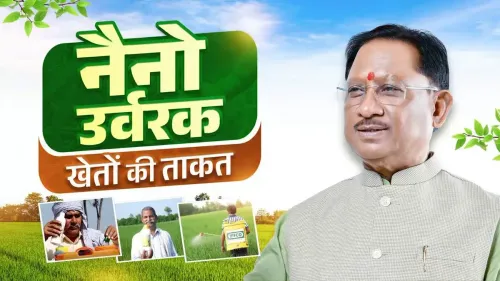
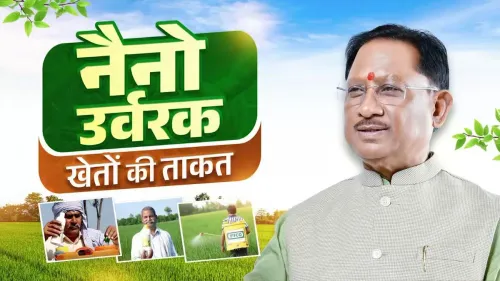
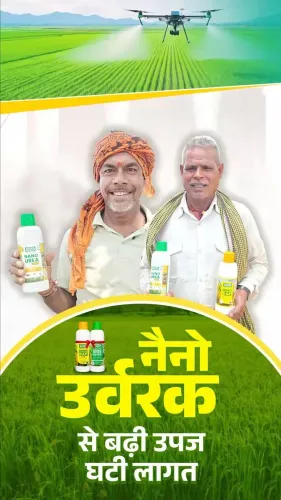
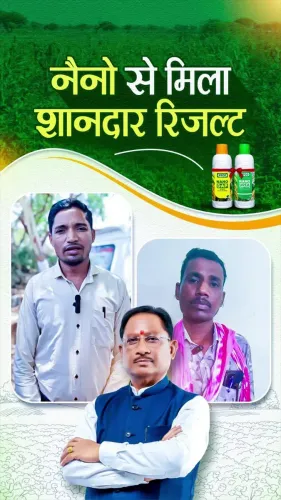
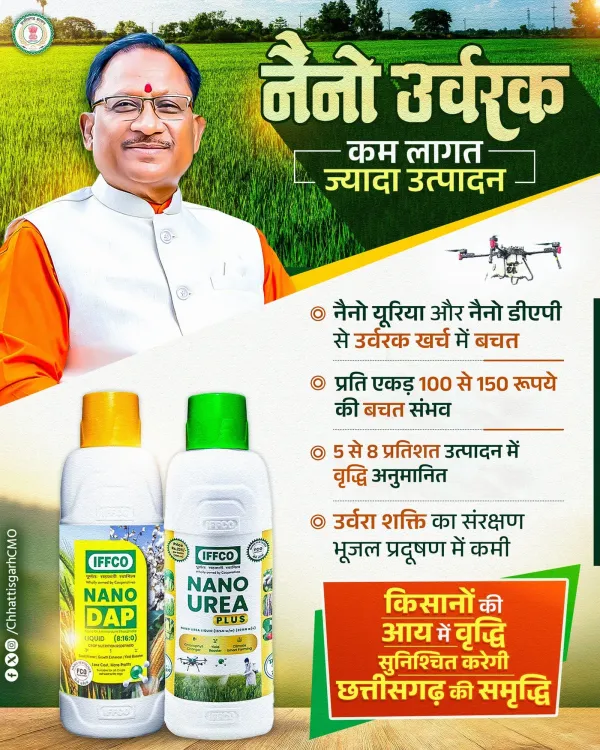
The Chief Minister's Office of Chhattisgarh on Monday, June 1, 2026, highlighted the growing role of technology and innovation in agriculture, specifically promoting the adoption of Nano Urea and Nano DAP among farmers in the state as tools to cut fertiliser costs, improve yields, and preserve soil health.
The post, shared on the official CMO handle, stated: 'तकनीक, नवाचार और नई कृषि पद्धतियों से किसानों को खेती में मिल रहा अधिक लाभ' ('Farmers are getting more benefit in farming through technology, innovation and new agricultural practices'). It added that the use of Nano Urea and Nano DAP is promoting savings in fertiliser costs, better production, and conservation of soil fertility.
Context
Nano Urea is a nanotechnology-based liquid fertiliser developed by IFFCO, India's largest fertiliser cooperative, as an alternative to conventional granular urea. It was commercially launched in 2021 following trials by the Indian Council of Agricultural Research. Nano DAP is a similarly formulated nano-version of diammonium phosphate, designed to deliver phosphorus more efficiently at lower application volumes. Both products are positioned as solutions to India's heavy dependence on conventional chemical fertilisers, a large share of which is imported.Policy Backdrop
Chhattisgarh's agriculture department began pilot distribution of Nano Urea in 2022-23 under the current BJP government, integrating it into extension programmes aimed at reducing urea consumption and protecting soil quality. Nationally, the central government approved Nano Urea's inclusion under fertiliser subsidy schemes, and multiple states have linked its distribution to existing programmes such as the Soil Health Card scheme and PM-KISAN. The broader push aligns with the Atmanirbhar Bharat objective of deploying domestic technology solutions to reduce import bills and address soil degradation caused by excessive conventional fertiliser use.Stakeholders and Impact
The primary beneficiaries are Chhattisgarh's smallholder farming communities, who account for a significant share of the state's agricultural workforce. Nano fertilisers require far smaller volumes per application compared to conventional alternatives — a single bottle of Nano Urea can substitute for a standard bag of granular urea — which directly reduces out-of-pocket expenditure for farmers. For fertiliser cooperatives such as IFFCO, wider state adoption translates into expanded distribution networks. Soil conservation benefits are also cited as a long-term gain, as reduced chemical loading is expected to improve soil microbial health over successive cropping seasons.What's Next
Attention will now turn to state-level data on fertiliser subsidy savings and yield outcomes from the current kharif 2026 season, which will be the clearest indicator of how widely nano fertilisers have been adopted on the ground. Any revision to the central government's fertiliser control order that formally expands the nano fertiliser category could further accelerate uptake. Chhattisgarh's continued emphasis on this technology under its Sushasan Sarkar ('Good Governance Government') messaging suggests it will remain a visible plank of the state's agricultural outreach in the months ahead.Point of View
Which emphasises technology-driven governance. By anchoring the messaging around farmer cost savings and soil conservation, the government is aligning itself with a central policy priority without requiring new state-level expenditure. The timing ahead of the kharif season is strategic: it maximises the window for farmer adoption before sowing decisions are finalised. If yield and savings data from this season are positive, it could become a significant electoral talking point for the ruling dispensation in a state where agricultural welfare is a decisive voter concern.
NationPress
16 Oct 2026
Frequently Asked Questions
What is Nano Urea and how does it help farmers in Chhattisgarh?
Nano Urea is a liquid, nanotechnology-based fertiliser developed by IFFCO that delivers nitrogen more efficiently than conventional granular urea. Chhattisgarh has been distributing it since 2022-23 to help smallholder farmers reduce fertiliser costs and protect soil health.
What is Nano DAP and how is it different from regular DAP?
Nano DAP is a nano-formulation of diammonium phosphate that delivers phosphorus at much lower application volumes compared to conventional DAP granules, reducing input costs and minimising soil chemical loading.
Who developed Nano Urea in India?
Nano Urea was developed and commercialised by IFFCO, India's largest fertiliser cooperative, following ICAR trials, and was launched commercially in 2021.
Is Nano Urea covered under government subsidy in India?
Yes, the central government approved Nano Urea's inclusion under fertiliser subsidy schemes, making it accessible to farmers at subsidised rates through cooperative distribution networks.
What is the Chhattisgarh government's agriculture policy for 2026?
The Chhattisgarh government under the BJP is promoting technology-driven farming including Nano Urea and Nano DAP adoption as part of its 'Sushasan Sarkar' agenda, aimed at cutting input costs and improving soil health for the state's smallholder farmers.