CM Sai Pushes Nano Urea, Nano DAP Adoption in Chhattisgarh
Synopsis
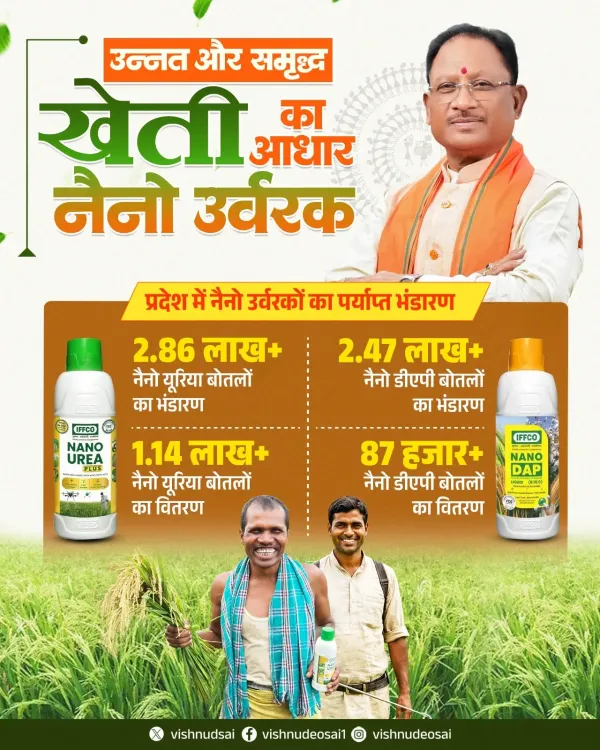
Chhattisgarh Chief Minister Vishnu Deo Sai has announced state-level promotion of Nano Urea and Nano DAP, with adequate stocks secured for farmers ahead of the kharif season. The move aligns with the national push to cut farming costs, reduce fertilizer imports, and raise farmer incomes through modern agricultural technology.
Key Takeaways
CM Vishnu Deo Sai announced on 6 July 2026 that Chhattisgarh is promoting Nano Urea and Nano DAP adoption among farmers.
The state government has ensured adequate storage of nano fertilizers ahead of the kharif sowing season to prevent supply gaps.
IFFCO commercially launched Nano Urea in 2021 ; the central government subsequently included nano fertilizers in the Fertiliser Control Order.
Nano fertilizers require lower application volumes than conventional urea and DAP, potentially reducing per-acre input costs for farmers.
The initiative supports national objectives of cutting urea imports, lowering fertilizer subsidy outgo, and improving soil health.
The state's kharif-season performance data on nano fertilizer uptake will be closely watched by the central agriculture ministry.
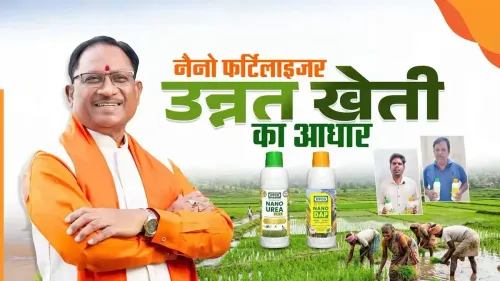
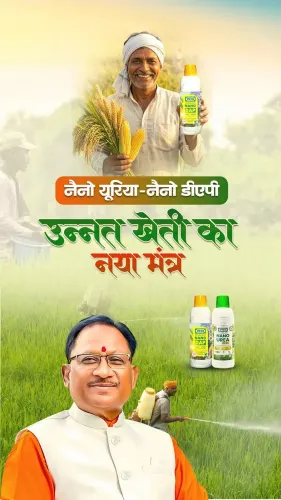
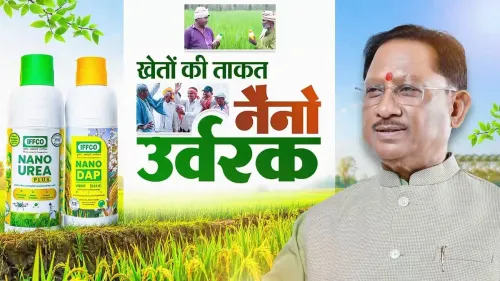
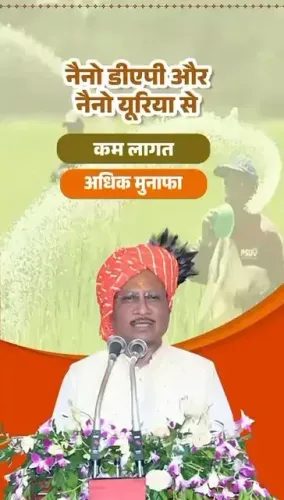
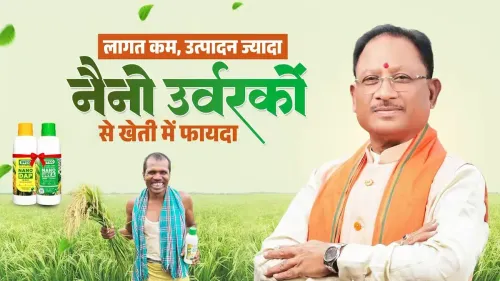
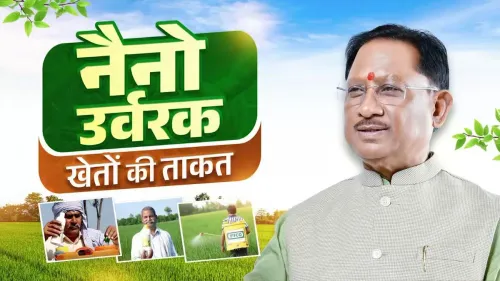
Chhattisgarh Chief Minister Vishnu Deo Sai on Monday, 6 July 2026, announced that the state government is actively promoting the use of Nano Urea and Nano DAP among farmers, with adequate stocks secured to meet agricultural demand ahead of the kharif season.
Posting on X, CM Sai stated — translated from Hindi — that 'nano urvarak unnat, samridh aur kifayati kheti ki nayi pehchaan ban rahe hain' ('nano fertilizers are becoming the new identity of advanced, prosperous, and affordable farming'). He added that his government is working 'with full commitment' to reduce farming costs, increase production, and raise farmer incomes through modern agricultural technologies.
Context
Chhattisgarh is a predominantly agrarian state in central India where a large share of rural households depend on farming for their livelihoods. The state government's push for nano fertilizers is framed as a direct response to the input-cost burden that conventional fertilizers place on smallholder farmers. By encouraging Nano Urea and Nano DAP, the administration aims to bring down per-acre expenditure while maintaining or improving crop yields.
The announcement comes as farmers across the state prepare for the kharif sowing season, when demand for fertilizers typically peaks. Ensuring adequate storage of nano fertilizers at this juncture is intended to prevent supply gaps at the critical planting stage.
Policy Backdrop
IFFCO (Indian Farmers Fertiliser Cooperative Limited) commercially launched Nano Urea in 2021, followed by the central government's inclusion of nano fertilizers in the Fertiliser Control Order. From 2022 onward, the Union Ministry of Agriculture began promoting nano urea and nano DAP through state agricultural departments as a strategy to cut urea imports and improve nutrient-use efficiency in Indian soils.
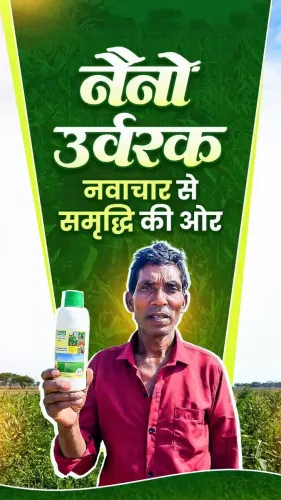
Nano Urea is a liquid nitrogen fertilizer that delivers nutrients more efficiently than conventional urea, requiring significantly lower application volumes. Nano DAP is a nanotechnology-based phosphate fertilizer engineered for better nutrient absorption at reduced usage rates compared to traditional diammonium phosphate. Both products support the broader national objective of reducing the government's subsidy outgo on conventional fertilizers while improving soil health over time.
Multiple states have already incorporated nano products into their fertilizer distribution networks and farmer-awareness campaigns since the initial IFFCO rollout. Chhattisgarh's move aligns with this national pattern and with the BJP-led state government's stated agricultural priorities following its 2023 assembly election victory.
Stakeholders and Impact
The primary beneficiaries of this push are Chhattisgarh's farming communities, particularly smallholders who spend a disproportionate share of their income on chemical inputs. Lower application volumes of nano fertilizers, if adopted at scale, could translate into measurable savings per crop cycle. Fertiliser cooperatives and state distribution networks are also key stakeholders, as they are responsible for ensuring that stocks reach farmers at the village level in time for sowing.
From a soil-health perspective, reduced over-application of conventional urea and DAP — a documented problem in Indian agriculture — could have longer-term benefits for land productivity across the state.
What's Next
Attention will now turn to the Chhattisgarh agriculture department's on-ground rollout: whether nano fertilizer stocks are distributed equitably across districts, what farmer-awareness campaigns accompany the push, and how uptake is tracked during the kharif season. A central review of nano fertilizer performance data across states is also anticipated, which could influence future subsidy and procurement decisions. The state's experience this season may serve as a reference point for other agrarian states evaluating a similar shift.
Point of View
The government is trying to pre-empt the supply-chain failures that have historically undermined new fertilizer rollouts in rural India. The framing around cost reduction and income growth is politically significant in an agrarian state where farmer welfare is a persistent electoral variable. Whether the push translates into measurable adoption numbers will determine if this remains a policy statement or becomes a genuine agricultural shift.
NationPress
5 Oct 2026
Frequently Asked Questions
What are Nano Urea and Nano DAP?
Nano Urea is a liquid nitrogen fertilizer developed by IFFCO that delivers nutrients more efficiently than conventional urea at lower application volumes. Nano DAP is a nanotechnology-based phosphate fertilizer designed for better nutrient absorption and reduced usage compared to traditional diammonium phosphate.
Why is Chhattisgarh promoting nano fertilizers?
The Chhattisgarh government is promoting nano fertilizers to reduce farming input costs, increase crop production, and raise farmer incomes, in line with both state agricultural priorities and the Union government's broader strategy to cut urea imports and improve soil health.
What did CM Vishnu Deo Sai say about nano fertilizers?
CM Vishnu Deo Sai stated that nano fertilizers are becoming the 'new identity of advanced, prosperous, and affordable farming' and that his government has ensured adequate nano fertilizer stocks, working with 'full commitment' to modernise agriculture in the state.
Who makes nano fertilizers in India?
IFFCO (Indian Farmers Fertiliser Cooperative Limited) pioneered the commercial production of nano fertilizers in India, launching Nano Urea in 2021 and subsequently scaling up supply to state agricultural departments across the country.
How do nano fertilizers benefit farmers?
Nano fertilizers require significantly lower quantities per application than conventional fertilizers, which can reduce per-acre input costs for farmers. They are also associated with better nutrient-use efficiency, potentially improving yields while supporting longer-term soil health.