Chhattisgarh CMO: Driving Training Gives Bastar Youth New Livelihood
Synopsis
The Chhattisgarh CMO on 7 July 2026 spotlighted a driving training programme under the Badalta Bastar campaign that is giving rehabilitated youth in the LWE-affected region dignified employment and a self-reliant identity, deepening the state's socio-economic rehabilitation push.
Key Takeaways
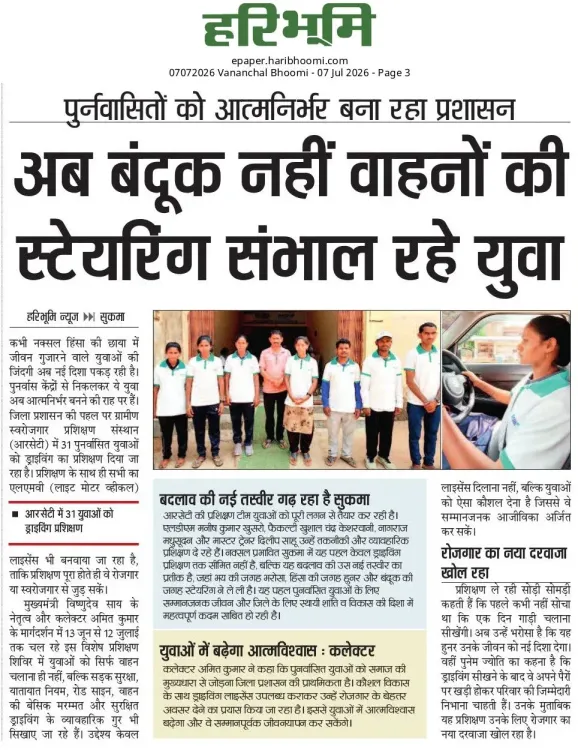
The Chief Minister's Office of Chhattisgarh announced on 7 July 2026 that rehabilitated youth in Bastar are receiving driving training for dignified livelihood.
The initiative operates under the Badalta Bastar campaign, the state government's umbrella programme for socio-economic transformation in the LWE-affected southern division.
Chief Minister Vishnu Deo Sai , in office since December 2023 , has prioritised livelihood-linked rehabilitation alongside security operations in Bastar.
Driving training provides a nationally recognised licence, opening pathways into transport and logistics sectors even in semi-urban Bastar.
The state's rehabilitation policy for Left-Wing Extremist cadres dates to the early 2000s, with vocational components strengthened under successive governments.
Expansion of training centres to other Bastar districts and public placement-rate data will be key indicators of the programme's scale and impact.
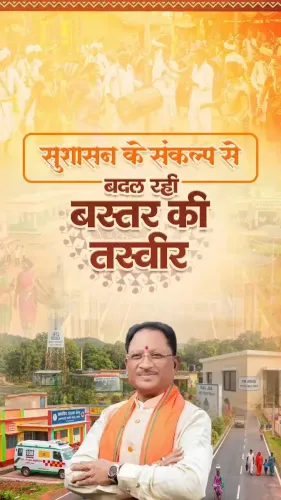
The Chief Minister's Office of Chhattisgarh announced on Tuesday, 7 July 2026 that rehabilitated youth in Bastar are being equipped with driving skills as part of a state-led effort to provide them dignified employment and self-reliant lives under the Badalta Bastar campaign.
The post, shared under the hashtags #BadaltaBastar and #SkillDevelopment, declared: 'Changing mindsets, changing paths and a changing Bastar. Through driving training, rehabilitated youth are receiving a respectable livelihood and a new identity of self-reliant life.' The message signals that the state government under Chief Minister Vishnu Deo Sai is doubling down on vocational integration as a pillar of its post-surrender rehabilitation architecture.
Context
Bastar is a southern division of Chhattisgarh comprising seven districts that have been deeply affected by Left-Wing Extremism (LWE) for decades. The region has seen sustained counter-insurgency operations alongside growing state investment in social infrastructure. The Badalta Bastar campaign — whose name translates to 'Changing Bastar' — is the state government's umbrella initiative to signal and accelerate attitudinal and economic transformation in this historically conflict-affected zone. Driving training as a livelihood tool fits squarely within this frame: it is low-barrier to entry, produces a nationally recognised licence, and opens pathways into transport, logistics and private hire sectors that are expanding even in semi-urban Bastar towns.Policy Backdrop
Chhattisgarh has maintained a formal surrender and rehabilitation policy for cadres of Left-Wing Extremist groups since the early 2000s, with vocational components added and updated over successive governments. The current administration under CM Vishnu Deo Sai, in office since December 2023, has placed particular emphasis on livelihood-linked rehabilitation, recognising that security operations alone cannot prevent recidivism among surrendered youth. This approach mirrors a broader national pattern in LWE-affected states, where driving, hospitality and technical training programmes have been bundled into post-surrender support packages. The emphasis on 'respectable' employment — sम्मानजनक आजीविका (sammanjanak aajivika) — reflects a deliberate policy choice to address the social stigma that often follows surrender, making reintegration more durable.Stakeholders and Impact
Rehabilitated youth from Bastar's tribal communities are the direct beneficiaries of this initiative. For many, acquiring a commercial or light-motor-vehicle driving licence represents not just income but social legitimacy — a documented skill that signals a clean break from armed cadre life. Bastar's tribal communities more broadly stand to benefit from reduced violence and from the economic multiplier effect of more locally employed youth. The state government gains a visible, measurable metric — licences issued, trainees placed — to demonstrate that its rehabilitation architecture is producing outcomes beyond mere surrender numbers. Businesses in the transport and logistics sectors operating in Bastar also gain a pipeline of locally trained drivers.What's Next
Attention will now turn to whether the Government of Chhattisgarh expands driving training centres or similar vocational hubs to other districts within the Bastar division, and whether placement-rate data for programme graduates is made public. Sustained follow-through — stipends, licence-fee support, job-placement linkages — will determine whether this initiative becomes a replicable model or remains a pilot. If placement rates prove strong, the driving-training module could be integrated into the state's wider skill-development infrastructure, reinforcing the argument that socio-economic integration is as central to LWE resolution as security operations.Point of View
Licence-backed skill to the broader narrative of LWE resolution — shifting the story from security operations to visible human outcomes. By framing the initiative around 'respectable livelihood' and 'self-reliant identity,' the administration is directly addressing the social-stigma barrier that has historically undermined rehabilitation programmes. This sits within a national policy arc in which state governments in LWE-affected regions increasingly treat vocational integration as a force-multiplier for surrender policies, not merely a welfare add-on. The durability of this approach, however, will hinge on whether placement infrastructure and follow-on support match the ambition of the messaging.
NationPress
7 Jul 2026
Frequently Asked Questions
What is the Badalta Bastar campaign in Chhattisgarh?
Badalta Bastar, meaning 'Changing Bastar,' is a state government campaign promoting attitudinal and infrastructural transformation in Bastar through livelihood, vocational training and development programmes targeting the LWE-affected southern division of Chhattisgarh.
Who are the rehabilitated youth getting driving training in Bastar?
They are former cadres or individuals associated with Left-Wing Extremist groups who have surrendered and are now enrolled in state rehabilitation programmes; driving training is one vocational stream offered to help them secure dignified employment.
What is Chhattisgarh's rehabilitation policy for Naxal surrendered youth?
Chhattisgarh has maintained a formal surrender and rehabilitation policy since the early 2000s that includes financial support, legal assistance and vocational training — including driving, technical and hospitality skills — to reintegrate surrendered cadres into mainstream society.
Who is the Chief Minister of Chhattisgarh in 2026?
Vishnu Deo Sai of the BJP has been serving as Chief Minister of Chhattisgarh since December 2023.
Why is driving training significant for Bastar rehabilitation?
A driving licence is a nationally recognised credential that opens doors to transport, logistics and private-hire work even in semi-urban areas, making it a practical, low-barrier vocational option that also carries social legitimacy for youth rebuilding their lives after surrender.