'A Learning Judiciary is an Evolving Judiciary': CJI Unveils Foundation Stone for Telangana High Court Zone-II Complex
Synopsis
On April 5, Chief Justice of India Justice Surya Kant announced that the upcoming Telangana High Court complex will be the finest in the country, emphasizing the importance of learning and sustainable infrastructure for the judiciary's evolution.
Key Takeaways
The Telangana High Court complex aims to be the best in the country.
Zone-II will feature integrated facilities for enhanced judicial functions.
Physical infrastructure is crucial for access to justice.
The project reflects a commitment to sustainable development.
Completion is targeted within two years, with significant state funding.
Hyderabad, April 5 (NationPress) The Chief Justice of India, Justice Surya Kant, proclaimed on Sunday that the forthcoming Telangana High Court complex will emerge as the premier high court in India.
He emphasized that courtrooms, administrative offices, archival spaces, residential accommodations, and training facilities will be centralized within a fully integrated site.
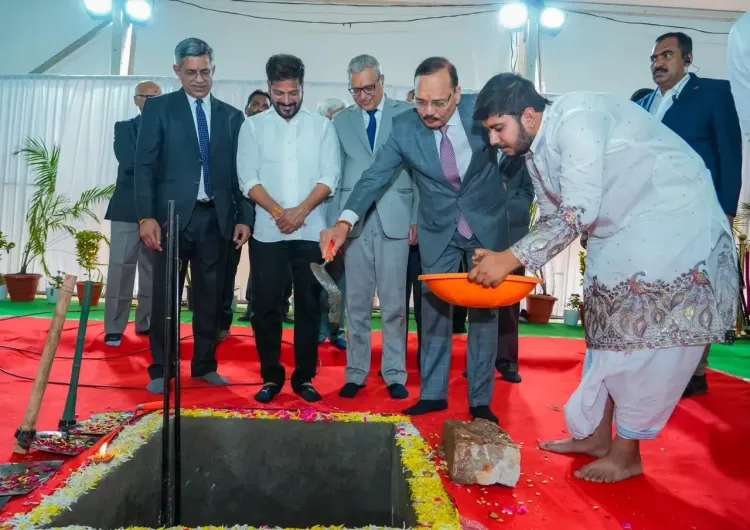
This statement followed the ceremonial laying of the foundation stone for Zone-II of the new High Court complex, which spans 100 acres in Rajendranagar.
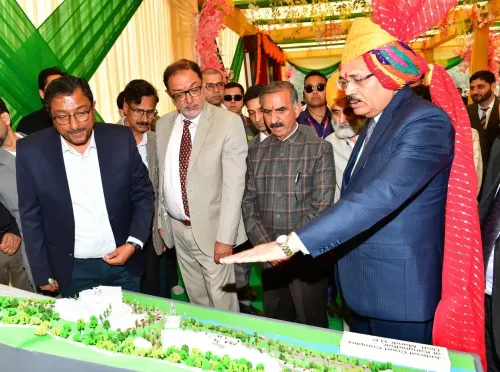
After reviewing the conceptual designs and models, the CJI expressed his belief that this High Court will indeed be the finest in the nation.
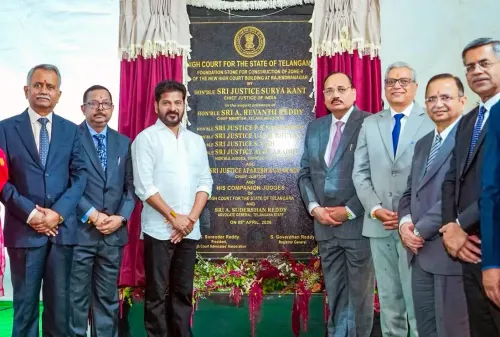
Accompanied by several Supreme Court judges, Telangana High Court Chief Justice Justice Aparesh Kumar Singh, and Chief Minister A. Revanth Reddy, he laid the cornerstone for Zone-II, which will cover 60 acres.
“The judiciary will function here on its own terms and its own grounds. This is the essence of institutional self-sufficiency, transitioning from theory to tangible infrastructure,” he remarked.
The two structures in Zone-II that particularly resonated with the CJI are the auditorium and the central record room.
The auditorium is set to host judicial conferences and training programs for the district judiciary, along with initiatives aimed at enhancing legal awareness among citizens. “A judiciary that stops learning will cease to progress. This is a conviction I hold strongly across the nation,” he stated.
He underscored the significance of the central record room, which is designed across three levels. “Institutional memory is not merely a luxury; it is the cornerstone of consistent judicial reasoning. Well-maintained and easily accessible precedents bolster every subsequent judgment. I am gratified to see the importance of this recognized in the design,” he commented.
“The commitment to sustainability is evident in the planning. A campus intended to benefit future generations of judges and litigants must honor the land it occupies,” the CJI added.
He expressed gratitude to the Telangana government for allocating 100 acres for the new complex and approving more than Rs 2,500 crore for its development.
Designed to endure for the next century, the new High Court campus is scheduled for completion within two years.
Satisfied with the progress of Zone-I, for which the foundation was laid in 2024, he remarked that Zone-II is equally crucial to the campus.
Characterizing Zone-II as the foundational element of the campus, he noted that with 57 buildings on 60 acres, it is structured to sustain the institution long after the courtroom has opened.
He stressed the importance of physical infrastructure, stating that without it, the principle of access to justice remains theoretical.
“We frequently discuss judicial independence in various contexts. However, independence also has practical implications that are sometimes overlooked. A High Court operating from dispersed locations and cramped facilities is one where daily operations rely on arrangements beyond its control,” he explained.
The CJI expressed confidence that this expansive 100-acre campus will redefine perceptions and significantly enhance the judiciary's operational independence with its state-of-the-art facilities.
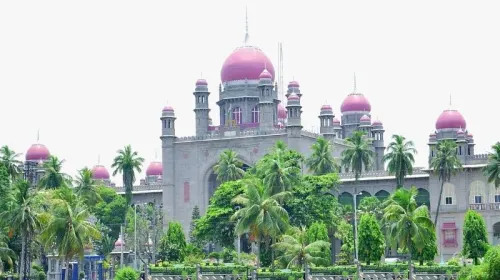
He acknowledged that while the existing High Court building holds historical significance, it does not meet the current needs of the institution. “Developing infrastructure that accommodates our requirements for the next century is not just a goal; it is an obligation,” he affirmed.
Chief Justice of Telangana High Court, Justice Aparesh Kumar Singh, acknowledged that the Telangana government has allocated 100 acres for this ambitious project, which will be executed in two phases.
Zone-I includes the main court complex and office buildings, whereas Zone-II will feature residential bungalows and a central record room.
The Chief Justice reported that the state government has approved Rs 2,583 crores for the construction of the new High Court building.
Chief Minister Revanth Reddy expressed his pride in initiating the project for the new High Court building, predicting it will become an iconic structure.
He reminisced that one of the first decisions made by the current government after taking office in December 2023 was to allocate land for the new High Court construction.
According to the CM, Zone-II, which will include residential quarters, is expected to be completed by December 2027.
Supreme Court Judges Justice Alok Aradhe, Justice S.V. Bhatti, Justice Ujjal Bhuyan, and Justice P.S. Narasimha also commented during the event.
Point of View
The establishment of the Telangana High Court Zone-II complex signifies a transformative step in judicial infrastructure. The emphasis on integrated facilities and learning reflects a commitment to evolving the judiciary into a more self-sufficient and effective entity, thereby enhancing access to justice.
NationPress
20 Sept 2026
Frequently Asked Questions
What is the significance of the Telangana High Court Zone-II complex?
The complex is designed to provide state-of-the-art facilities for the judiciary, promoting independence and efficiency in legal proceedings.
When is the new High Court complex expected to be completed?
The Telangana High Court complex is scheduled for completion within two years.
How much funding has the Telangana government allocated for the project?
The Telangana government has sanctioned over Rs 2,500 crore for the construction of the new High Court building.
What features will the Zone-II complex include?
Zone-II will house residential bungalows, a central record room, and an auditorium for judicial training and conferences.
Why is institutional memory important in the judiciary?
Institutional memory ensures consistency in judicial reasoning and strengthens the foundation for future judgments.