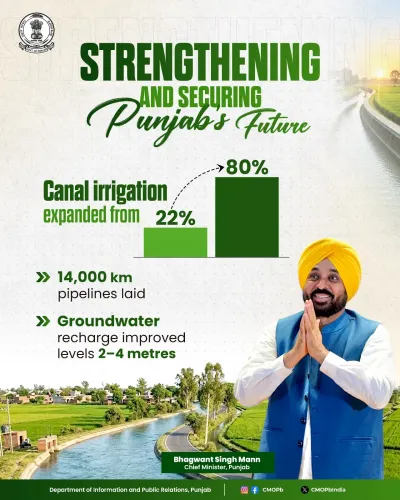
CM Bhagwant Mann: Punjab now irrigates 85% farms via canals

Synopsis
Chief Minister Bhagwant Mann announced on 20 November 2026 that over 85 per cent of Punjab's farm irrigation now uses canal water, citing state government management reforms as the driver behind the shift that benefits crops and eases groundwater pressure.
Key Takeaways
CM Bhagwant Mann announced on 20 November 2026 that canal water now accounts for more than 85 per cent of farm irrigation in Punjab.
The Punjab Government attributes the milestone to targeted improvements in canal irrigation management.
Raising canal-water usage directly reduces reliance on tubewells, helping to slow the rapid depletion of Punjab's groundwater table.
Canal water also delivers natural silt, offering agronomic benefits alongside the environmental ones.
Punjab has pursued canal lining, desilting and distribution reforms since the 1990s under programmes including the Accelerated Irrigation Benefits Programme .
Official Punjab Irrigation Department statistics and future state budget allocations will be key indicators of whether this improvement is sustained.
Punjab's fields are drinking deeper from its rivers than they have in years. Addressing citizens on Friday, 20 November 2026, Chief Minister Bhagwant Mann declared that strengthened canal irrigation management by the Punjab Government has pushed canal-water usage in farm irrigation beyond the 85 per cent mark — a milestone he called exceptionally beneficial for crops across the state.
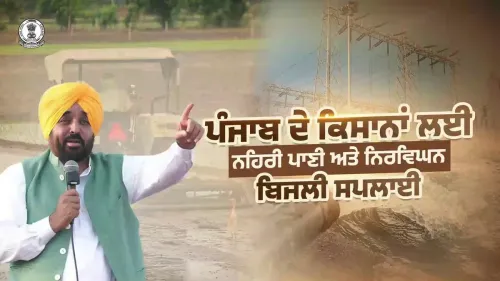
Speaking in Punjabi, the Chief Minister said: 'ਖੇਤਾਂ ਦੀ ਸਿੰਚਾਈ ਲਈ 85 ਫ਼ੀਸਦੀ ਤੋਂ ਵੱਧ ਨਹਿਰੀ ਪਾਣੀ ਵਰਤੋਂ 'ਚ ਲਿਆਂਦਾ ਜਾ ਰਿਹਾ ਹੈ' — 'more than 85 per cent canal water is now being utilised for field irrigation.' He attributed the shift directly to the state government's focused efforts to reform canal irrigation management.
Why 85 per cent canal water is a big deal for Punjab's farmers
Punjab's wheat-paddy belt runs on water — and for decades, that water has come overwhelmingly from tubewells punching deep into the earth. The groundwater table across large parts of the state has been falling at an alarming rate, threatening the long-term viability of farming in one of India's most productive agricultural regions. Shifting irrigation weight back to canals — fed by the Sutlej and Beas rivers — directly relieves that underground pressure.
The logic is straightforward: every litre drawn from a canal is a litre not extracted from a depleting aquifer. For Punjab's roughly ten million hectares of cultivable land, that arithmetic adds up fast. Canal water also carries silt that naturally replenishes soil nutrients, making the agronomic case as strong as the environmental one.
A decades-long push, now claiming a new high-water mark
The effort to raise canal irrigation's share is not new. Punjab governments going back to the 1990s launched successive programmes — including work under the Accelerated Irrigation Benefits Programme — focusing on canal lining, desilting clogged distributaries, and reforming last-mile water delivery. Progress was real but uneven; canal networks remained under-utilised as farmers found tubewells more reliable and easier to operate on demand.
The Bhagwant Mann administration, in office since March 2022, has framed canal management reform as a core plank of its agricultural agenda. The claim of crossing the 85 per cent utilisation threshold — if borne out by official Punjab Irrigation Department statistics — would represent a meaningful step-change in that multi-decade effort.
What Punjab's farmers stand to gain
For the state's farming community, the practical upside is two-fold. First, reduced dependence on tubewells cuts electricity and diesel costs that have squeezed margins for small and medium landholders. Second, more reliable canal supply — when backed by properly maintained distribution infrastructure — can stabilise water access across the growing season, reducing crop stress and potentially lifting yields.
The numbers to watch next are the Punjab Irrigation Department's official seasonal utilisation reports and any fresh budget allocations for canal modernisation in the state's upcoming financial plan. Those will determine whether the 85 per cent figure is a durable shift or a seasonal high-water mark.
Punjab's canals have carried the promise of abundance since the colonial era. If the Mann government has found the management formula to actually fill that promise, the state's water table — and its farmers — will feel the difference for generations.
Point of View
If verified, positions the Mann government as having made genuine headway on one of Punjab's most intractable long-term problems — groundwater depletion in the wheat-paddy belt. It fits a broader AAP pattern of framing infrastructure management reforms as farmer welfare, linking governance efficiency directly to rural livelihoods rather than headline subsidies. The political dividend, however, depends entirely on whether official irrigation data backs the figure: in a state where agrarian distress remains electorally decisive, unsubstantiated claims on water policy carry significant credibility risk. The real test will come at the next budget — whether canal modernisation receives the capital allocation needed to lock in the gains.
NationPress
20 Nov 2026
Frequently Asked Questions
What did CM Bhagwant Mann say about Punjab irrigation?
CM Bhagwant Mann stated on 20 November 2026 that more than 85 per cent of farm irrigation in Punjab is now being done through canal water, thanks to the state government's efforts to strengthen canal irrigation management.
Why is canal irrigation important for Punjab farmers?
Canal irrigation reduces reliance on tubewells, which have caused severe groundwater depletion across Punjab's wheat-paddy belt. It also cuts energy costs for farmers and delivers silt that naturally enriches soil.
What is Punjab's groundwater problem?
Punjab has seen rapidly falling water tables for decades due to heavy tubewell use for paddy and wheat cultivation. Shifting to canal-based irrigation is considered essential to arresting this decline and ensuring long-term agricultural viability.
What reforms has Punjab undertaken for canal irrigation?
Punjab governments since the 1990s have pursued canal lining, desilting and distribution reforms under programmes like the Accelerated Irrigation Benefits Programme. The current Mann administration has continued and expanded these management-focused efforts.
How much of Punjab's farmland depends on canal water now?
According to CM Bhagwant Mann's statement on 20 November 2026, over 85 per cent of farm irrigation in Punjab is now sourced from canal water, up from historically lower levels where tubewells dominated.