CM Bhajanlal Backs PM Modi's Vision for Easier E-Governance
Synopsis
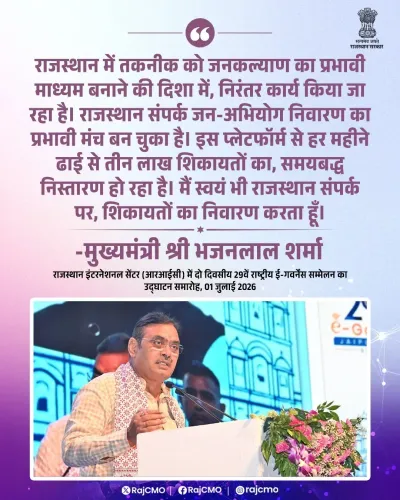
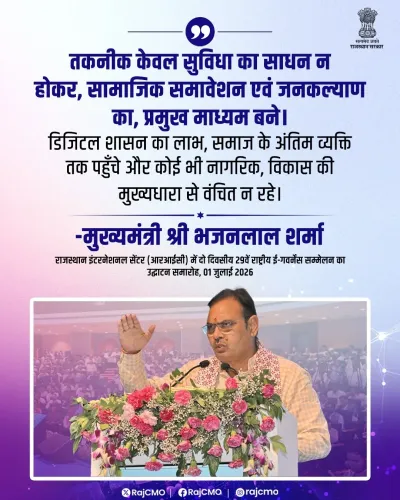
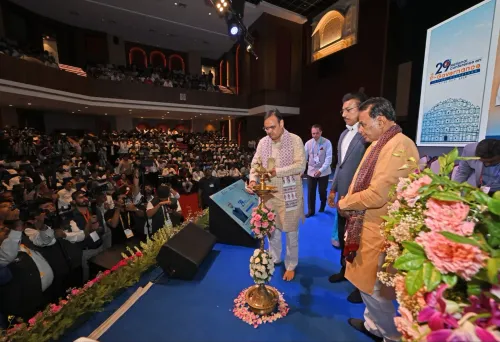
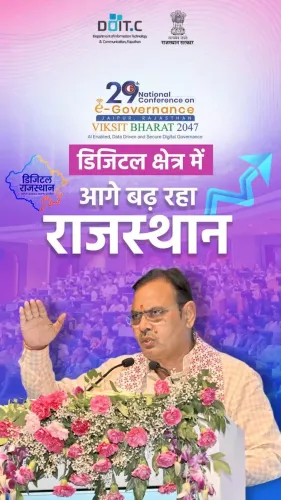
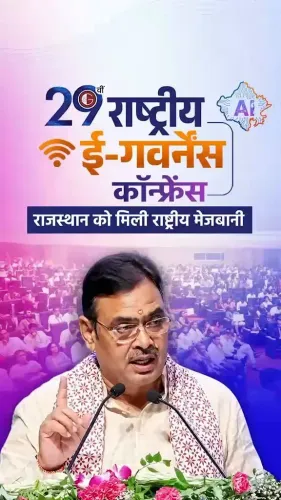
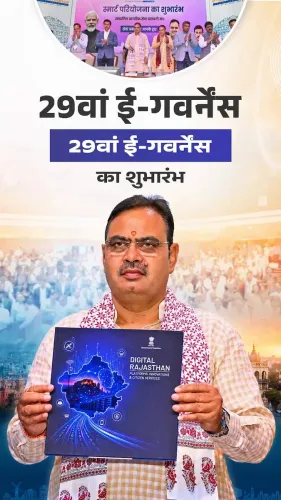
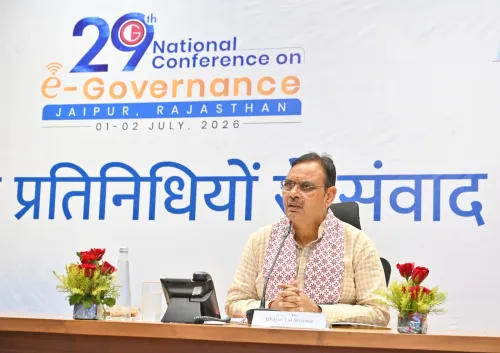
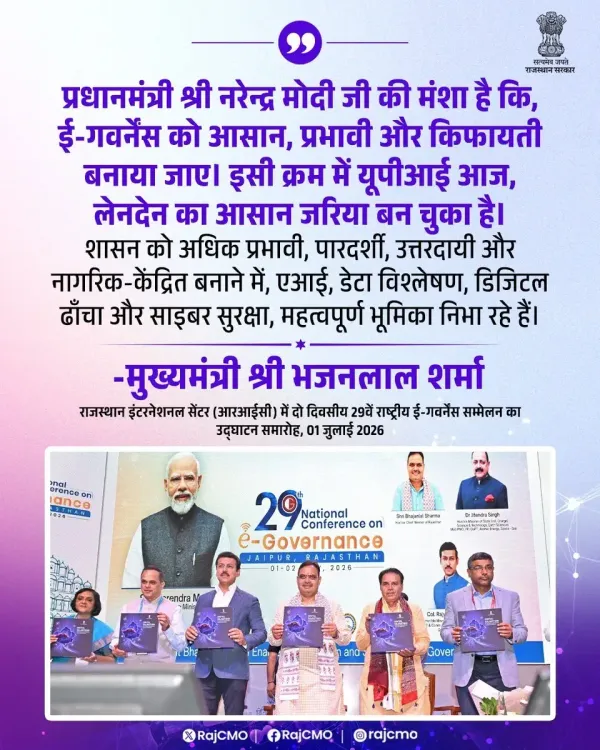
Rajasthan's Chief Minister's Office on 2 July 2026 endorsed PM Modi's vision to make e-governance easy, effective, and affordable, aligning with the 11th anniversary of Digital India and the National Conference on e-Governance 2026.
Key Takeaways
The Chief Minister's Office of Rajasthan posted on 2 July 2026 in support of PM Modi's e-governance vision.
The post was tagged to CM Bhajanlal Sharma and shared under #11YearsOfDigitalIndia and #NCeG2026 .
PM Modi's stated intent, as cited in the post, is to make e-governance 'easy, effective, and affordable' .
Digital India , launched in July 2015 , is now completing 11 years as a flagship national digital governance programme. #NCeG2026 refers to the annual National Conference on e-Governance , jointly organised by MeitY and DARPG.
Rajasthan's alignment signals the state's active participation in the Centre's digital public administration framework.
The Chief Minister's Office of Rajasthan on Thursday, 2 July 2026 invoked Prime Minister Narendra Modi's stated intent to make e-governance simpler, more effective, and affordable, aligning the state government's position with the Centre's ongoing push for digital public administration. The post, shared under the hashtags #11YearsOfDigitalIndia and #NCeG2026, tagged Chief Minister Bhajanlal Sharma, signalling Rajasthan's active participation in the national e-governance discourse.
Context
The CMO's post, written in Hindi, states: 'Pradhanmantri Shri Narendra Modi ji ki mansha hai ki, e-governance ko aasaan, prabhavi aur kifayati banaya jaye' — ('It is Prime Minister Shri Narendra Modi's intent that e-governance be made easy, effective, and affordable'). The message was shared in the context of 11 Years of Digital India, the landmark programme launched by the Central government in July 2015 to transform India into a digitally empowered society and knowledge economy.
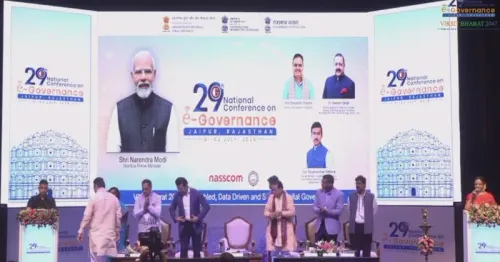
The hashtag #NCeG2026 refers to the National Conference on e-Governance 2026, an annual flagship event jointly organised by the Ministry of Electronics and Information Technology (MeitY) and the Department of Administrative Reforms and Public Grievances (DARPG), which brings together state governments, central ministries, and technology stakeholders to review progress and chart the roadmap for digital governance in India.
Policy Backdrop
The Digital India programme, now in its eleventh year, has been one of the Central government's most visible administrative reform initiatives. It encompasses pillars ranging from broadband infrastructure and mobile connectivity to digital literacy and the delivery of government services online. Key components include the Common Services Centres (CSC) network, the Unified Mobile Application for New-age Governance (UMANG) platform, and the DigiLocker service, all aimed at reducing citizens' dependence on physical government offices.
Rajasthan, as one of India's largest states by area, has historically faced challenges in last-mile service delivery due to its vast geography and dispersed rural population. State-level e-governance initiatives, including the Jan Aadhaar scheme for unified beneficiary identification and the Rajasthan Sampark grievance portal, have sought to bridge this gap. Chief Minister Bhajanlal Sharma, who leads the BJP government in the state, has positioned digital delivery of services as a priority since taking office in December 2023.
Stakeholders and Impact
The push for affordable and accessible e-governance directly affects crores of citizens in Rajasthan, particularly those in rural and semi-urban areas who interact with government for services such as land records, pensions, ration cards, and certificates. Simplifying digital interfaces and reducing the cost of access — including data costs and device requirements — is seen as critical to ensuring that the benefits of e-governance reach the last mile.
For state administrators and district-level officials, alignment with the Centre's digital governance framework also means access to shared infrastructure, technical support, and funding under centrally sponsored schemes. The National Conference on e-Governance provides a platform for states like Rajasthan to showcase innovations and adopt best practices from across the country.
What's Next
With #NCeG2026 as the immediate backdrop, Rajasthan's public endorsement of PM Modi's e-governance vision is likely to be followed by state-level announcements or presentations at the national conference. The coming months could see Rajasthan rolling out or scaling up digital service delivery initiatives in line with the Centre's framework. As Digital India enters its second decade, the emphasis is expected to shift from infrastructure creation to measurable improvements in citizen experience — making the 'easy, effective, and affordable' benchmark set by the Prime Minister a concrete policy target for states.
Point of View
The programme's eleventh anniversary. By invoking the Prime Minister's 'intent' verbatim, the state government signals ideological continuity with the Centre, a pattern common among BJP-ruled states seeking to reinforce their federal partnership ahead of national-level events like NCeG2026. The framing around 'easy, effective, and affordable' e-governance also subtly addresses a long-standing criticism that digital services, while expanding, remain inaccessible to large sections of rural India. Rajasthan's vast geography makes it a high-stakes test case for whether Digital India's second decade can deliver on that promise.
NationPress
2 Jul 2026
Frequently Asked Questions
What did Rajasthan's CMO post about Digital India on 2 July 2026?
The Rajasthan Chief Minister's Office posted that PM Modi's intent is to make e-governance easy, effective, and affordable, tagging CM Bhajanlal Sharma and using the hashtags #11YearsOfDigitalIndia and #NCeG2026.
When was Digital India launched and how many years has it completed?
Digital India was launched in July 2015 by the Central government and completed 11 years in July 2026, making it one of India's longest-running digital reform programmes.
Who is Bhajanlal Sharma and what is his role in Rajasthan?
Bhajanlal Sharma is the Chief Minister of Rajasthan, leading the BJP government in the state since December 2023. He was tagged in the CMO's post on e-governance.
What is the Digital India programme?
Digital India is a Central government initiative launched in 2015 to transform India into a digitally empowered society, covering broadband infrastructure, digital literacy, and online delivery of government services through platforms like UMANG, DigiLocker, and Common Services Centres.