CM Bhajanlal Calls for Water Conservation Mass Movement in Rajasthan
Synopsis
The Chief Minister's Office of Rajasthan on 25 July 2026 called on CM Bhajanlal Sharma to turn water harvesting into a people's movement, citing the absence of any alternative to water and the need to protect future generations in the chronically water-scarce state.
Key Takeaways
The Rajasthan CMO posted on 25 July 2026 urging that water conservation be made a jan andolan (people's movement).
The appeal was directed at Chief Minister Bhajanlal Sharma under the hashtag #आपणो_अग्रणी_राजस्थान .
Rajasthan is one of India's most water-stressed states, covering large arid and semi-arid zones including the Thar Desert .
The state previously launched the Mukhya Mantri Jal Swavlamban Abhiyan in 2016 to promote community-driven rainwater harvesting.
The post frames water conservation as a puneet kary ('noble task') aimed at securing the future of coming generations.
The timing coincides with the active monsoon season in July , the key window for replenishing harvesting structures.
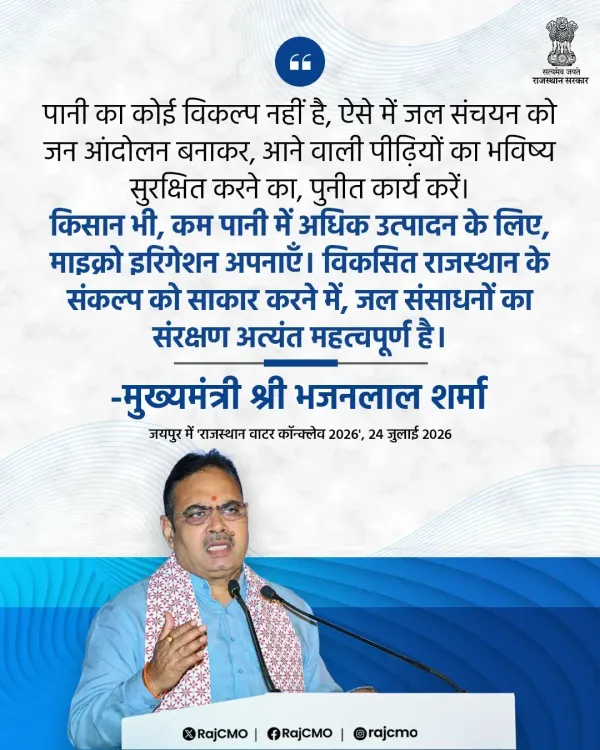
The Chief Minister's Office of Rajasthan on Saturday, 25 July 2026, called upon citizens to transform water harvesting into a mass public movement, framing it as a sacred duty to secure the future of coming generations. The appeal, directed at Chief Minister Bhajanlal Sharma, was shared under the campaign hashtag #आपणो_अग्रणी_राजस्थान ('Our Leading Rajasthan').
The post stated: 'There is no alternative to water — in such a situation, make water conservation a people's movement and perform the noble task of securing the future of generations to come.' The message was addressed directly to @BhajanlalBjp, the official handle of Chief Minister Bhajanlal Sharma.
Context
Rajasthan is one of India's most water-stressed states, covering large arid and semi-arid zones including the Thar Desert. The state faces chronic groundwater depletion and erratic monsoon patterns, making community-level water harvesting a perennial governance priority. The timing of the post — during the active monsoon season in July — aligns with the annual window when rainwater harvesting structures can be most effectively utilised and replenished.
Policy Backdrop
Rajasthan has a documented history of state-led water conservation initiatives. The Mukhya Mantri Jal Swavlamban Abhiyan, launched in 2016, sought to promote rainwater harvesting and community-driven conservation across villages and towns in the state. That scheme emphasised public participation as central to its design — a philosophy echoed in Saturday's post.
At the national level, the Jal Shakti Abhiyan has similarly promoted water conservation through district-level campaigns, with Rajasthan among the states prioritised given its acute scarcity conditions. Successive state governments have framed conservation not merely as a technical intervention but as a civic and moral obligation — language that Saturday's message reinforces.
Stakeholders and Impact
The communities most directly affected by water scarcity in Rajasthan are rural households and farmers, who depend on seasonal rainfall and traditional water structures such as baoris (stepwells), johads (community ponds), and kunds (underground cisterns). These structures, when maintained through community effort, can significantly reduce dependence on groundwater and tanker supply during lean months.
Urban residents in cities such as Jaipur, Jodhpur, and Bikaner also face water stress, and any broadened campaign would need to address both rural harvesting infrastructure and urban demand management. The framing of conservation as a puneet kary ('noble task') is intended to build moral ownership across social groups rather than positioning it purely as a government programme.
What's Next
The post's language — calling for water conservation to become a jan andolan ('people's movement') — signals a possible push toward expanded community mobilisation, potentially through integration with existing central or state schemes in the current budget cycle. Observers will watch whether the Bhajanlal Sharma government announces a new campaign, revives or scales up the Mukhya Mantri Jal Swavlamban Abhiyan, or aligns state efforts more closely with national water missions ahead of the post-monsoon review period.
With Rajasthan's groundwater table under sustained stress and climate variability intensifying, the government's ability to convert this public appeal into measurable on-ground action — through funding, administrative machinery, and community engagement — will determine its long-term impact on the state's water security.
Point of View
Insulating the government if targets are missed while amplifying credit if the campaign gains traction. By invoking intergenerational duty rather than technical metrics, the messaging echoes the BJP's broader governance vocabulary of civic nationalism applied to environmental challenges. The direct address to CM Bhajanlal Sharma on a public platform also serves an internal signalling function, publicly aligning the Chief Minister's image with a cause that resonates deeply in a desert state where water anxiety cuts across caste and class. Whether this translates into a funded, structured campaign or remains aspirational rhetoric will be the real test.
NationPress
25 Jul 2026
Frequently Asked Questions
What did the Rajasthan CMO say about water conservation on 25 July 2026?
The Rajasthan Chief Minister's Office posted that there is no alternative to water and called on Chief Minister Bhajanlal Sharma to make water harvesting a mass people's movement to secure the future of coming generations.
What is the Mukhya Mantri Jal Swavlamban Abhiyan?
It is a Rajasthan state scheme launched in 2016 to promote rainwater harvesting and community-led water conservation across villages and towns, making citizens active participants rather than passive beneficiaries.
Why is water conservation so critical for Rajasthan?
Rajasthan covers large arid and semi-arid zones including the Thar Desert and faces chronic groundwater depletion and erratic monsoon patterns, making it one of India's most water-stressed states.
What does 'jan andolan' mean in the context of water conservation?
'Jan andolan' means a people's movement — the CMO's post used this phrase to call for broad public participation in water harvesting rather than treating it as a government programme alone.
What is the hashtag #आपणो_अग्रणी_राजस्थान about?
The hashtag translates to 'Our Leading Rajasthan' and is used by the Rajasthan government to promote state development and governance initiatives on social media.