CM Bhajanlal Directs Police, Prosecution to Boost SC/ST Conviction Rate
Synopsis
Rajasthan Chief Minister Bhajanlal Sharma has directed the state police and prosecution department to work in close coordination to improve conviction rates in crimes against Scheduled Castes and Scheduled Tribes, signalling a renewed push on POA Act enforcement.
Key Takeaways
The Chief Minister's Office of Rajasthan issued a directive on 22 July 2026 to improve SC/ST atrocity conviction rates.
CM Bhajanlal Sharma instructed Rajasthan Police and the Rajasthan Prosecution Department to coordinate closely on these cases.
The directive is anchored in the Scheduled Castes and Scheduled Tribes (Prevention of Atrocities) Act, 1989 , amended in 2015 and 2018 .
Low conviction rates under the POA Act have been a persistent national challenge, with coordination gaps between police and prosecutors identified as a key cause.
Rajasthan has maintained monitoring committees for POA Act cases since at least 2016 ; this directive represents a fresh administrative push under the current government.
Similar coordination orders have been issued by states such as Madhya Pradesh and Gujarat in recent years.
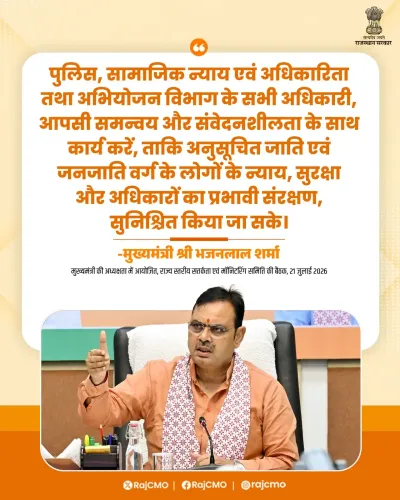
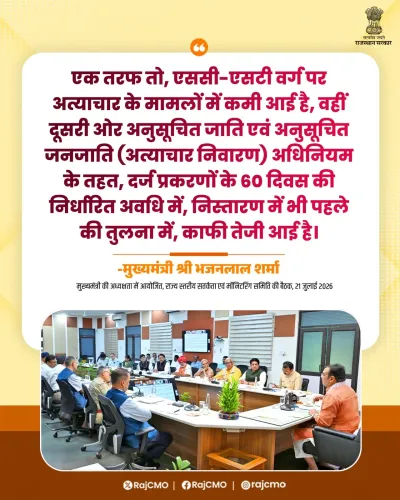
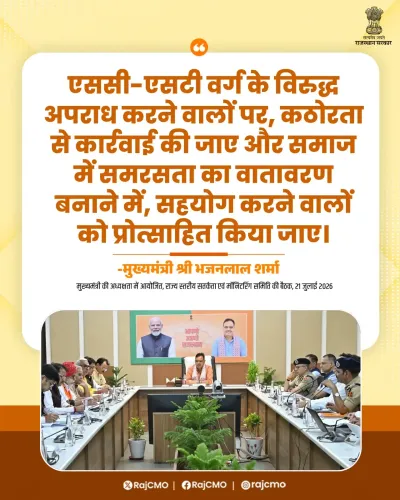
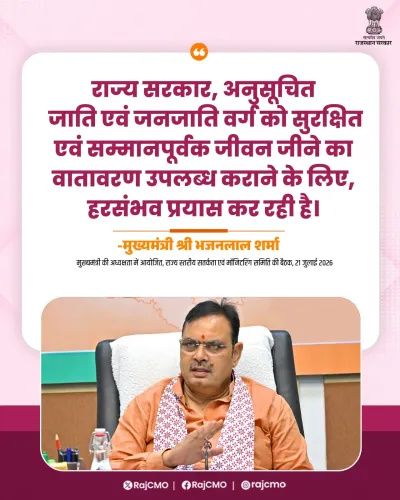
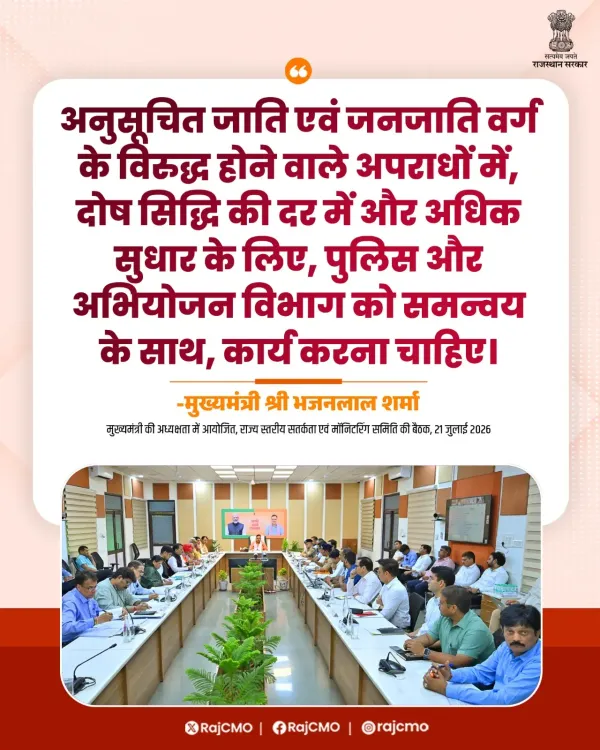
The Chief Minister's Office of Rajasthan, on behalf of Chief Minister Bhajanlal Sharma, issued a directive on Wednesday, 22 July 2026, instructing the state police and prosecution department to work in close coordination to improve conviction rates in crimes committed against members of Scheduled Castes and Scheduled Tribes.
The official post stated: 'अनुसूचित जाति एवं जनजाति वर्ग के विरुद्ध होने वाले अपराधों में, दोष सिद्धि की दर में और अधिक सुधार के लिए, पुलिस और अभियोजन विभाग को समन्वय के साथ, कार्य करने के निर्देश दिए।' — translated: 'Instructions have been given to the police and prosecution department to work in coordination, in order to further improve the conviction rate in crimes committed against Scheduled Castes and Scheduled Tribes.'
Context
Crimes against SC/ST communities in India are governed primarily by the Scheduled Castes and the Scheduled Tribes (Prevention of Atrocities) Act, 1989, commonly known as the POA Act. The legislation was enacted by Parliament to provide special protections and procedural safeguards to victims of atrocities from marginalised communities. It was substantially amended in 2015 and again in 2018 to strengthen prosecution mechanisms and expand victim rights. Despite the law's strong provisions, conviction rates under the POA Act have remained persistently low across Indian states, a trend consistently reflected in annual data compiled by national crime-tracking authorities. Low conviction rates are often attributed to gaps in evidence collection, poor coordination between investigating officers and public prosecutors, and delays in trial proceedings.Policy Backdrop
Rajasthan has maintained state-level monitoring committees to review POA Act cases since at least 2016. The fresh directive from CM Bhajanlal Sharma — who has led the state since December 2023 — signals a renewed administrative push to address the structural disconnect between police investigation and courtroom prosecution. The move fits a broader pattern seen across several states, where governments have issued inter-departmental coordination orders aimed at tightening the chain from FIR registration to final conviction. Madhya Pradesh and Gujarat have issued similar instructions in recent years, framing such coordination as an administrative efficiency measure in delivering justice to marginalised groups. The hashtag #आपणो_अग्रणी_राजस्थान ('Our Leading Rajasthan') used in the post is part of the state government's broader governance branding, positioning Rajasthan as a proactive state on social justice and law enforcement.Stakeholders and Impact
The directive directly concerns Rajasthan Police, the state force responsible for investigating atrocity cases, and the Rajasthan Prosecution Department, which handles legal proceedings and argues for convictions in court. Effective coordination between the two is considered critical because weaknesses in case-building at the investigation stage often translate into acquittals during trial. For SC/ST communities across Rajasthan, higher conviction rates would represent a meaningful improvement in access to justice. Victim-support groups and legal advocates have long argued that the POA Act's deterrent value is diminished when cases end in acquittal due to procedural lapses rather than lack of evidence.What's Next
The practical impact of this directive will become clearer when Rajasthan releases its next annual crime statistics report, which will indicate whether coordination efforts have translated into measurable improvements in conviction percentages under the POA Act. State-level review meeting minutes and any follow-up orders from the Chief Minister's Office will also be closely watched by civil society organisations working on Dalit and Adivasi rights. If implemented effectively, the coordination framework could serve as a model for other states grappling with the same challenge — and reinforce the state government's stated commitment to ensuring justice for the most vulnerable communities.Point of View
Particularly for communities that have historically faced barriers in accessing the courts. The real test will be whether this translates into structural reforms — such as dedicated special public prosecutors and regular case-review meetings — or remains a one-time instruction. Nationally, the move could add pressure on other state governments to similarly audit their POA Act conviction pipelines.
NationPress
22 Jul 2026
Frequently Asked Questions
What did CM Bhajanlal Sharma direct regarding SC/ST crimes in Rajasthan?
CM Bhajanlal Sharma directed the Rajasthan Police and the state Prosecution Department to work in coordination to improve conviction rates in crimes committed against Scheduled Castes and Scheduled Tribes, as announced by the Chief Minister's Office on 22 July 2026.
What is the SC/ST Prevention of Atrocities Act?
The Scheduled Castes and the Scheduled Tribes (Prevention of Atrocities) Act, 1989, is a central law that provides special protections and legal safeguards to SC/ST victims of atrocities. It was significantly strengthened through amendments in 2015 and 2018.
Why are conviction rates under the SC/ST Act low in India?
Conviction rates under the POA Act are persistently low across India largely due to gaps in evidence collection, poor coordination between police investigators and public prosecutors, and delays in the trial process.
How does Rajasthan monitor SC/ST atrocity cases?
Rajasthan has maintained state-level monitoring committees to review cases under the Prevention of Atrocities Act since at least 2016, and the latest directive from CM Bhajanlal Sharma reinforces this oversight mechanism.
Which other states have issued similar SC/ST conviction coordination orders?
States including Madhya Pradesh and Gujarat have issued similar inter-departmental coordination directives in recent years aimed at improving conviction rates in SC/ST atrocity cases.