CM Bhajanlal Links Revenue Collection to Rajasthan's Progress
Synopsis
The Chief Minister's Office of Rajasthan, citing CM Bhajan Lal Sharma, declared on 10 July 2026 that revenue collection is the foundation of the state's progress and public welfare, reinforcing the BJP government's fiscal governance narrative under the 'Our Leading Rajasthan' campaign.
Key Takeaways
The Chief Minister's Office of Rajasthan posted on 10 July 2026 that revenue collection is the foundation of state progress and public welfare.
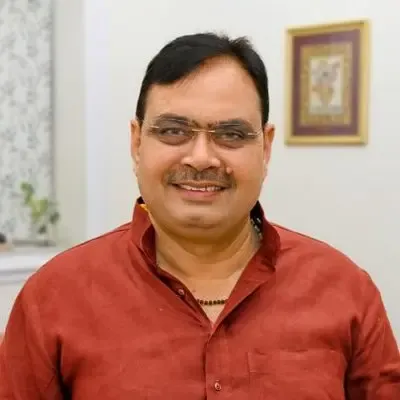
The message was attributed to Chief Minister Bhajan Lal Sharma , who has led the state since December 2023 .
The post was tagged under the campaign hashtag #आपणो_अग्रणी_राजस्थान ('Our Leading Rajasthan'), the BJP government's governance branding initiative.
The statement aligns with a national trend of state governments emphasising own-source revenue mobilisation in the post-GST fiscal federalism framework.
Quarterly revenue figures and the next state budget session will be key indicators of whether this stated priority translates into measurable fiscal outcomes.
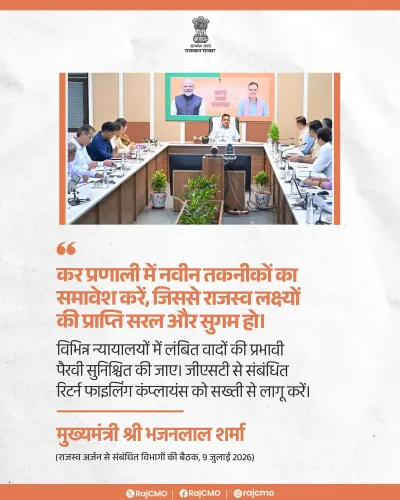
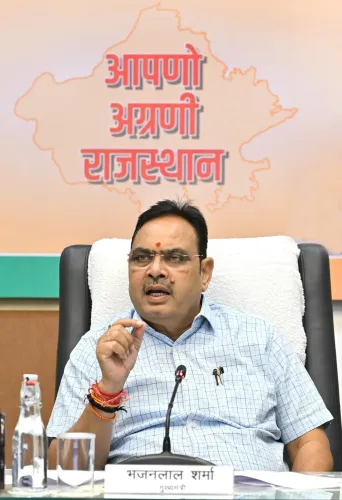
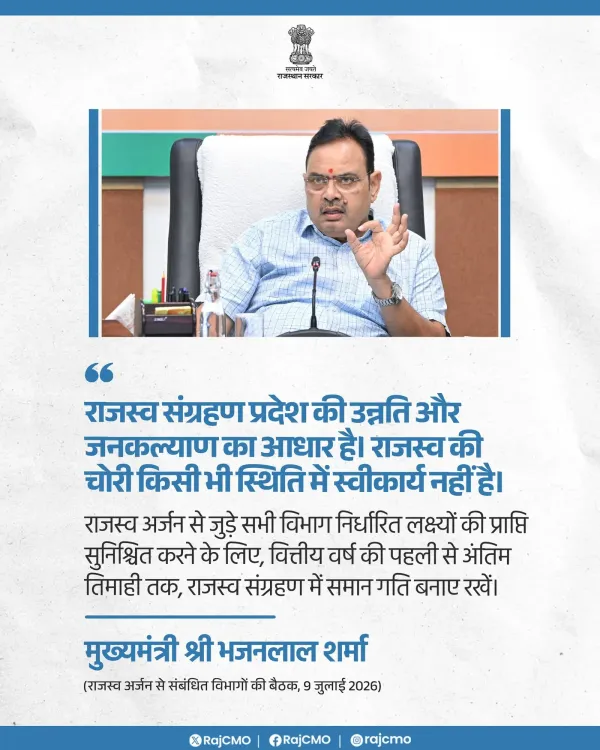
The Chief Minister's Office of Rajasthan, the official handle of the state government, on Friday, 10 July 2026, underscored the centrality of revenue collection to the state's development and public welfare, attributing the message to Chief Minister Bhajan Lal Sharma. The post, shared under the campaign hashtag #आपणो_अग्रणी_राजस्थान ('Our Leading Rajasthan'), positions fiscal mobilisation as the bedrock of state progress.
Context
The post, in Hindi, states: 'राजस्व संग्रहण प्रदेश की उन्नति और जनकल्याण का आधार है' — 'Revenue collection is the foundation of the state's progress and public welfare.' The message was tagged to Chief Minister Bhajan Lal Sharma's personal account, signalling that the sentiment carries the weight of the top executive's office. The hashtag 'Our Leading Rajasthan' has been used by the BJP government to brand its governance agenda since assuming power.
Policy Backdrop
Bhajan Lal Sharma took charge as Chief Minister of Rajasthan in December 2023 following the BJP's victory in the state assembly elections, with public commitments to strengthen state finances and improve development delivery. Across Indian states, the post-GST fiscal federalism framework has intensified pressure on state governments to maximise own-source revenue — from stamp duties, excise, mining royalties, and state taxes — to fund welfare programmes and capital expenditure without over-relying on central transfers. Rajasthan, a large state with significant infrastructure and social welfare obligations, is no exception to this fiscal dynamic.
The statement fits a broader pattern in which state administrations explicitly link efficient tax administration and revenue mobilisation to their ability to deliver on welfare commitments — an argument that serves both as a governance signal and a communication strategy directed at taxpayer compliance.
Stakeholders and Impact
Rajasthan's residents and taxpayers are the primary stakeholders in this message. For citizens, the framing connects the act of tax compliance to tangible public goods — roads, hospitals, schools, and social protection schemes. For the state administration, robust own-source revenue reduces fiscal stress and enables greater discretion in expenditure planning. The government's emphasis on revenue collection also signals to the finance department and district administrations that collection targets remain a priority under the current leadership.
The message is also directed at the broader political audience: by associating revenue health with public welfare, the BJP administration in Jaipur reinforces its narrative of responsible and development-oriented governance ahead of any forthcoming budget or fiscal review exercise.
What's Next
Observers will watch for the Rajasthan Finance Department's quarterly or annual revenue collection disclosures, which would give measurable weight to the Chief Minister's Office's assertion. The next state budget session will be a key moment to assess whether improved revenue mobilisation has translated into expanded welfare allocations or accelerated infrastructure spending. Any new tax administration reforms or compliance drives announced by the state government would also be seen in the light of this stated priority.
Point of View
Nudges taxpayer compliance, and builds a political narrative of fiscal responsibility. For a government now in its third year, linking administrative efficiency to citizen welfare outcomes is a standard mid-term signalling strategy. The 'Our Leading Rajasthan' hashtag suggests this is part of a coordinated brand-building effort ahead of potential fiscal milestones. How the state's actual revenue numbers perform will determine whether this messaging holds or becomes a liability.
NationPress
10 Jul 2026
Frequently Asked Questions
What did the Rajasthan Chief Minister's Office say about revenue collection?
The Chief Minister's Office of Rajasthan stated on 10 July 2026 that revenue collection is the foundation of the state's progress and public welfare, attributing the message to Chief Minister Bhajan Lal Sharma.
Who is Bhajan Lal Sharma and what is his role in Rajasthan?
Bhajan Lal Sharma is a BJP politician who has served as Chief Minister of Rajasthan since December 2023, following the party's victory in the state assembly elections.
What is the 'Aapno Agrani Rajasthan' hashtag about?
'Aapno Agrani Rajasthan' translates to 'Our Leading Rajasthan' and is a campaign hashtag used by the Rajasthan BJP government to brand its governance and development agenda.
Why do Indian state governments emphasise revenue collection?
Post-GST fiscal federalism has made own-source revenue — from state taxes, excise, and duties — critical for states to fund welfare schemes and infrastructure without over-depending on central transfers.
What should we watch for next regarding Rajasthan's revenue policy?
Key developments to watch include the Rajasthan Finance Department's quarterly or annual revenue figures and any new tax administration measures or welfare allocations announced in the next state budget session.