CM Bhupendra Patel Pays Tribute to C.V. Raman on Death Anniversary
Synopsis
Gujarat CM Bhupendra Patel honoured Dr. C.V. Raman on his death anniversary, calling the Nobel laureate's discovery of the Raman Effect a source of enduring inspiration for India's younger generation of scientists and researchers.
Key Takeaways
Gujarat Chief Minister Bhupendra Patel posted a tribute to Dr.
Raman on 21 November 2026 , Raman's death anniversary.
Raman won the Nobel Prize in Physics in 1930 for discovering the Raman Effect , the inelastic scattering of light by matter.
He was awarded the Bharat Ratna in 1954 , India's highest civilian honour.
The date of the Raman Effect's discovery, 28 February 1928 , is celebrated annually as National Science Day in India.
CM Patel described Raman's contribution as an 'invaluable' and 'eternal source of inspiration' for the younger generation in science and research.
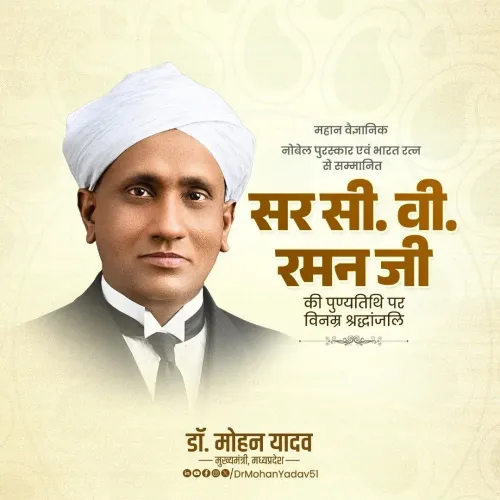
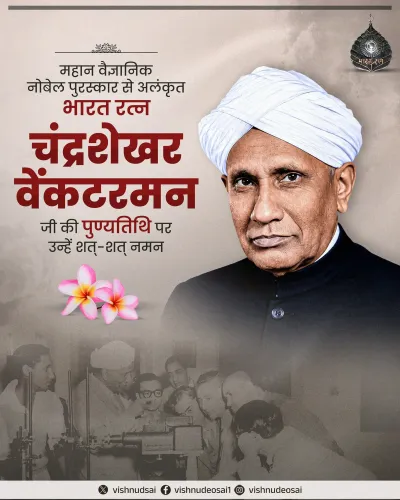
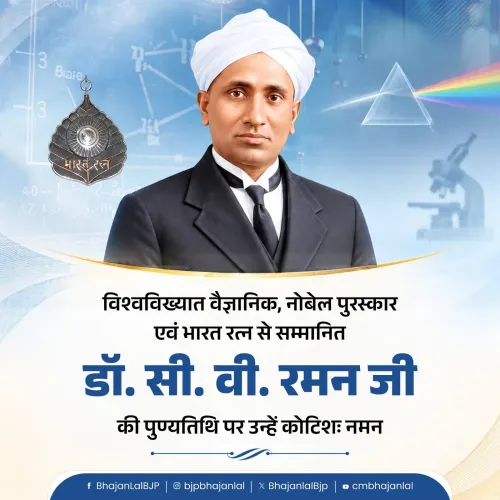
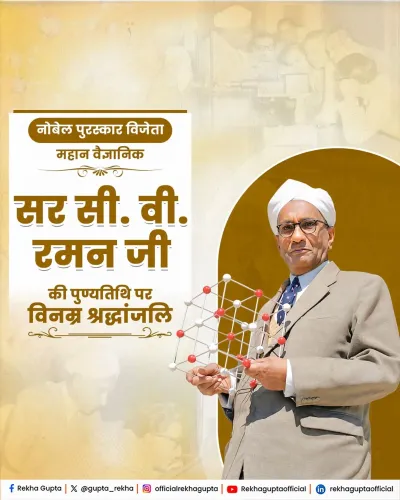
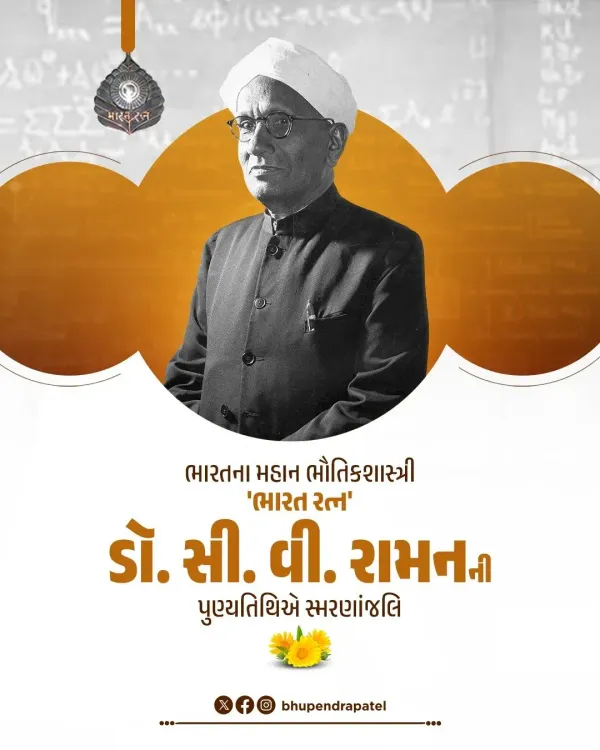
On the death anniversary of Nobel laureate and 'Bharat Ratna' recipient Dr. C.V. Raman, Gujarat Chief Minister Bhupendra Patel offered a heartfelt tribute on Saturday, 21 November 2026, honouring the physicist whose discovery changed the course of global science.
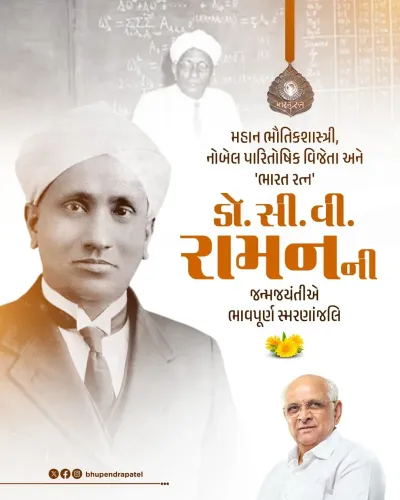
Posting in Gujarati, CM Patel wrote: 'નોબેલ પુરસ્કારથી સન્માનિત ભારતના મહાન ભૌતિકશાસ્ત્રી, ભારત રત્ન ડૉ. સી. વી. રામનજીની પુણ્યતિથિ પર ભાવપૂર્ણ સ્મરણાંજલિ.' — 'A heartfelt tribute on the death anniversary of India's great physicist, Nobel laureate and Bharat Ratna Dr. C.V. Raman.' He added that through the historic discovery of the 'Raman Effect', Raman brought glory to Indian science on the world stage, and that his invaluable contribution to science and research will forever remain a source of inspiration for the younger generation.
The discovery that put India on the global science map
Dr. Chandrasekhara Venkata Raman discovered the Raman Effect — the inelastic scattering of photons by matter — on 28 February 1928, a date India now observes as National Science Day. The finding earned him the Nobel Prize in Physics in 1930, making him the first Asian and first non-white scientist to receive a Nobel in science. India conferred upon him the Bharat Ratna in 1954, the country's highest civilian honour.
The Raman Effect has since become foundational to spectroscopy, with applications ranging from pharmaceutical analysis to materials science and astrophysics. It remains one of the most cited discoveries in modern physics — proof that a single observation, made with discipline and curiosity, can ripple across a century of science.
A pattern of political tribute, and what it signals
Indian political leaders across party lines mark Raman's death anniversary with public statements, part of a broader effort to anchor India's contemporary ambitions in its rich scientific heritage. For Gujarat — a state that has consistently positioned education and innovation as pillars of its development narrative — the tribute carries particular resonance. CM Patel's message, addressed implicitly to students and researchers, frames Raman not as a museum exhibit but as a living challenge: can the next generation match what one man did with a spectrometer in Kolkata nearly a century ago?
That question, more than any ceremony, is the real inheritance Dr. Raman left behind.
Point of View
A state that markets itself as a hub of industry and innovation, invoking Raman connects contemporary ambitions to a proven lineage of excellence. CM Patel's framing — Raman as an 'eternal source of inspiration for the younger generation' — is a soft but deliberate signal that scientific achievement remains central to the state's identity. In a broader context, such tributes reflect a consistent political consensus across parties that India's Nobel legacy in science must be honoured publicly, even as the country works to produce its next generation of globally recognised researchers.
NationPress
21 Nov 2026
Frequently Asked Questions
When did Dr. C.V. Raman die and when is his death anniversary?
Dr. C.V. Raman passed away on 21 November 1970 , and his death anniversary is observed on 21 November each year.
What is the Raman Effect?
The Raman Effect is the phenomenon of inelastic scattering of photons by matter, discovered by Dr. C.V. Raman on 28 February 1928 . When light passes through a substance, a small fraction of it is scattered at a different wavelength, revealing information about the material's molecular structure.
Why did Dr. C.V. Raman win the Nobel Prize?
Dr. C.V. Raman was awarded the Nobel Prize in Physics in 1930 for his discovery of the Raman Effect, making him the first Asian and first non-white scientist to win a Nobel Prize in science.
What is National Science Day and why is it celebrated on 28 February?
National Science Day is observed in India on 28 February every year to mark the anniversary of Dr. C.V. Raman's discovery of the Raman Effect in 1928, honouring India's contributions to global science.
What is Bharat Ratna and did C.V. Raman receive it?
The Bharat Ratna is India's highest civilian honour. Dr. C.V. Raman received the Bharat Ratna in 1954 , recognising his extraordinary contribution to science and to India's global standing.