CM Bhupendra Patel Steers Gujarat Toward Energy Self-Reliance

Synopsis
Gujarat's Chief Minister's Office spotlighted CM Bhupendra Patel's energy self-reliance agenda on 18 November 2026, reinforcing the state's decades-long lead in solar and wind policy as India races toward its 500 GW clean-energy target.
Key Takeaways
The Chief Minister's Office of Gujarat posted an update on 18 November 2026 under the #અગ્રેસર_ગુજરાત ('Gujarat Always Ahead') campaign.
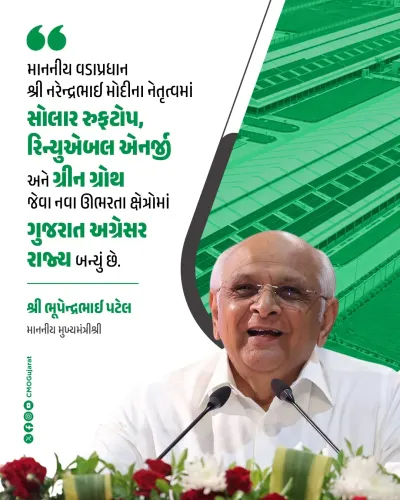
CM Bhupendra Patel , in office since 2021 , has made Urja Atmanirbharta (energy self-reliance) a flagship theme of his administration.
Gujarat's policy lineage dates to the 2009 Solar Power Policy , one of India's earliest dedicated solar frameworks.
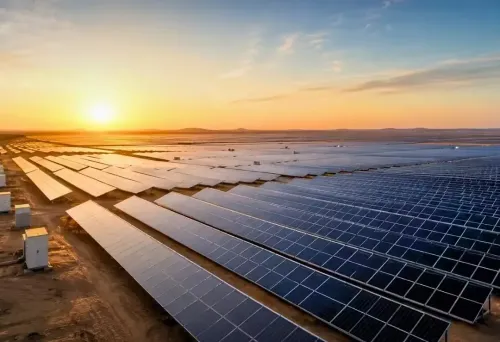
The state hosts major renewable assets including the Charanka Solar Park in Kutch, underpinning its grid leadership.
India's national target of 500 GW non-fossil capacity by 2030 places Gujarat's renewable pipeline under close national scrutiny.
Upcoming state budget allocations and fresh tender announcements are the key milestones to watch for Gujarat's next capacity addition.
Gujarat has consistently punched above its weight on energy infrastructure — and Chief Minister Bhupendra Patel's office is making sure the country knows it. On Wednesday, 18 November 2026, the Chief Minister's Office of Gujarat posted a Gujarati-language update under its signature #અગ્રેસર_ગુજરાત ('Gujarat Always Ahead') campaign, spotlighting the state's drive to turn energy self-reliance from a slogan into a deliverable.
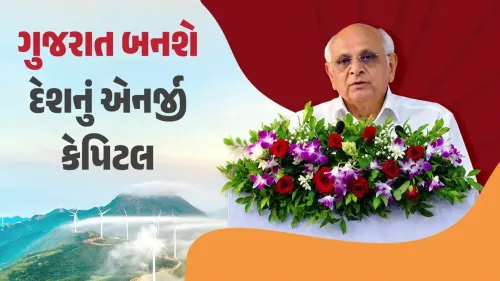
The post, translated from Gujarati, reads: 'Gujarat, always ahead! Come, let us know the news of Gujarat — committed to realising the resolve of energy self-reliance under the leadership of Chief Minister Shri Bhupendrabhai Patel.' The message is a window into the state government's sustained public-communication push around Urja Atmanirbharta — energy independence — as a defining pillar of the Patel administration.
A Policy Tradition That Predates the National Conversation
Gujarat's energy ambitions are not a new talking point. The state's 2009 Solar Power Policy was among India's first dedicated frameworks for large-scale solar parks and private investment, laying the groundwork for landmarks like the Charanka Solar Park in the Little Rann of Kutch. Long before the national Atmanirbhar Bharat messaging took hold, successive Gujarat governments were using policy incentives and land allocation to court renewable developers — both domestic and foreign.
That institutional head-start matters. India has committed to reaching 500 GW of non-fossil fuel capacity by 2030, and Gujarat's grid — anchored by solar, wind, and hybrid projects — is expected to shoulder a significant share of that target. Renewable energy developers and large industrial consumers in the state have both benefited from this policy continuity, giving Gujarat a competitive edge in attracting clean-energy investment.
Bhupendra Patel's Energy Focus Since 2021
Bhupendra Patel, who has led the state since 2021, has kept energy infrastructure central to his administration's development narrative. The #અગ્રેસર_ગુજરાત campaign serves as a regular content vehicle to aggregate and amplify these developments for a Gujarati-speaking audience — a digital-first governance communication strategy that also signals policy priorities to investors and partner agencies.
The watch item now is whether the next state budget cycle or fresh tender announcements will add measurable gigawatts to Gujarat's renewable pipeline — translating the political commitment captured in Wednesday's post into contracted capacity on the grid.
Point of View
And CM Patel is continuing that playbook. The alignment with India's 500 GW non-fossil target gives the state leverage in central allocation discussions and green-finance circles. The #અગ્રેસર_ગુજરાત campaign, however, is notably vague on specifics — the real test of the administration's commitment will come in the next budget cycle, when targets and tendered capacity either materialise or stall.
NationPress
18 Nov 2026
Frequently Asked Questions
What is Gujarat's energy self-reliance plan under CM Bhupendra Patel?
CM Bhupendra Patel's administration is pursuing 'Urja Atmanirbharta' — energy self-reliance — by expanding Gujarat's solar, wind, and hybrid renewable capacity, building on a policy tradition that began with the state's landmark 2009 Solar Power Policy.
What is the #AgresserGujarat or #અગ્રેસર_ગુજરાત campaign?
It is a digital communication campaign run by the Chief Minister's Office of Gujarat to highlight the state's development milestones and policy achievements, with 'Gujarat Always Ahead' as its tagline.
What is the Charanka Solar Park in Gujarat?
Charanka Solar Park, located in the Little Rann of Kutch in Gujarat, is one of India's earliest and largest solar parks, developed under Gujarat's 2009 Solar Power Policy framework.
How does Gujarat contribute to India's 500 GW renewable energy target?
Gujarat is a leading contributor through its large-scale solar and wind installations. The state's early policy infrastructure and industrial ecosystem make it central to India achieving its 500 GW non-fossil fuel capacity goal by 2030.
Who is Bhupendra Patel and when did he become Gujarat's Chief Minister?
Bhupendra Patel is the Chief Minister of Gujarat, a post he has held since 2021. His administration has prioritised energy infrastructure and renewable self-reliance as key development pillars.