CM Conrad Sangma flags El Niño threat, backs natural farming

Synopsis
Meghalaya Chief Minister Conrad Sangma addressed an El Niño preparedness workshop on 3 July 2026, stressing that climate change is a present reality. He backed natural farming, water conservation, and spring rejuvenation as core pillars of the state's resilience strategy, while signalling active coordination with central environment and agriculture ministries.
Key Takeaways
CM Conrad Sangma addressed a workshop on El Niño preparedness focused on food and water security on 3 July 2026 .
He described climate change as 'our present reality' and called for immediate preparedness rather than waiting on updated forecasts.
Key solutions highlighted include natural farming , water conservation , spring rejuvenation , and community-led action.
Meghalaya's natural farming programme has received national recognition, according to the Chief Minister.
The post tagged PMO India , the Union Environment Minister , and MoEFCC , indicating active central-state coordination.
The state's response framework aims for cross-departmental convergence among agriculture, rural development, and environment bodies.
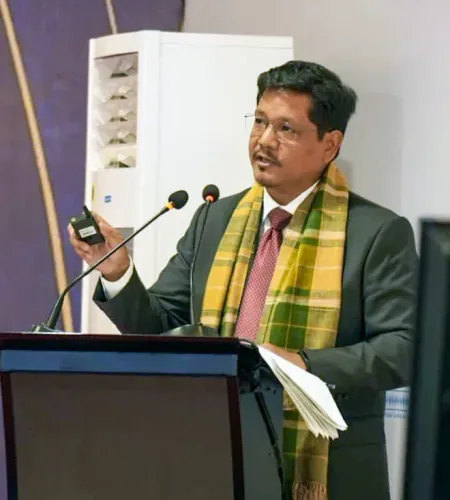
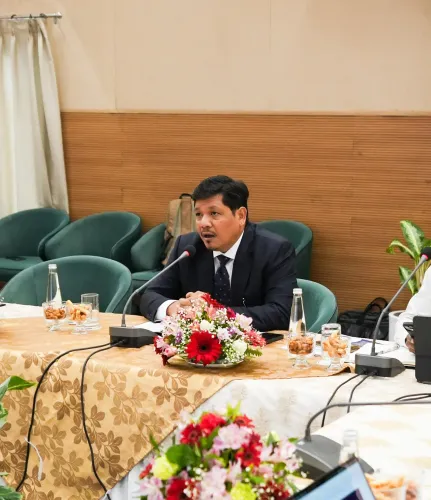
Meghalaya Chief Minister Conrad Sangma on Friday, 3 July 2026, addressed a workshop titled 'Developing State Response for El Niño Preparedness: Strengthening Food and Water Security', calling climate change an immediate reality and urging accelerated action on natural farming, water conservation, and community-led resilience-building.
Context
Speaking at the workshop, CM Sangma said, 'Climate change is no longer a future challenge, it is our present reality. While forecasts may change, preparedness cannot wait.' He outlined a multi-pronged response centred on natural farming, water conservation, spring rejuvenation, and cross-departmental coordination. The session brought together departments, communities, and institutions to align on a state-level El Niño response framework.
El Niño is a recurrent climate phenomenon that disrupts monsoon patterns across India, increasing risks of drought or erratic rainfall — conditions that disproportionately affect agrarian and hill-state economies like Meghalaya. The Chief Minister also tagged @PMOIndia, @byadavbjp (Union Minister for Environment), and @moefcc, signalling active central-state coordination on the issue.
Policy Backdrop
India has maintained a structured climate adaptation architecture since the launch of the National Action Plan on Climate Change in 2008, which established eight national missions including the National Water Mission and the National Mission for Sustainable Agriculture. Indian states have been building El Niño-specific contingency plans since the early 2010s, integrating food and water security measures into existing climate action frameworks.
Northeastern states have historically emphasised spring-shed management and agro-ecological practices suited to fragile hill ecosystems. Meghalaya, with its high rainfall variability and community-based natural resource management traditions, has positioned natural farming as a flagship intervention. CM Sangma noted that the state's efforts in promoting natural farming have received national recognition, and that Meghalaya would 'continue to innovate solutions suited to our unique landscape.'
Natural farming — a chemical-free agricultural practice promoted by both central and state governments — aims to improve soil health, reduce input costs for farmers, and build long-term ecological resilience. These state-level efforts complement central schemes that promote convergence between agriculture, rural development, and environment ministries.
Stakeholders and Impact
Meghalaya's farming communities and rural populations stand at the centre of this preparedness push. El Niño-linked rainfall disruptions can damage kharif crops, deplete springs that supply drinking water to hill villages, and erode food security for subsistence farmers. The workshop's focus on cross-departmental action suggests the state is moving toward integrated planning rather than siloed departmental responses.
The Ministry of Environment, Forest and Climate Change (MoEFCC), tagged in the post, oversees national climate adaptation policy and coordinates with states on implementing India's climate commitments. Its involvement signals that Meghalaya's preparedness framework may feed into broader national guidelines for the 2026-27 season.
What's Next
Attention will now turn to the rollout of Meghalaya's state climate adaptation plan and any new directives from MoEFCC on El Niño preparedness for the 2026-27 agricultural season. The Chief Minister's public framing — emphasising community-led action and sustainable agriculture — suggests the state intends to anchor its response in locally appropriate solutions rather than purely top-down interventions. How quickly these workshop outcomes translate into on-ground implementation for farmers and rural communities will be the key measure of the state's preparedness.
Point of View
He is simultaneously signalling state readiness and nudging central agencies for resources and policy alignment. Meghalaya's emphasis on spring rejuvenation and natural farming also positions the state within a northeastern narrative of community-rooted ecological governance, distinct from the large-infrastructure responses favoured by plains states. Whether the workshop translates into concrete, funded action plans will determine if this represents genuine policy momentum or pre-season optics.
NationPress
3 Jul 2026
Frequently Asked Questions
What is the El Niño preparedness workshop that Conrad Sangma addressed?
It is a workshop titled 'Developing State Response for El Niño Preparedness: Strengthening Food and Water Security', addressed by Meghalaya CM Conrad Sangma on 3 July 2026 to develop a state-level plan for managing El Niño-linked risks to food and water supplies.
What is natural farming and why is Meghalaya promoting it?
Natural farming is a chemical-free agricultural practice that improves soil health and reduces input costs for farmers. Meghalaya is promoting it as a climate-resilient alternative suited to its hill ecosystem, and CM Sangma has stated the state's efforts have received national recognition.
How does El Niño affect Meghalaya and northeastern India?
El Niño disrupts monsoon patterns, increasing the risk of erratic rainfall or drought. In northeastern states like Meghalaya, this can damage crops, deplete springs that supply drinking water to hill villages, and threaten food security for rural communities.
What is spring rejuvenation and why does Meghalaya focus on it?
Spring rejuvenation refers to efforts to restore natural water springs, which are a primary source of drinking and irrigation water in Meghalaya's hilly terrain. Reviving degraded springs is a key water-security measure given the state's dependence on them.
What is India's national framework for climate change adaptation?
India launched the National Action Plan on Climate Change in 2008, establishing eight national missions including the National Water Mission and the National Mission for Sustainable Agriculture, which provide the policy backbone for state-level climate adaptation efforts.