CM Dhami Backs Modi's Fast-Track Courts for Paper Leaks
Synopsis
Uttarakhand Chief Minister Pushkar Singh Dhami on 23 July 2026 lauded PM Narendra Modi's decision to create fast-track courts for paper-leak offences, saying the move will deter organised exam malpractice, ensure strict punishment, and restore student trust in India's public examination system.
Key Takeaways
CM Pushkar Singh Dhami publicly endorsed PM Narendra Modi 's decision to set up fast-track courts for paper-leak cases on 23 July 2026 .
Dhami called the decision 'historic and far-sighted,' saying it will protect the futures of crores of students .
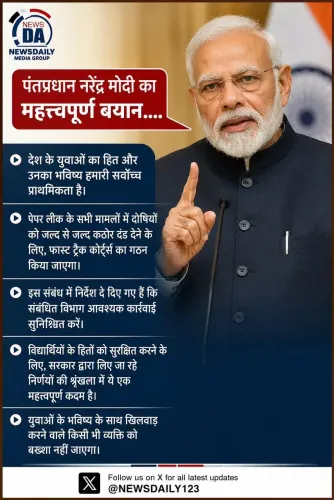
PM Modi's stated message: those who 'play with the future of the youth will not be spared.' The move builds on the Public Examinations (Prevention of Unfair Means) Act, 2024 , which targets organised malpractice in public exams.
Fast-track courts are expected to expedite justice and strengthen deterrence against paper-leak networks ahead of 2026-27 examination cycles.
Dhami conveyed gratitude on behalf of all Uttarakhand residents for the Centre's student-focused decision.
Uttarakhand Chief Minister Pushkar Singh Dhami on Thursday, 23 July 2026, welcomed Prime Minister Narendra Modi's decision to establish fast-track courts for the swift disposal of paper-leak cases, calling it a 'historic and far-sighted step' toward protecting the futures of crores of students.
Context
In a post on X, CM Dhami praised the move in strong terms, stating that PM Modi has sent a clear message that 'yuvaon ke bhavishy se khilwad karne walon ko baksha nahin jayega' ('those who play with the future of the youth will not be spared'). He extended gratitude on behalf of the people of Uttarakhand for a decision he described as placing student interests at the highest priority.
The post specifically highlighted that the fast-track court mechanism would help curb organised crimes like paper leaks, ensure stringent punishment for the guilty, enhance the transparency and credibility of examinations, and assure students that no injustice will be allowed against their hard work.
Policy Backdrop
The announcement builds on a legislative foundation laid in 2024, when Parliament enacted the Public Examinations (Prevention of Unfair Means) Act — a law designed to deter organised malpractice, including paper leaks, in public recruitment and entrance tests. Fast-track courts represent the judicial enforcement arm of this broader policy push.
Successive central governments have responded to repeated paper-leak scandals by combining stricter legislation with specialised, time-bound judicial mechanisms. The current decision follows the same pattern, aiming to restore credibility in public examination systems that have faced repeated integrity challenges.
Stakeholders and Impact
The decision directly concerns crores of competitive exam aspirants across India who appear annually for high-stakes national examinations such as NEET and JEE, where paper-leak allegations have previously led to widespread protests and legal challenges. Uttarakhand, with a significant student population appearing for these examinations, stands among the states with a direct stake in the outcome.
For students, the fast-track court model promises faster justice and a stronger deterrent against organised paper-leak networks. For examination bodies, it signals that administrative lapses enabling leaks could face rapid judicial scrutiny.
What's Next
Attention will now turn to the formal notification and operationalisation of the proposed fast-track courts, and whether their establishment will influence the conduct of major 2026-27 national examinations. The speed with which these courts are constituted and begin hearing cases will determine whether the initiative translates into a credible deterrent or remains a policy declaration.
Political observers will also watch whether other BJP-governed states follow Uttarakhand's lead in publicly endorsing the Centre's judicial mechanism, signalling coordinated messaging ahead of upcoming examination cycles.
Point of View
Signalling an attempt to move from law-on-paper to visible enforcement. By framing the Centre's action as protection of 'crores of students,' both Modi and Dhami are positioning the BJP as the guarantor of meritocracy — a narrative with direct electoral resonance among India's vast competitive-exam demographic. The real test, however, lies in operationalising these courts quickly enough to affect examinations in the 2026-27 cycle.
NationPress
23 Jul 2026
Frequently Asked Questions
What is the fast-track court decision for paper leaks announced by PM Modi?
PM Narendra Modi announced the formation of fast-track courts dedicated to the swift disposal of paper-leak cases, aiming to ensure rapid punishment for those involved in organised exam malpractice and to restore credibility in public examinations.
Why did CM Dhami praise the fast-track court decision?
Uttarakhand CM Pushkar Singh Dhami praised the decision as 'historic and far-sighted,' saying it will deter organised paper leaks, ensure strict punishment for the guilty, and assure crores of students that their hard work will be protected from injustice.
What law already exists to prevent paper leaks in India?
Parliament enacted the Public Examinations (Prevention of Unfair Means) Act in 2024, which provides a legal framework to deter organised malpractice including paper leaks in public recruitment and entrance examinations.
Which exams will benefit from the fast-track court mechanism?
The fast-track courts are expected to benefit aspirants of major national examinations such as NEET and JEE, which have previously been affected by paper-leak allegations that led to widespread protests and legal challenges.
What did PM Modi say about those involved in paper leaks?
According to CM Dhami's post, PM Modi sent a clear message that 'those who play with the future of the youth will not be spared,' signalling zero tolerance for exam malpractice.