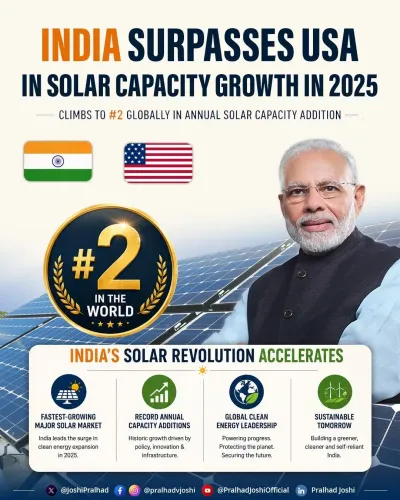
Joshi Highlights India's Rise as Low-Cost Solar Power Leader
Synopsis
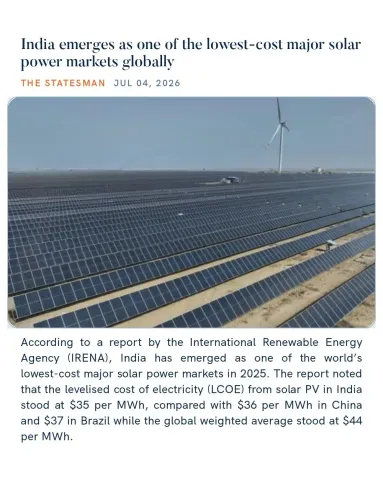
Union Minister Pralhad Joshi on 23 July 2026 highlighted India's emergence as one of the world's lowest-cost major solar power markets, tying the achievement to PM Narendra Modi's Viksit Bharat vision and India's accelerating renewable energy expansion.
Key Takeaways
Union Minister Pralhad Joshi on 23 July 2026 highlighted India's position among the world's lowest-cost major solar power markets.
The minister linked the achievement to Prime Minister Narendra Modi's Viksit Bharat vision for a developed India by 2047 .
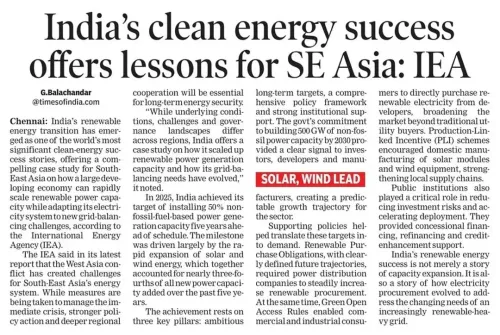
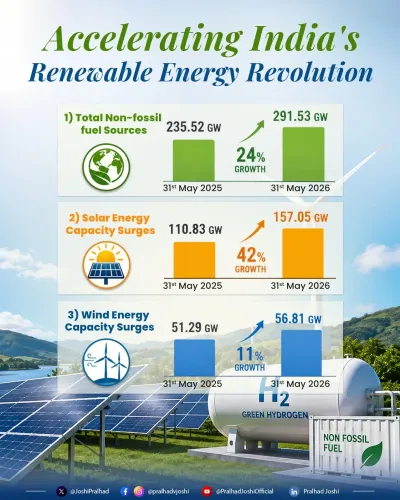
India's renewable energy target stands at 500 GW of non-fossil fuel capacity by 2030 , up from an initial 20 GW solar target set in 2010 .
At COP26 in 2021 , PM Modi committed India to the Panchamrit pledges, including net-zero emissions by 2070 .
Falling solar tariffs, driven by competitive auctions and manufacturing incentives, underpin India's growing global clean-energy standing.
Future policy signals to watch include Union Budget capacity targets and new solar manufacturing or storage announcements.
Union Consumer Affairs and New and Renewable Energy Minister Pralhad Joshi on Thursday, 23 July 2026, pointed to India's emergence as one of the world's lowest-cost major solar power markets, crediting the momentum to Prime Minister Narendra Modi's Viksit Bharat vision for a developed India by 2047.
Context
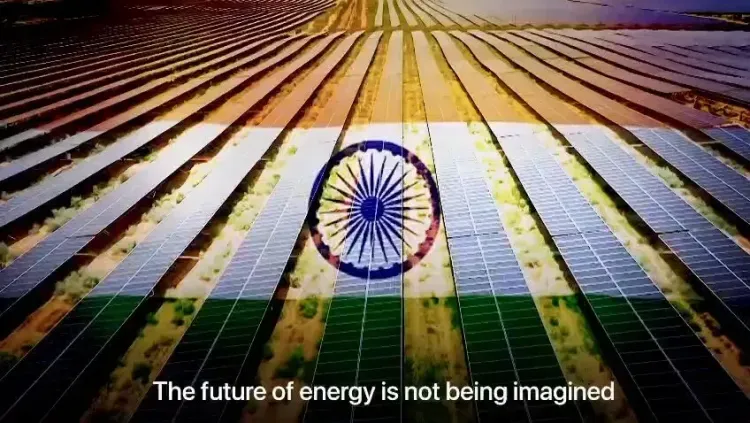
Posting on X, Minister Joshi wrote: 'Every sunrise over India is now powered by a stronger vision for a cleaner tomorrow. As India emerges among the world's lowest-cost major solar power markets and strengthens its global leadership in renewable energy, the vision of Viksit Bharat is becoming a reality under the guidance of Prime Minister Narendra Modi.' The post was accompanied by a video and came as India's renewable energy expansion remains a centrepiece of the government's economic and climate agenda.
The minister's remarks reflect a broader push by the National Democratic Alliance government to position India as a global clean-energy powerhouse, linking falling solar tariffs to the country's long-term development narrative.
Policy Backdrop
India's solar journey began in earnest with the Jawaharlal Nehru National Solar Mission in 2010, which initially targeted 20 GW of grid-connected solar capacity by 2022. That ambition was scaled up sharply: in 2015, the government raised the renewable energy target to 175 GW by 2022, and subsequently expanded it to 500 GW of non-fossil fuel capacity by 2030.
At the COP26 climate summit in 2021, Prime Minister Modi announced India's Panchamrit climate commitments, including a pledge to reach net-zero emissions by 2070. Successive policy frameworks have combined central capacity targets, state-level competitive auctions, and domestic manufacturing incentives to drive solar tariffs steadily lower — making India one of the most competitive solar markets globally.
Stakeholders and Impact
The beneficiaries of India's solar scale-up span a wide range: domestic solar developers and project developers gain from a stable policy environment and falling input costs, while renewable energy investors — both domestic and international — find India an increasingly attractive destination for capital deployment.
For ordinary consumers and industrial users, lower solar tariffs translate into the prospect of cheaper electricity over time. The government has also framed the renewable push as a driver of domestic manufacturing, job creation, and energy security — reducing dependence on fossil fuel imports and insulating the economy from volatile global commodity prices.
What's Next
Analysts and industry participants will watch closely for renewable energy capacity addition figures in the next Union Budget, as well as any new announcements on solar manufacturing incentives or grid-scale battery storage policy. Minister Joshi's post signals that the government intends to keep renewable energy front and centre in its communications ahead of any such announcements.
If India sustains its trajectory, the country's role in shaping global clean-energy pricing and supply chains is set to deepen — reinforcing the Viksit Bharat narrative with tangible economic milestones that extend well beyond domestic borders.
Point of View
Using India's solar cost competitiveness as evidence that the Viksit Bharat framework is delivering tangible results — not merely aspirational rhetoric. The framing connects energy economics to national identity, a pattern the BJP has refined over successive election cycles to translate infrastructure milestones into political capital. By invoking PM Modi's guidance explicitly, Joshi reinforces the centralised credit-attribution model that has defined the government's communication strategy on flagship programmes. The real test will come when verifiable capacity and tariff data for 2025-26 are published, which will either substantiate or complicate the 'lowest-cost' claim.
NationPress
23 Jul 2026
Frequently Asked Questions
What did Pralhad Joshi say about India's solar energy in July 2026?
Minister Pralhad Joshi said on 23 July 2026 that India has emerged among the world's lowest-cost major solar power markets and is strengthening its global leadership in renewable energy, crediting PM Modi's Viksit Bharat vision.
What is India's renewable energy target for 2030?
India has set a target of 500 GW of non-fossil fuel electricity capacity by 2030, a goal announced as part of PM Modi's Panchamrit climate commitments at COP26 in 2021.
What is Viksit Bharat and how does it relate to solar energy?
Viksit Bharat is PM Narendra Modi's vision for India to become a fully developed nation by 2047. Renewable energy expansion, including solar power, is a key pillar of this vision, linking clean energy growth to economic development and energy security.
What is the Jawaharlal Nehru National Solar Mission?
The Jawaharlal Nehru National Solar Mission, launched in 2010, was India's foundational solar policy, initially targeting 20 GW of grid-connected solar power by 2022 before targets were substantially raised.
Why are solar power tariffs low in India?
India's solar tariffs have fallen due to a combination of large-scale competitive auctions, central government capacity targets, domestic manufacturing incentives, and significant private and public investment, making it one of the most competitive solar markets globally.