CM Sai Backs Community Solar Model for Chhattisgarh Villages
Synopsis
Chhattisgarh CM Vishnu Deo Sai on 23 July 2026 spotlighted the Gram Thenhi community solar model and pledged to bring the PM Surya Ghar Muft Bijli Yojana — offering up to 300 units of free monthly electricity — to every eligible family in the state, framing it as a cornerstone of rural development and energy self-reliance.
Key Takeaways
CM Vishnu Deo Sai highlighted the community solar model at Gram Thenhi as a replicable example of rural solar innovation in Chhattisgarh.
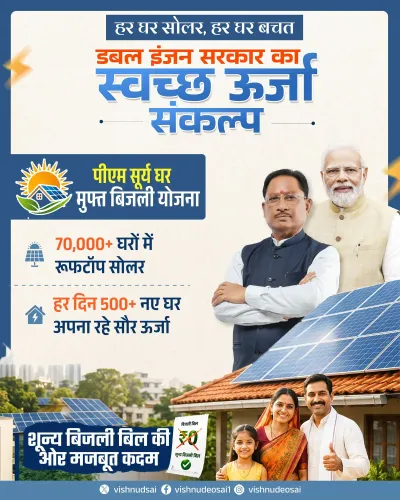
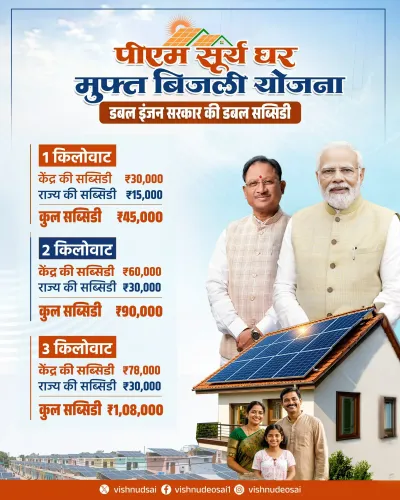
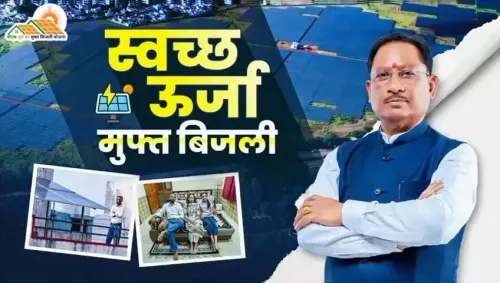
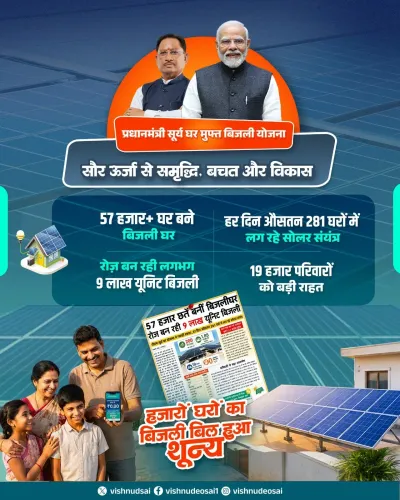
The PM Surya Ghar Muft Bijli Yojana , launched by the central government in 2024 , provides up to 300 units of free electricity per month to eligible households through subsidised rooftop solar installations.
CM Sai stated the state's goal is to extend the scheme's benefits to every eligible family across Chhattisgarh.
The initiative is positioned to reduce household electricity costs while advancing clean energy adoption and rural economic strengthening.
Community solar models are being used to bridge implementation gaps in villages where individual rooftop installations are not feasible.
The push aligns with India's broader renewable energy targets and the goal of decentralised energy generation at the village level.
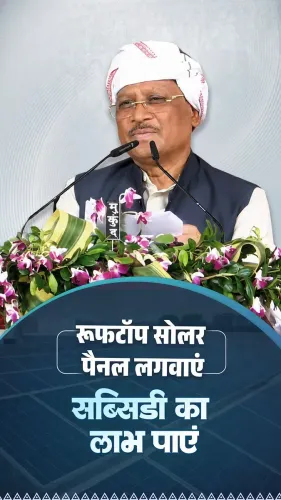
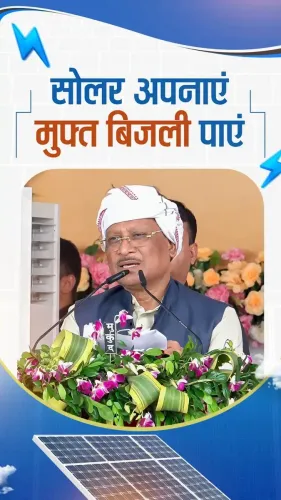
Chhattisgarh Chief Minister Vishnu Deo Sai on Thursday, 23 July 2026, highlighted the community solar initiative at Gram Thenhi as a model for rural energy transformation, reaffirming the state government's commitment to extending the PM Surya Ghar Muft Bijli Yojana to every eligible household in Chhattisgarh.
Context
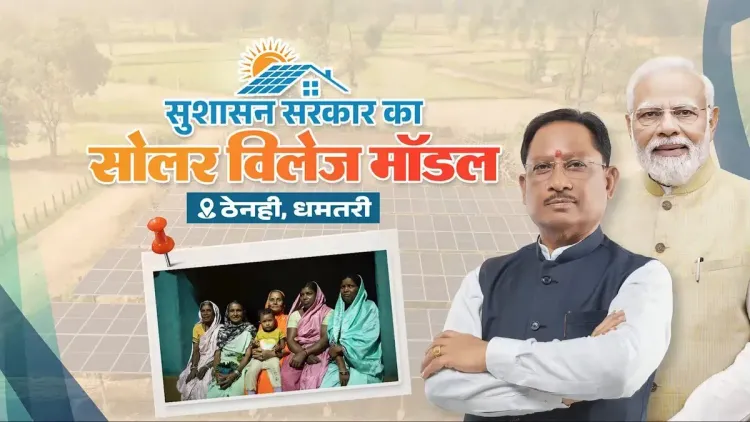
Posting in Hindi on X, CM Sai wrote: 'जब संकल्प जनकल्याण का हो, तो नवाचार विकास की नई राह बनता है' — 'When the resolve is for public welfare, innovation becomes a new path of development.' He specifically cited the community solar model at Gram Thenhi as an inspiring example of this philosophy in action.
The Chief Minister stated that the goal is to ensure the benefits of the PM Surya Ghar Muft Bijli Yojana reach every eligible family in the state. He added that the initiative would not merely reduce electricity costs, but would also forge a new identity for a developed Chhattisgarh through clean energy, energy self-reliance, and a stronger rural economy.
Policy Backdrop
The PM Surya Ghar Muft Bijli Yojana is a central government scheme launched in 2024 that subsidises rooftop solar installations for households, providing up to 300 units of free electricity per month to eligible beneficiaries. The scheme is part of India's broader push to expand renewable energy capacity and reduce dependence on fossil fuels.
Chhattisgarh, a state with a significant rural and tribal population, has been working to adapt national solar programmes through locally tailored models. The community solar approach — as demonstrated at Gram Thenhi — addresses implementation gaps in areas where individual rooftop installations may be logistically or financially challenging for households.
India has set ambitious renewable energy targets, and decentralised solar generation at the village level is increasingly seen as a critical component of achieving energy security alongside grid-scale projects.
Stakeholders and Impact
The primary beneficiaries of this push are rural households across Chhattisgarh, particularly those in villages where access to reliable and affordable electricity has historically been limited. Community solar models allow multiple families to share the benefits of a single installation, lowering per-household costs and simplifying maintenance.
A stronger rural energy supply also has downstream effects on the local economy — enabling small enterprises, reducing household energy expenditure, and supporting agriculture. CM Sai's framing of the initiative as a pillar of a 'developed Chhattisgarh' signals that the state government views solar expansion as integral to its broader development agenda.
What's Next
The state government is expected to scale outreach for the PM Surya Ghar Muft Bijli Yojana across Chhattisgarh's districts, with Gram Thenhi's community model potentially serving as a replicable template for other villages. Progress on beneficiary enrollment, subsidy disbursement, and new installation targets will be key indicators of the programme's momentum in the coming months.
As Chhattisgarh moves to position itself as a leader in rural clean energy adoption, the state's ability to translate political commitment into measurable household coverage will determine whether this initiative becomes a defining feature of the Vishnu Deo Sai government's tenure.
Point of View
Local success story — a common BJP governance communication strategy that links Delhi's policy ambition to state-level delivery. By invoking clean energy, self-reliance, and rural economic empowerment together, Sai is weaving the solar push into the larger 'Viksit Bharat' narrative that the party has made central to its political identity. The community solar format also signals pragmatic adaptation: rather than forcing a one-size-fits-all rooftop model onto villages with limited infrastructure, the state is experimenting with shared-installation approaches. How quickly and equitably the scheme reaches tribal and remote districts will be the real test of whether this political commitment translates into measurable development outcomes.
NationPress
23 Jul 2026
Frequently Asked Questions
What is the PM Surya Ghar Muft Bijli Yojana?
The PM Surya Ghar Muft Bijli Yojana is a central government scheme launched in 2024 that subsidises rooftop solar panel installations for households, providing eligible families with up to 300 units of free electricity per month.
What is the Gram Thenhi community solar model?
Gram Thenhi is a village in Chhattisgarh that has implemented a community solar model, where solar energy infrastructure is shared among multiple households. CM Vishnu Deo Sai cited it as an inspiring example of local solar innovation.
Is PM Surya Ghar Yojana available in Chhattisgarh?
Yes. Chhattisgarh is actively working to extend the PM Surya Ghar Muft Bijli Yojana to all eligible households in the state, as reaffirmed by Chief Minister Vishnu Deo Sai on 23 July 2026.
What is a community solar model in India?
A community solar model allows a group of households in a village to collectively benefit from a shared solar installation, reducing per-household costs and making solar energy accessible where individual rooftop systems are not practical.
What are Chhattisgarh's solar energy goals?
Chhattisgarh aims to achieve clean energy access, energy self-reliance, and rural economic development through solar initiatives, with the state government targeting coverage of every eligible family under the PM Surya Ghar Muft Bijli Yojana.