CM Dhami Makes Canal Irrigation Free for Uttarakhand Farmers
Synopsis
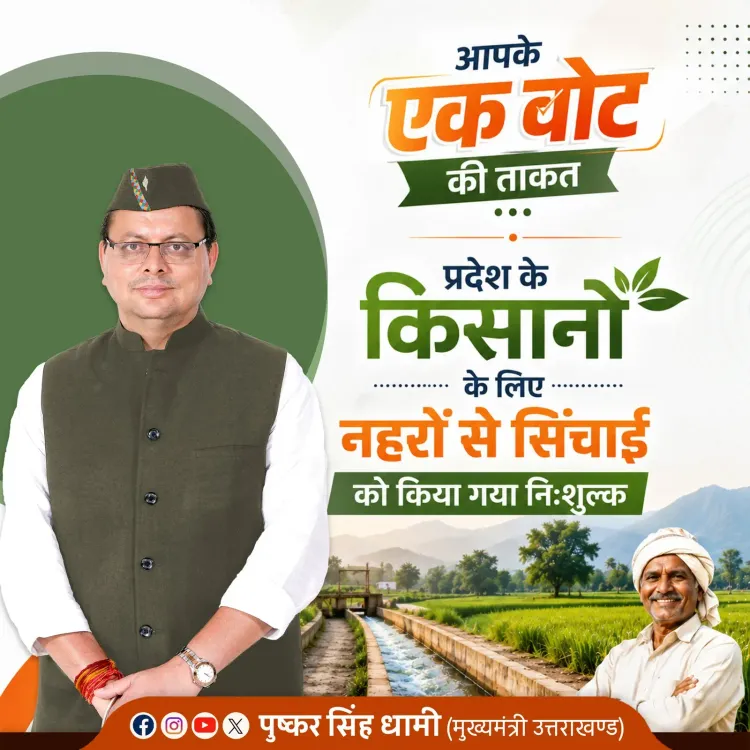
Uttarakhand Chief Minister Pushkar Singh Dhami announced on 25 July 2026 that canal irrigation is now completely free for the state's farmers. The move aims to cut cultivation costs, boost agricultural output, and ensure steady income growth for farming households across the Himalayan state.
Key Takeaways
CM Pushkar Singh Dhami announced on 25 July 2026 that canal irrigation facilities in Uttarakhand are now completely free for farmers.
The waiver is intended to reduce cultivation costs, increase production, and ensure continuous growth in farmer incomes.
Uttarakhand's hilly terrain makes reliable canal access a longstanding policy priority for sustaining agriculture.
The announcement aligns with a broader BJP -governed state pattern of input-cost reduction measures for smallholders.
The Pradhan Mantri Krishi Sinchayee Yojana (launched 2015 ) had earlier expanded irrigation infrastructure across the state.
Fiscal sustainability and formal codification of the waiver through budget allocations remain key points to watch.
Uttarakhand Chief Minister Pushkar Singh Dhami announced on Saturday, 25 July 2026, that canal irrigation facilities across the state have been made completely free of charge for farmers, framing the move as central to his government's commitment to reducing cultivation costs and raising agricultural incomes.
Context
In his post on X, CM Dhami stated: 'किसानों का सशक्तिकरण हमारी सरकार की सर्वोच्च प्राथमिकताओं में है' ('Empowerment of farmers is among the highest priorities of our government'). He added that canal irrigation has been made 'completely free' so that 'farming costs are reduced, production increases, and a continuous rise in farmers' income is ensured.' The announcement signals a direct subsidy on one of the most critical inputs for Uttarakhand's agricultural sector.
Policy Backdrop
Irrigation access has long been a structural challenge in Uttarakhand, a Himalayan state where terrain limits the reach of canal networks and makes consistent water supply a persistent concern for smallholders. The state's farmers have historically relied on a combination of canal systems, rain-fed cultivation, and traditional water-sharing arrangements. The Pradhan Mantri Krishi Sinchayee Yojana, launched in 2015, expanded irrigation infrastructure across states including Uttarakhand, laying groundwork for measures that improve access at the last mile.
State governments across India have periodically waived or subsidised irrigation charges as a tool to lower cultivation costs and support smallholders. BJP-ruled states in particular have pursued input-cost reduction measures alongside central schemes aimed at raising farm incomes, and this announcement fits within that broader pattern of agricultural welfare policy.
Stakeholders and Impact
The primary beneficiaries are Uttarakhand's farming households, particularly smallholders who depend on canal water for kharif and rabi crops. By eliminating irrigation charges, the state government aims to reduce the per-unit cost of cultivation, which could improve net margins for farmers who previously paid canal water fees. Lower input costs can also discourage distress selling and reduce dependence on informal credit for meeting seasonal expenses.
The move carries fiscal implications for the state exchequer, which will absorb the revenue previously collected as irrigation charges. The sustainability of the waiver will depend on Uttarakhand's budget allocations for irrigation infrastructure maintenance in coming financial years, since canal networks require ongoing upkeep to remain functional and efficient.
What's Next
Observers will watch for formal government orders or budget notifications that codify the waiver and specify its scope — including which canal systems and categories of land-holding are covered. Subsequent seasons will offer data on whether the policy translates into measurable increases in irrigated area, crop output, or farmer income in the state. The announcement may also set a reference point for opposition parties and farmer organisations to hold the government accountable on delivery timelines and maintenance of canal infrastructure.
Point of View
It could become a replicable model; if not, the announcement risks remaining symbolic.
NationPress
25 Jul 2026
Frequently Asked Questions
What did CM Dhami announce for Uttarakhand farmers?
Chief Minister Pushkar Singh Dhami announced on 25 July 2026 that canal irrigation facilities across Uttarakhand have been made completely free of charge for farmers, with the aim of reducing cultivation costs and raising agricultural incomes.
Which farmers will benefit from free canal irrigation in Uttarakhand?
All farmers in Uttarakhand who use state canal systems for irrigation are intended to benefit. The specific categories of land-holding and canal networks covered will be clarified through formal government orders.
How does this relate to the Pradhan Mantri Krishi Sinchayee Yojana?
The Pradhan Mantri Krishi Sinchayee Yojana, launched in 2015, expanded irrigation infrastructure across states including Uttarakhand. The canal irrigation waiver builds on that infrastructure by removing the fee barrier at the point of use.
Is waiving irrigation charges a new practice in India?
No. State governments across India have periodically waived or subsidised irrigation charges as a tool to lower cultivation costs for smallholders. BJP-governed states have pursued similar input-cost reduction measures alongside central farm income schemes.
What are the fiscal implications of the Uttarakhand canal irrigation waiver?
The state exchequer will absorb the revenue previously collected as canal irrigation charges. Sustainability will depend on future budget allocations for irrigation infrastructure maintenance, which requires ongoing funding to keep canal networks functional.