CM Dhami Marks 5 Years, Highlights Women's Quota Push
Synopsis
Uttarakhand CM Pushkar Singh Dhami, on completing five years in office, reaffirmed the state's 30% horizontal reservation for women in government jobs and pledged continued support for SHGs and women entrepreneurs under the BJP's double-engine governance model.
Key Takeaways
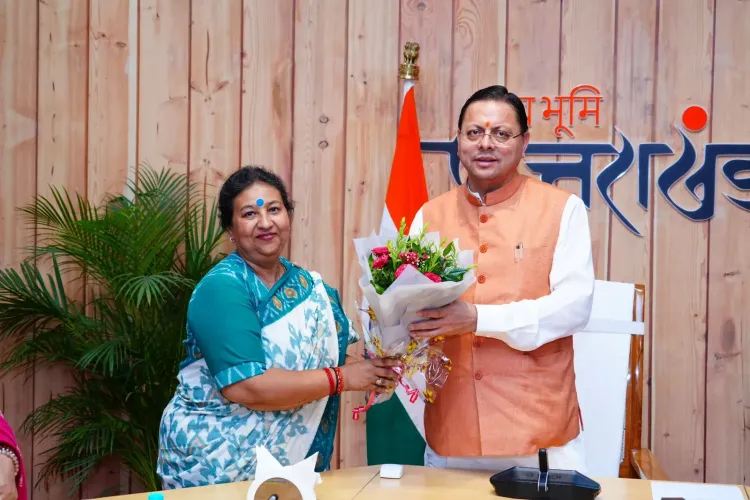
CM Pushkar Singh Dhami marked five years in office on 14 July 2026 , receiving congratulations from a BJP Mahila Morcha delegation at his official residence.
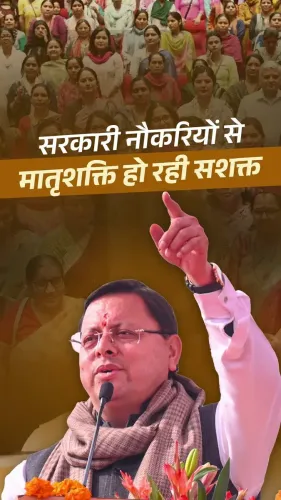
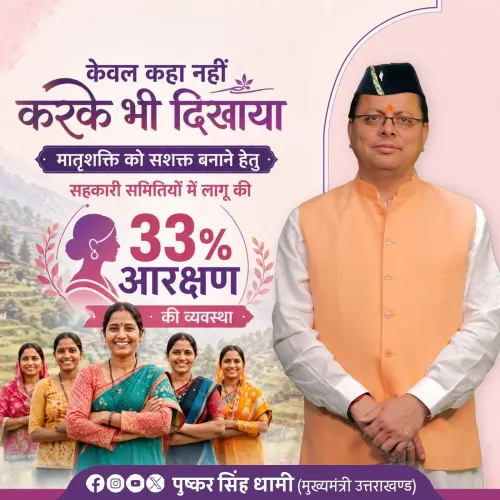
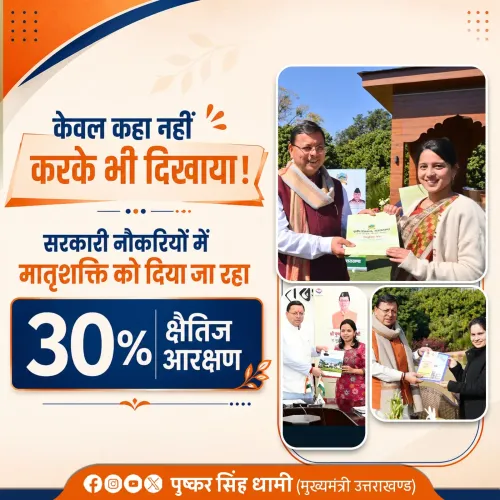
Uttarakhand has instituted 30 percent horizontal reservation for women across all categories in state government employment.
The government has prioritised Self-Help Groups , women entrepreneurship, local-product promotion and new leadership pathways as part of its women's empowerment agenda.
Dhami framed these measures within PM Narendra Modi 's 'double-engine government' model, linking state policies to national 'Nari Shakti' goals.
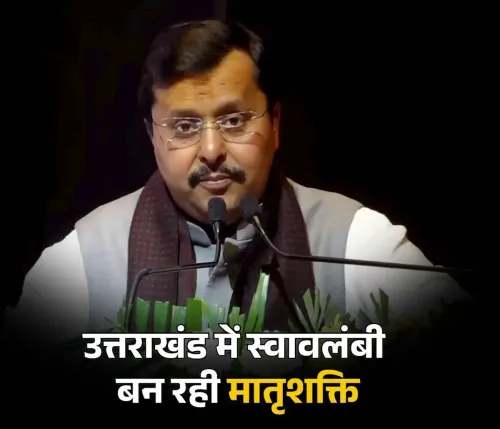
The CM stated that matrishakti (women's power) will play the 'most important role' in building a 'developed Uttarakhand' aligned with the Centre's Viksit Bharat 2047 vision.
Uttarakhand Chief Minister Pushkar Singh Dhami on Tuesday, 14 July 2026, received a delegation from the BJP Mahila Morcha, Uttarakhand at his official residence, where members congratulated him on completing five years as 'chief servant' (mukhya sevak) of the state. The CM used the occasion to reaffirm his government's commitment to women's empowerment across safety, health, education and economic participation.
Context
In a post on X, CM Dhami stated that under the 'visionary leadership' of Prime Minister Narendra Modi, the 'double-engine government' continues to accord the highest priority to the 'honour, security, health, education and economic empowerment of women.' The BJP Mahila Morcha delegation's visit to the Chief Minister's official residence in Dehradun marked a symbolic milestone in his tenure, which began in July 2021.
The CM underscored that the state has provided 30 percent horizontal reservation for women across categories in government jobs, a key plank of what he described as the resolve to achieve 'development led by women's leadership' (mahila netritva mein vikas ka sankalp).
Policy Backdrop
Uttarakhand's 30 percent horizontal reservation for women in state government employment cuts across existing vertical categories — general, OBC, SC and ST — ensuring women within each category receive a defined share of posts. This is distinct from vertical reservation and is designed to increase the absolute number of women entering the public sector workforce.
The initiative sits within the broader national framework of the Constitution (One Hundred and Sixth Amendment) Act, 2023, which reserved one-third of seats for women in Parliament and state legislative assemblies, signalling a legislative push for female representation at multiple levels of governance. The Uttarakhand government's job reservation policy predates that amendment and reflects state-level action on the same theme.
The CM also highlighted efforts to strengthen Self-Help Groups (SHGs), promote women entrepreneurship, boost local and traditional products, and create new leadership opportunities — all framed under the BJP's wider 'Nari Shakti' programme that links central financial-inclusion schemes with state-specific delivery mechanisms.
Stakeholders and Impact
The primary beneficiaries of these policies are women job aspirants in Uttarakhand competing for state government positions, members of Self-Help Groups engaged in micro-enterprise and local-product marketing, and women entrepreneurs seeking institutional support and market access. The BJP Mahila Morcha, as the party's women's wing, plays an organising and advocacy role in amplifying these programmes at the grassroots level.
CM Dhami expressed 'complete confidence' that matrishakti — the power of women — will play the 'most important role' in building a 'developed Uttarakhand' (viksit Uttarakhand), aligning state messaging with the Centre's 'Viksit Bharat' vision for 2047. The government pledged to continue working with 'full commitment' for the holistic empowerment and self-reliance (atmanirbharta) of women.
What's Next
The practical test of these commitments lies in implementation data — specifically, how many government posts have been filled under the 30 percent horizontal quota and the scale at which SHGs and women-led enterprises have been supported. These figures are expected to feature in the next Uttarakhand budget session and legislative reviews. Observers will watch whether the state translates the anniversary messaging into measurable, publicly reported targets for female workforce participation in the months ahead.
Point of View
But the absence of implementation data in public discourse leaves its impact open to scrutiny. How the government presents verifiable outcomes — rather than intent — in the next budget session will determine whether this anniversary messaging translates into durable political capital.
NationPress
14 Jul 2026
Frequently Asked Questions
What is the 30 percent horizontal reservation for women in Uttarakhand?
Uttarakhand state policy provides 30 percent horizontal reservation for women across all categories — general, OBC, SC and ST — in state government jobs, meaning women within each category receive a defined share of posts regardless of vertical reservation.
How long has Pushkar Singh Dhami been Chief Minister of Uttarakhand?
Pushkar Singh Dhami has served as Chief Minister of Uttarakhand since July 2021, completing five years in the role as of July 2026.
What is the BJP Mahila Morcha?
The BJP Mahila Morcha is the women's wing of the Bharatiya Janata Party, active at both national and state levels, including Uttarakhand, where it engages with state leadership on gender-focused programmes and grassroots mobilisation.
What is the double-engine government model?
The double-engine government model refers to coordinated governance between a BJP-led state government and the BJP-led central government under Prime Minister Narendra Modi, with the idea that aligned political leadership accelerates development delivery.
What schemes support women entrepreneurs in Uttarakhand?
Uttarakhand has pursued multiple initiatives including strengthening Self-Help Groups, promoting women entrepreneurship, boosting local and traditional products, and creating new leadership opportunities, aligned with central financial-inclusion and Nari Shakti programmes.