CM Dhami Meets Rail Minister, Seeks Mumbai-Dehradun Vande Bharat
Synopsis
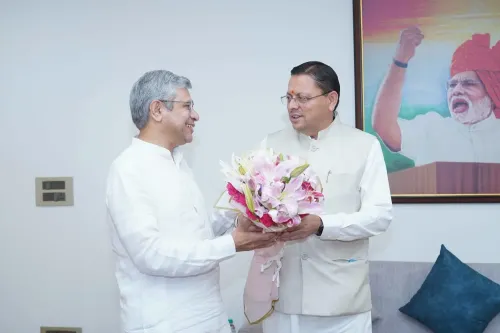
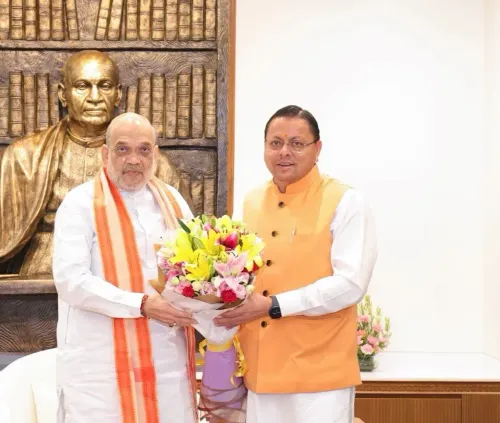
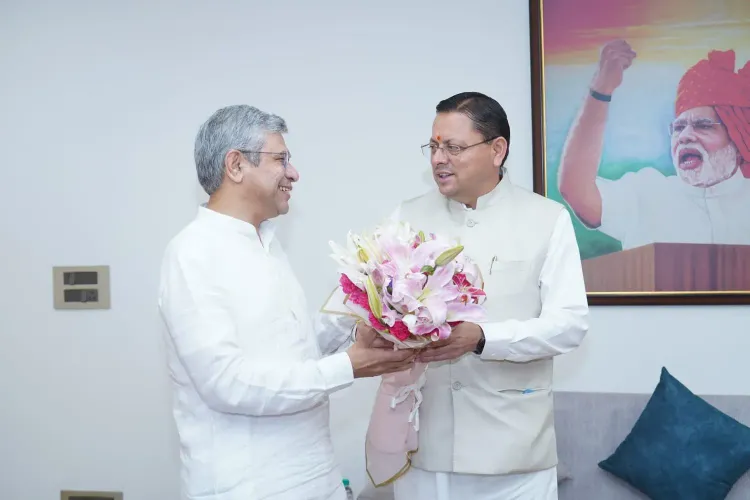
Chief Minister Pushkar Singh Dhami met Railway Minister Ashwini Vaishnaw in New Delhi on 9 July 2026, seeking a Mumbai-Dehradun Vande Bharat service, higher train frequencies, central funding for new rail lines, and early launch of the Rishikesh-Karnprayag project. The minister gave in-principle approval for a Banbasa station halt.
Key Takeaways
CM Dhami met Railway Minister Ashwini Vaishnaw in New Delhi on 9 July 2026 to discuss Uttarakhand rail infrastructure.
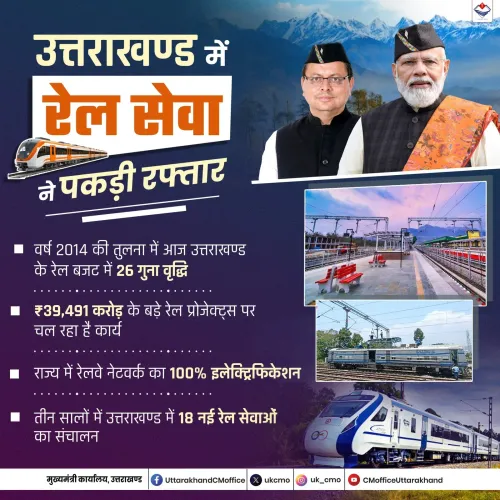
A new Vande Bharat or Superfast Express service between Mumbai and Dehradun was formally requested, along with higher frequencies on Mumbai–Haridwar and Mumbai–Ramnagar routes.
The Chief Minister sought full central funding for the Kichha–Sitarganj–Khatima new rail line and early train operations on the Rishikesh–Karnprayag Rail Project .
Transfer of the old Rishikesh railway station land to the state government was requested for the Rishikesh Ganga Corridor project under a UIIDB-RLDA asset monetisation plan.
Railway Minister Vaishnaw gave in-principle approval for a brief halt of Triveni Express, Mathura Express, and Daurai Express at Banbasa Station on the India-Nepal border.
The proposals aim to benefit Char Dham pilgrims, Uttarakhand migrants in Mumbai , defence personnel at Banbasa, and the state's tourism and investment ecosystem ahead of Kumbh 2027 .
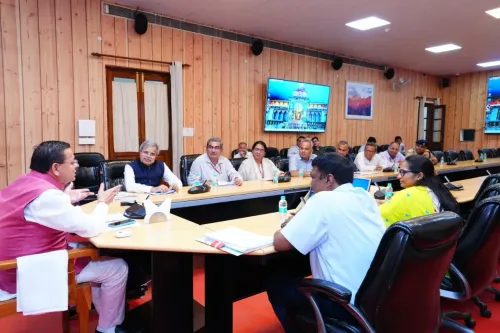
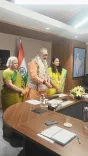
Chief Minister Pushkar Singh Dhami met Union Railway Minister Ashwini Vaishnaw in New Delhi on 9 July 2026 to press for a major expansion of rail infrastructure and connectivity for Uttarakhand, placing before the minister a comprehensive set of proposals covering new services, enhanced frequencies, land transfer, and long-pending project funding.
Context
Addressing the minister, CM Dhami underscored that Uttarakhand is among the country's foremost states from a religious, cultural, and natural standpoint. He noted that millions of pilgrims and tourists from across India and abroad travel to the state every year for the Char Dham Yatra, the religious sites of Haridwar and Rishikesh, yoga and spiritual tourism, and the forthcoming Kumbh 2027 event. The Chief Minister argued that the growing volume of visitors makes the expansion of a modern, robust, and convenient rail network an urgent necessity.
Dhami pointed out that a large number of people originally from Uttarakhand reside in Maharashtra, particularly Mumbai, and maintain continuous travel ties with their home state. Pilgrims also travel year-round to Char Dham, Baba Neem Karoli Dham (Shri Kainchi Dham), and Jageshwar Dham, among other major religious sites. The key rail gateways for the state's Kumaon and Garhwal divisions are Ramnagar, Dehradun, and Haridwar.
Policy Backdrop
The Chief Minister told the Railway Minister that the frequency and number of train services currently operating between Mumbai and Haridwar and between Mumbai and Ramnagar fall short of passenger demand, causing acute reservation difficulties during the travel season, Char Dham Yatra, holidays, and festivals. He formally requested the launch of a Vande Bharat or Superfast Express service between Mumbai and Dehradun, and an increase in the frequency of Mumbai–Haridwar and Mumbai–Ramnagar rail services. He also sought extension of the Dehradun–Kota rail service to Surat–Vadodara–Mumbai, and asked that Ramnagar–Mumbai and Haridwar–Mumbai services be operated either daily or at least three days a week.
On the Rishikesh–Karnprayag Rail Project — a 125-km broad-gauge line linking the Dehradun region to Himalayan pilgrimage sites that received its funding sanction over a decade ago — the Chief Minister requested that train operations begin at the earliest. He also asked that the entire cost of the Kichha–Sitarganj–Khatima new rail line project be borne by the Government of India, and that the concerns of local farmers related to survey work be resolved. Regarding Rishikesh, he requested the closure of the old railway station and transfer of its land to the state government, noting that the Uttarakhand Investment and Infrastructure Development Board (UIIDB) and the Rail Land Development Authority (RLDA) are already working on an asset monetisation plan under the proposed Rishikesh Ganga Corridor master plan. He urged that formal directions be issued to RLDA in this regard.
Stakeholders and Impact
CM Dhami highlighted that Banbasa, a town on the India–Nepal border, is strategically and commercially significant and hosts a unit of the Indian Army's Rajput Regiment. He requested a brief halt at Banbasa Railway Station for the Triveni Express, Mathura Express, and Daurai Express — all operating from Tankpur — to benefit local residents, travellers, and defence personnel. In a notable outcome from the meeting, Railway Minister Vaishnaw gave in-principle approval for a brief stoppage of these three train services at Banbasa Station.
Dhami said that improved rail connectivity would provide better facilities to passengers, Uttarakhand migrants, and tourists, and would give fresh impetus to tourism, trade, and investment in the state. The proposals, if implemented, would directly benefit pilgrims travelling to major shrines, migrant workers commuting between Mumbai and the hills, and communities in the Terai belt near the Nepal border.
What's Next
The in-principle approval for the Banbasa halt is the only formal outcome confirmed from the meeting. The broader requests — including the Mumbai–Dehradun Vande Bharat service, enhanced frequencies on the Mumbai corridor, full central funding for the Kichha–Sitarganj–Khatima line, formal RLDA directions for the Rishikesh Ganga Corridor, and early operations on the Rishikesh–Karnprayag line — remain at the proposal stage and will require formal Railway Ministry decisions. With Kumbh 2027 approaching and pilgrim footfall on a sustained upward trajectory, the pace of these approvals will be closely watched by state officials and the travel and hospitality sector alike.
Point of View
Dhami frames rail expansion as a national religious-infrastructure obligation rather than a purely state demand — a framing that has historically accelerated central approvals. The in-principle nod on Banbasa is a small but concrete deliverable that signals goodwill, while the larger asks — particularly the Vande Bharat corridor and full central funding for the Terai line — remain subject to Railway Board prioritisation in an already-stretched capital expenditure cycle. The push also fits the broader national rollout of Vande Bharat services and RLDA-led station redevelopment, suggesting alignment with central rail policy direction.
NationPress
9 Jul 2026
Frequently Asked Questions
Will there be a Vande Bharat train from Mumbai to Dehradun?
CM Pushkar Singh Dhami has formally requested Railway Minister Ashwini Vaishnaw to launch a Vande Bharat or Superfast Express service between Mumbai and Dehradun, but no formal sanction has been announced yet — only the Banbasa halt received in-principle approval at the 9 July 2026 meeting.
What is the Rishikesh-Karnprayag rail project status in 2026?
The Rishikesh–Karnprayag Rail Project is a 125-km broad-gauge line that has been under construction for several years. CM Dhami has requested the Railway Minister to expedite the start of train operations on this route at the earliest.
Why did CM Dhami meet Railway Minister Vaishnaw?
CM Dhami met Railway Minister Ashwini Vaishnaw in New Delhi on 9 July 2026 to present proposals for strengthening rail infrastructure in Uttarakhand, including new services, enhanced frequencies, new rail lines, land transfer at Rishikesh, and faster implementation of key projects.
What is the Banbasa railway station halt approval?
Railway Minister Vaishnaw gave in-principle approval for a brief stoppage of the Triveni Express, Mathura Express, and Daurai Express — all running from Tankpur — at Banbasa Station, which is located on the India-Nepal border and hosts a unit of the Indian Army's Rajput Regiment.
What is the Kichha-Sitarganj-Khatima rail line project?
The Kichha–Sitarganj–Khatima new rail line is a proposed connectivity project in Uttarakhand's Terai region. CM Dhami has requested that its entire cost be borne by the Government of India and that concerns of local farmers affected by survey work be addressed.