CM Dhami Meets Rail Minister, Seeks Vande Bharat for Uttarakhand
Synopsis
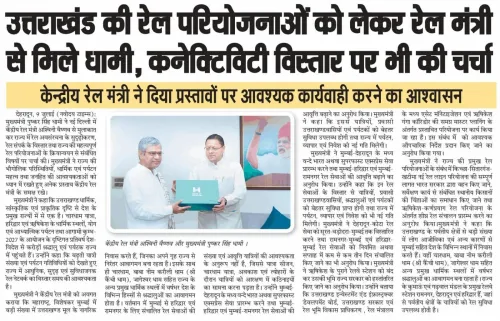
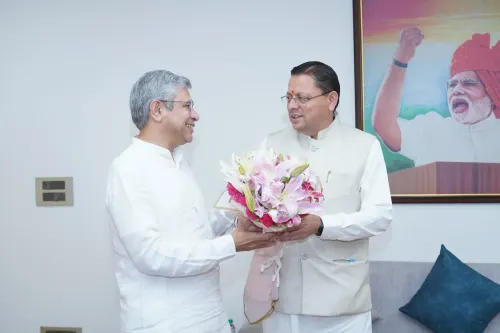
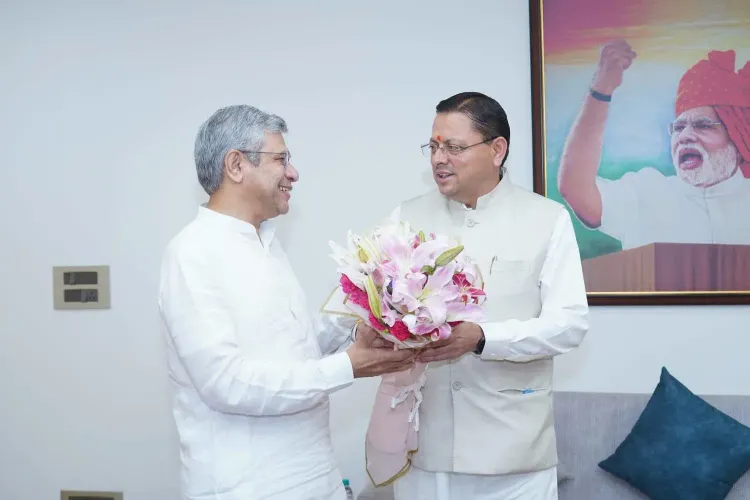
Uttarakhand CM Pushkar Singh Dhami met Railway Minister Ashwini Vaishnaw in New Delhi on 9 July 2026, seeking a Mumbai-Dehradun Vande Bharat service, line doubling, new rail projects, and land transfer for the Rishikesh Ganga Corridor, ahead of Char Dham Yatra and Kumbh 2027.
Key Takeaways
CM Dhami met Railway Minister Vaishnaw in New Delhi on 9 July 2026 to discuss Uttarakhand rail expansion.
A new Mumbai–Dehradun Vande Bharat or Superfast service was formally requested, citing Char Dham Yatra and Kumbh 2027 traffic.
Proposals include extending the Dehradun–Kota service to Surat, Vadodara, and Mumbai, and increasing frequency of Mumbai–Haridwar and Mumbai–Ramnagar trains.
Infrastructure asks cover the Haridwar–Dehradun rail line doubling , Kichha–Sitarganj–Khatima and Tanakpur–Bageshwar new rail lines, and Rishikesh Ganga Corridor land transfer.
Railway Minister gave in-principle approval for brief halts at Banbasa station and positive assurances on other proposals.
Formal sanctions and budget allocations for the remaining projects are still pending.
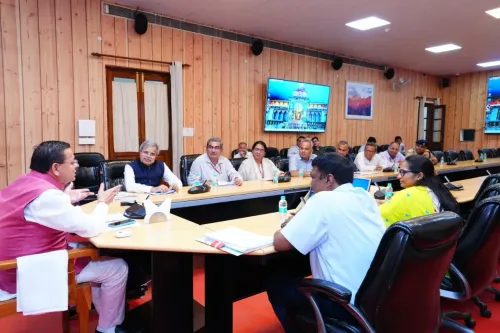
Uttarakhand Chief Minister Pushkar Singh Dhami met Union Railway Minister Ashwini Vaishnaw in New Delhi on 9 July 2026 to press for a sweeping expansion of rail infrastructure and passenger services across the hill state, citing the upcoming Kumbh 2027 and the perennial Char Dham Yatra as key drivers of demand.
Context
In a detailed post on X, CM Dhami said he held wide-ranging discussions with the Railway Minister on rail infrastructure expansion, connectivity strengthening, and passenger amenities in Uttarakhand. The meeting covered multiple proposals simultaneously — an unusual breadth that signals the state government's urgency ahead of two major pilgrimage events expected to draw millions of visitors.
Dhami specifically sought the launch of a Mumbai–Dehradun Vande Bharat or Superfast rail service, citing rising tourism and pilgrimage traffic. The Vande Bharat Express, first introduced in 2019, has become the flagship of India's passenger rail modernisation drive and its extension to Uttarakhand would mark a significant upgrade for the state.
Policy Backdrop
The Chief Minister also requested the extension of the existing Dehradun–Kota rail service up to Surat, Vadodara, and Mumbai, and an increase in the frequency of Mumbai–Haridwar and Mumbai–Ramnagar services. These western-corridor links are critical for the large number of pilgrims from Maharashtra and Gujarat who travel to Uttarakhand's shrines each year.
On infrastructure, Dhami raised the Rishikesh Ganga Corridor project, requesting that land belonging to the old railway station be transferred to the state government for its development. He also discussed the Kichha–Sitarganj–Khatima and Tanakpur–Bageshwar rail projects, the doubling of the Haridwar–Dehradun rail line, and brief halts for major train services at Banbasa station. Rail connectivity proposals for Uttarakhand, including new lines and doubling works, have featured in central-state discussions since 2014.
Stakeholders and Impact
The proposals, if sanctioned, would directly benefit pilgrims, tourists, and residents of Uttarakhand — particularly those in the Kumaon and Garhwal divisions that remain underserved by rail. The Tanakpur–Bageshwar line, long-pending, would open remote hill districts to direct rail access for the first time.
In a concrete outcome from the meeting, Railway Minister Vaishnaw gave siddhantik sweekriti (in-principle approval) for brief halts of rail services at Banbasa station, and offered positive assurances on the remaining proposals, according to Dhami's post. The Chief Minister publicly thanked the minister for both the approval and the assurances.
What's Next
The in-principle nod for Banbasa station halts is the only confirmed outcome at this stage; formal sanctions, budget allocations, and timelines for the remaining proposals — including the Mumbai–Dehradun Vande Bharat and the Haridwar–Dehradun line doubling — are yet to be announced. With Kumbh 2027 acting as a hard deadline, pressure on the Ministry of Railways to accelerate clearances is expected to intensify in the coming months. The pattern from other states suggests that high-level political meetings of this kind often precede formal project sanctions in subsequent railway budget cycles.
Point of View
Publicly understood deadline that makes it harder for the Centre to defer decisions. The breadth of proposals tabled in a single sitting — spanning new services, frequency hikes, line doubling, new rail lines, and a land transfer — suggests Uttarakhand is front-loading its railway asks to maximise leverage in the next budget cycle. The in-principle approval for Banbasa halts, while modest, gives Dhami a deliverable to announce to constituents in the Kumaon belt. Whether the larger asks, particularly the Mumbai–Dehradun Vande Bharat, translate into formal sanctions will be a test of how seriously the Centre prioritises hill-state connectivity in the run-up to a politically significant pilgrimage season.
NationPress
8 Oct 2026
Frequently Asked Questions
What did CM Dhami request from the Railway Minister on 9 July 2026?
CM Dhami requested a new Mumbai–Dehradun Vande Bharat or Superfast train service, extension of the Dehradun–Kota service to Mumbai via Surat and Vadodara, higher frequency on Mumbai–Haridwar and Mumbai–Ramnagar routes, Haridwar–Dehradun line doubling, new rail lines including Tanakpur–Bageshwar, and transfer of old Rishikesh station land for the Ganga Corridor project.
Did Railway Minister Vaishnaw approve any of Uttarakhand's rail proposals?
Railway Minister Ashwini Vaishnaw gave in-principle approval for brief halts of major train services at Banbasa station and offered positive assurances on the other proposals discussed, according to CM Dhami's post. Formal sanctions are yet to be announced.
Why is Kumbh 2027 important for Uttarakhand's railway expansion?
Kumbh 2027 is expected to draw millions of pilgrims to Haridwar and surrounding areas, creating a surge in passenger demand that existing rail capacity may not be able to handle. The event provides a hard deadline for infrastructure upgrades and is being used by the state government to push for faster central approvals.
What is the Tanakpur–Bageshwar rail project?
The Tanakpur–Bageshwar rail project is a long-pending proposal to connect the remote Kumaon hill districts of Uttarakhand by rail for the first time, linking Tanakpur in the plains to Bageshwar deeper in the hills. It has featured in central-state discussions for several years but formal construction is yet to begin.
What is the Rishikesh Ganga Corridor and why does it need railway land?
The Rishikesh Ganga Corridor is a state government development project along the Ganga riverfront in Rishikesh. The Uttarakhand government has requested the transfer of land belonging to the old Rishikesh railway station from Indian Railways to the state to enable the corridor's development.