CM Dhami Orders Swift, Transparent Grievance Redressal
Synopsis
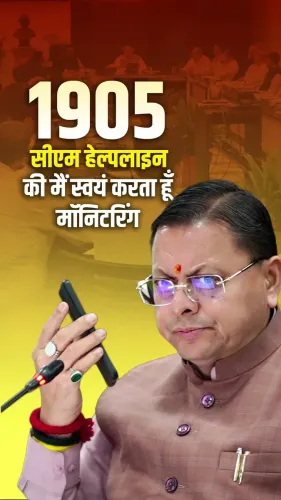
Uttarakhand Chief Minister Pushkar Singh Dhami directed state officials on August 11, 2026, to resolve every public grievance swiftly, transparently, sensitively, and within set timelines, reinforcing his administration's focus on accountable, citizen-first governance.
Key Takeaways
CM Pushkar Singh Dhami issued a directive on August 11, 2026 for time-bound disposal of public grievances in Uttarakhand.
Officials were instructed to ensure redressal that is swift, transparent, sensitive, and time-bound — four explicit benchmarks.
The directive applies to all 'concerned officials' across the state administration.
Uttarakhand participates in national grievance platforms like CPGRAMS , making disposal data trackable and publicly accountable.
The word 'sensitive' in the order signals a focus on quality of resolution, not just speed of closure.
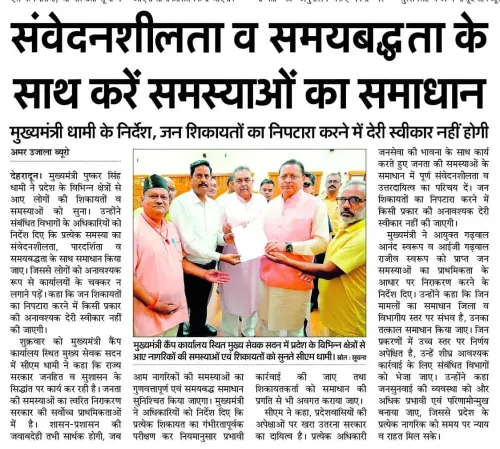
Every complaint filed by an Uttarakhand citizen now carries a direct instruction from the top: resolve it fast, resolve it fairly, and resolve it on time. Uttarakhand Chief Minister Pushkar Singh Dhami issued a firm directive on Tuesday, August 11, 2026, instructing concerned officials to ensure the quick, transparent, sensitive, and time-bound disposal of every public grievance received by the state administration.
What Dhami's directive actually demands
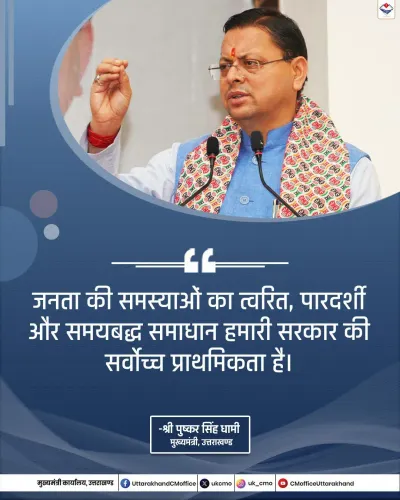
Posting on X, CM Dhami stated that relevant officials have been directed to ensure 'त्वरित, पारदर्शी, संवेदनशील एवं समयबद्ध निस्तारण' — swift, transparent, sensitive, and time-bound resolution — of each complaint. The four-word mandate is deliberate: speed alone is not enough; the process must also be humane and accountable.
Grievance redressal as a governance benchmark in Uttarakhand
Indian state administrations are increasingly judged not just on policy announcements but on last-mile delivery — and grievance disposal timelines are a measurable proxy for both. Uttarakhand participates in national grievance platforms such as CPGRAMS (Centralised Public Grievance Redress and Monitoring System), which tracks pending and resolved complaints across states. A directive from the Chief Minister signals that disposal rates and pendency are under active political scrutiny, not just bureaucratic review.
Dhami, who has served as Chief Minister since 2021, has repeatedly emphasised responsive administration as a pillar of his tenure. Instructions of this nature typically cascade from the Chief Minister's Office to district magistrates and departmental heads, who are then held accountable for turnaround metrics.
Why 'sensitive' is the word that matters here
The inclusion of 'संवेदनशील' — sensitive — in the directive is notable. It signals that the administration is not merely chasing closure numbers but is asking officials to engage with the human dimension of each complaint. In a hill state like Uttarakhand, where citizens in remote areas often face geographic barriers to accessing government offices, the quality of redressal matters as much as its speed. District-level compliance reports and any administrative reviews that follow will be the real test of whether this directive moves beyond the screen.
Point of View
Transparent, sensitive, time-bound — mirrors the language of national governance reform frameworks, suggesting alignment with the Centre's push for measurable service delivery. The real political weight of such orders, however, is always tested at the district level, where pendency data either validates or undermines the headline. In a state heading toward its next electoral cycle, grievance disposal performance is as much a political metric as a bureaucratic one.
NationPress
11 Aug 2026
Frequently Asked Questions
What did CM Dhami order regarding public grievances in Uttarakhand?
CM Pushkar Singh Dhami directed concerned officials to ensure swift, transparent, sensitive, and time-bound resolution of every public complaint filed with the state administration.
When did Dhami issue the grievance redressal directive?
The directive was issued on Tuesday, August 11, 2026 , and announced by CM Dhami via a post on X.
What is CPGRAMS and how does it relate to Uttarakhand?
CPGRAMS (Centralised Public Grievance Redress and Monitoring System) is a national platform that tracks public complaint resolution across Indian states, including Uttarakhand, making disposal timelines measurable and accountable.
How long has Pushkar Singh Dhami been Chief Minister of Uttarakhand?
Pushkar Singh Dhami has served as Chief Minister of Uttarakhand since 2021 .
Why does the 'sensitive' requirement in Dhami's order matter?
Including sensitivity as a benchmark signals that the administration wants officials to engage with the human context of each grievance — not just close cases quickly — which is especially significant for citizens in remote hill areas of Uttarakhand.