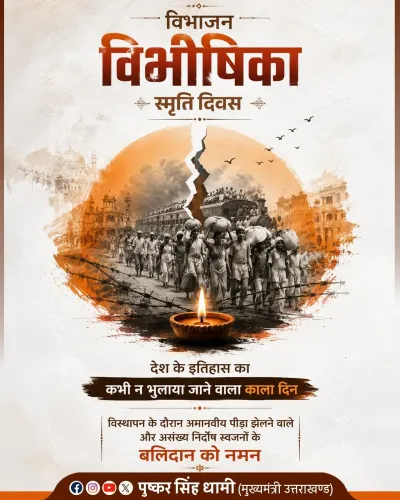
CM Dhami Marks Partition Horrors Day With Sombre Reflection
Synopsis
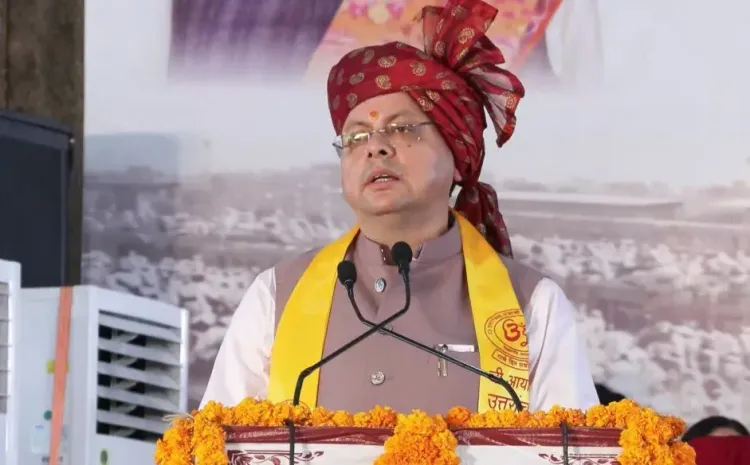
On Partition Horrors Remembrance Day, Uttarakhand CM Pushkar Singh Dhami reflected on the 1947 Partition as not just a physical displacement but an erasure of identity and memory — a sombre note ahead of India's Independence Day on 15 August 2026.
Key Takeaways
Uttarakhand CM Pushkar Singh Dhami issued a reflective statement on 14 August 2026 , Partition Horrors Remembrance Day.
He described the 1947 Partition as a displacement not only of people but of identity and memories — communities separated after centuries of shared life.
The Government of India designated 14 August as Partition Horrors Remembrance Day in 2021 , institutionalising annual remembrance on the eve of Independence Day.
The 1947 Partition displaced an estimated 10 to 20 million people across the India-Pakistan border, accompanied by widespread communal violence.
Dhami's statement sets the emotional tone ahead of Uttarakhand's Independence Day observances on 15 August 2026 .
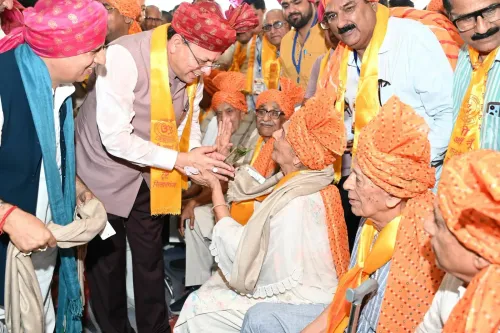
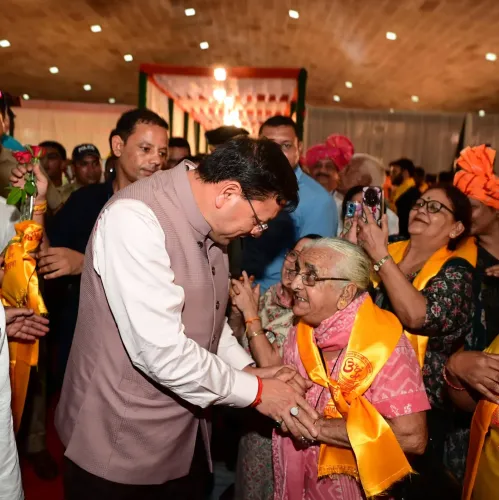
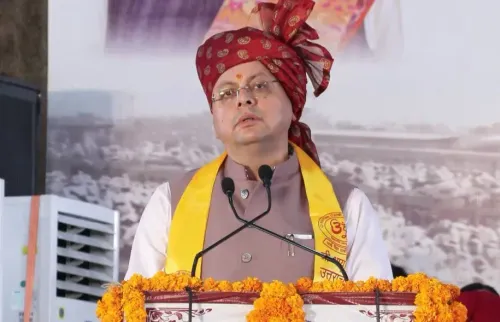
Seventy-nine years after the lines were drawn, the wounds still speak. On 14 August 2026 — Partition Horrors Remembrance Day — Uttarakhand Chief Minister Pushkar Singh Dhami offered a sombre reckoning with one of history's most devastating forced migrations, reminding the nation that 1947 was not only a birth but also a rupture.
Quoting Chief Minister Dhami directly: '1947 mein Bharat maa ke seene par aisi lakeer khinchi gayi, jisne sadiyon se ek saath rehne waale logon ko alag kar diya. Yeh visthapan pehchaan aur smritiyon ka bhi tha.' In English: 'In 1947, a line was drawn across the heart of Mother India that separated people who had lived together for centuries. This displacement was also one of identity and memories.'
A Line Drawn Across Centuries
The Partition of British India in August 1947 triggered one of the largest forced migrations in recorded history — an estimated 10 to 20 million people displaced across the newly created borders of India and Pakistan, accompanied by catastrophic communal violence. Dhami's framing goes beyond the physical: the loss of ancestral homes, shared shrines, languages, and neighbourhood bonds — an erasure of memory that outlasted the generation that lived it.
His choice of the phrase 'pehchaan aur smritiyon ka visthapan' — displacement of identity and memories — reflects a register that is less political and more elegiac, consistent with the solemn tone Indian leaders have adopted around this date in recent years.
Why 14 August Is Now a Day of Remembrance
In 2021, the Government of India officially designated 14 August as Partition Horrors Remembrance Day, institutionalising what had long been informal reflection into a national observance. The date — the eve of Independence Day — was chosen deliberately: to hold both grief and gratitude in the same breath. Since then, statements from state governments and constitutional offices on this day have become an established part of India's annual August calendar.
Dhami's statement follows that pattern but carries its own weight. Uttarakhand, a hill state carved from Uttar Pradesh in 2000, has communities whose histories are deeply intertwined with the broader Partition story — families displaced from what is now Pakistan's northwest, resettled across northern India's plains and foothills.
Remembrance as a Political and Moral Act
Indian leaders routinely combine Partition remembrance with unity themes around Independence Day. Dhami's statement leans into the human cost rather than the political resolution — a choice that signals the maturing of this observance from a government directive into something closer to genuine civic mourning. The kicker in his words is the word 'bhi' — 'also'. The displacement was also of identity and memories. The 'also' does the heavy lifting: it acknowledges that the physical horror has been documented, but the interior loss is still being counted.
As Uttarakhand prepares its Independence Day events on 15 August 2026, the Chief Minister's office has set the emotional register: pride in freedom, tempered by an honest accounting of what freedom cost.
Point of View
The framing sidesteps communal provocation while still anchoring a nationalist emotional narrative. For a Chief Minister heading into an Independence Day cycle, it is a calibrated act of statecraft: solemn enough to be dignified, resonant enough to be remembered.
NationPress
28 Sept 2026
Frequently Asked Questions
What is Partition Horrors Remembrance Day in India?
Partition Horrors Remembrance Day is observed every year on 14 August to commemorate the victims of the 1947 Partition of British India. The Government of India officially designated the day in 2021 to honour those who suffered displacement, violence, and loss during the creation of India and Pakistan.
What did CM Pushkar Singh Dhami say about the 1947 Partition?
On 14 August 2026 , Chief Minister Dhami said that the line drawn in 1947 separated people who had lived together for centuries, and that the displacement was not only physical but also one of identity and memories .
How many people were displaced during the 1947 Partition of India?
The 1947 Partition is estimated to have displaced between 10 and 20 million people across the newly created borders of India and Pakistan, making it one of the largest forced migrations in recorded history.
When did India designate 14 August as Partition Horrors Remembrance Day?
The Government of India designated 14 August as Partition Horrors Remembrance Day in 2021 , choosing the date as the eve of Independence Day to hold both grief and celebration together.
Why do Indian leaders issue Partition statements around Independence Day?
Since the official designation of Partition Horrors Remembrance Day in 2021 , issuing reflective statements on 14 August has become an established national practice — combining remembrance of the human cost of Partition with the celebration of India's independence on 15 August.