CM Dhami Thanks PM Modi After Anti-Copying Bill Passed

Synopsis
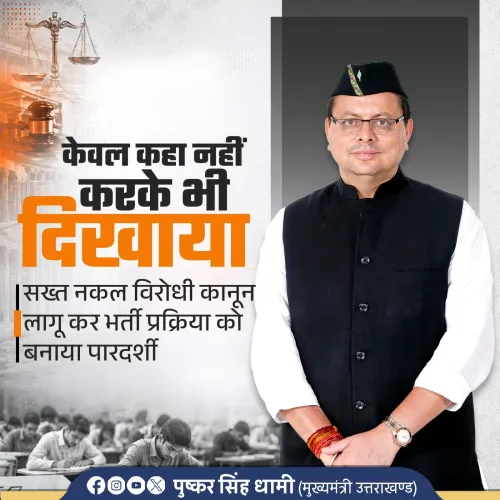
Uttarakhand Chief Minister Pushkar Singh Dhami thanked PM Narendra Modi on 30 July 2026 after the state legislature passed an anti-cheating amendment bill, strengthening the 2023 Public Examinations (Prevention of Unfair Means) Act amid India's broader crackdown on exam fraud.
Key Takeaways
CM Pushkar Singh Dhami publicly thanked PM Narendra Modi after Uttarakhand's anti-cheating amendment bill was passed on 30 July 2026 .
The bill amends the Public Examinations (Prevention of Unfair Means) Act , first enacted by Uttarakhand in 2023 .
The legislation targets cheating, paper leaks, and unfair means in competitive public examinations.
Uttarakhand is among multiple Indian states that have strengthened anti-cheating laws following repeated exam malpractice incidents.
Enforcement mechanisms under the amended law are the critical next step to watch.
Uttarakhand's war on exam fraud just got a fresh chapter. Chief Minister Pushkar Singh Dhami publicly thanked Prime Minister Narendra Modi on Thursday, 30 July 2026, after the state's anti-cheating amendment bill was passed — a move the Chief Minister's Office of Uttarakhand framed as a landmark step in cleaning up the state's public examination system.
The Amendment That Tightened Uttarakhand's Exam Law
The new bill builds on a foundation Uttarakhand laid in 2023, when the state enacted the Public Examinations (Prevention of Unfair Means) Act — one of the early state-level legislative responses to India's spiralling crisis of paper leaks and recruitment exam fraud. The amendment is designed to sharpen that law's teeth, though its exact new provisions are yet to be officially detailed in the public domain.
Dhami's office posted the gratitude in Hindi: 'नकल विरोधी संशोधन विधेयक पारित होने पर प्रधानमंत्री श्री नरेंद्र मोदी जी का मुख्यमंत्री श्री पुष्कर सिंह धामी ने जताया आभार' — ('CM Pushkar Singh Dhami expressed gratitude to Prime Minister Narendra Modi on the passage of the anti-cheating amendment bill'). The framing is deliberate: positioning the legislation as a shared BJP priority between Dehradun and New Delhi.
A National Pattern, One State at a Time
Uttarakhand is not acting in isolation. Across India, states have scrambled to legislate against exam malpractice after a string of high-profile paper leaks shook public confidence in competitive recruitment tests — from constable exams to teacher eligibility tests. The political cost of inaction has become too visible to ignore. Uttarakhand, with its large aspirant population competing for government jobs, sits squarely in that pressure zone.
The passage of this amendment signals that the state intends to stay ahead of the curve — and that the BJP governments in both the state and at the Centre are keen to be seen as the architects of that credibility. Enforcement, however, is where such laws are won or lost.
Whether the amended law delivers on its promise will depend on how swiftly the state deploys its enforcement machinery — and whether other states now feel the legislative pressure to follow.
Point of View
Job-seeking electorate. By publicly crediting PM Modi, CM Dhami reinforces the Centre-state alignment that has been a hallmark of BJP-ruled states. The real test, however, is implementation — India has seen tough exam laws enacted before without the enforcement infrastructure to match. How Uttarakhand operationalises this amendment could either set a template for other states or expose the gap between legislation and delivery.
NationPress
30 Jul 2026
Frequently Asked Questions
What is Uttarakhand's anti-cheating amendment bill 2026?
It is an amendment to Uttarakhand's Public Examinations (Prevention of Unfair Means) Act, 2023 , passed in July 2026 to strengthen legal provisions against cheating and paper leaks in competitive public exams.
Why did CM Dhami thank PM Modi for the anti-cheating bill?
CM Pushkar Singh Dhami expressed gratitude to PM Narendra Modi framing the bill's passage as a shared priority of the BJP governments in Uttarakhand and at the Centre.
When was the anti-cheating amendment bill passed in Uttarakhand?
The bill was passed on or before 30 July 2026 , the date on which CM Dhami publicly acknowledged PM Modi for the development.
What was Uttarakhand's original anti-cheating law?
Uttarakhand enacted the Public Examinations (Prevention of Unfair Means) Act in 2023 , one of the early state-level laws targeting exam fraud and paper leaks in public recruitment tests.
Which other states have passed anti-cheating laws in India?
Multiple Indian states have enacted or strengthened anti-cheating legislation in recent years following repeated incidents of paper leaks and malpractice in public recruitment and eligibility examinations.