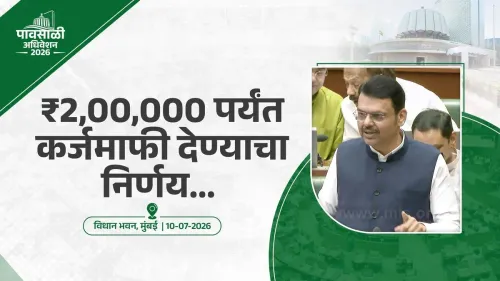
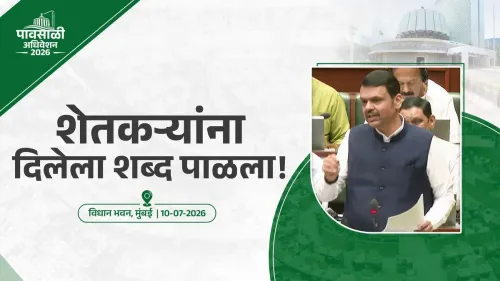
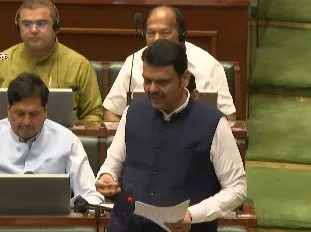
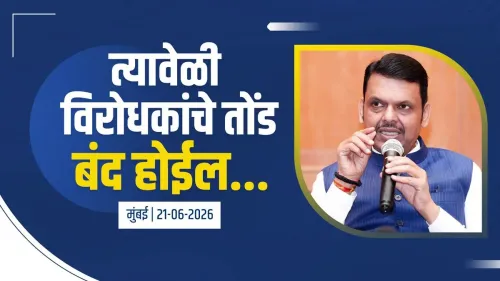
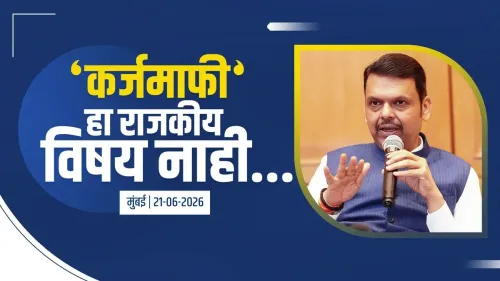
CM Fadnavis Announces Largest-Ever Farm Loan Waiver in Maharashtra
Synopsis
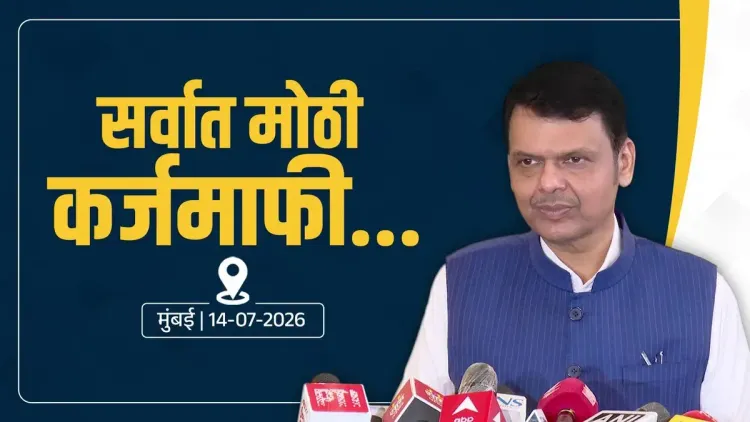
Maharashtra Chief Minister Devendra Fadnavis on 14 July 2026 declared the largest farm loan waiver in the history of both Maharashtra and India. The announcement, made in Mumbai via X in Marathi and Hindi, offers no outlay figure yet. Beneficiary details and disbursement timelines are awaited as the state enters the kharif sowing season.
Key Takeaways
Devendra Fadnavis announced on 14 July 2026 what he termed the largest farm loan waiver in both Maharashtra and India's history.
The declaration was made in Mumbai simultaneously in Marathi and Hindi , signalling a national-scale claim.
No specific outlay figure, eligibility criteria, or disbursement timeline was included in the announcement.
Maharashtra's previous major waiver in 2017 covered crop loans up to Rs 1.5 lakh for small and marginal farmers but faced significant delays.
Fiscal impact on the state budget and coverage of cooperative bank loans remain key details to be disclosed.
The announcement comes during the kharif sowing season , a period of peak financial pressure for Maharashtra's farming community.
Maharashtra Chief Minister Devendra Fadnavis on Tuesday, 14 July 2026, announced what he described as the largest farm loan waiver in the history of both the country and the state, posting the declaration on X from Mumbai. The announcement, made in Marathi and Hindi, signals a sweeping debt-relief push for the state's farming community.
Context
Fadnavis posted in both Marathi and Hindi: 'देशातील आणि राज्यातील सर्वात मोठी शेतकरी कर्जमाफी' — 'The largest farmer loan waiver in the country and the state.' The parallel Hindi line, 'देश और राज्य की सबसे बड़ी किसान ऋण माफी', underscores that the claim is being pitched at a national scale, not merely a state-level measure. No exact outlay figure or eligibility criteria were specified in the post itself.
Maharashtra has one of India's largest farming populations, concentrated heavily in the rain-dependent Vidarbha and Marathwada regions, which have long reported acute agrarian distress and a persistent incidence of farmer suicides.
Policy Backdrop
This is not Maharashtra's first major debt-relief intervention. During Fadnavis's earlier tenure as Chief Minister (2014–2019), the state announced a farm loan waiver in 2017 covering crop loans up to Rs 1.5 lakh for small and marginal farmers — a measure that ran into prolonged delays in disbursement and beneficiary verification. At the national level, the 2008 Agricultural Debt Waiver and Debt Relief Scheme under the central government had set an earlier benchmark for large-scale farm debt relief across India.
State governments across the country have repeatedly turned to loan waivers as a tool to address rural indebtedness, with multiple states — including Uttar Pradesh, Rajasthan, and Punjab — rolling out similar schemes through the 2010s and early 2020s. Economists have noted that while such measures provide immediate cash-flow relief, they often lack accompanying structural reforms in agricultural credit, irrigation, and market access.
Stakeholders and Impact
The primary beneficiaries, if the scheme proceeds as announced, would be small and marginal farmers across Maharashtra — a constituency that has been at the centre of political mobilisation in the state for over a decade. Farmer organisations have consistently demanded comprehensive waivers covering all outstanding institutional loans, not just crop loans below a fixed ceiling.
The announcement is also significant for cooperative banks and regional rural banks that hold a large share of agricultural loan portfolios in the state. The fiscal impact on Maharashtra's state budget will depend on the final scope, eligibility norms, and the mechanism chosen for reimbursement to lending institutions — details that are yet to be made public.
What's Next
The critical next steps will be the formal government resolution detailing the scheme's financial outlay, the categories of loans covered, and the timeline for disbursement. Observers will also watch whether the waiver extends to loans from cooperative credit societies — a sector that has historically been excluded or only partially covered in past schemes.
With Maharashtra's agricultural calendar in the thick of the kharif sowing season, the timing of the announcement carries both economic and political weight. The actual impact on farm households will ultimately hinge on how swiftly and transparently the beneficiary verification process is conducted — a stage where past waivers have frequently stalled.
Point of View
Invoking a superlative that will be scrutinised once the actual outlay figures are released. Farm loan waivers in India have a well-documented pattern: the announcement generates immediate political capital, while the implementation phase — beneficiary lists, bank reimbursement, exclusion disputes — tends to dilute the relief actually delivered. The timing, mid-kharif and mid-tenure, suggests the government is attempting to reset its agrarian narrative ahead of potential local body or assembly cycles. Whether this waiver breaks from the structural limitations of past schemes will depend entirely on the administrative architecture that follows.
NationPress
14 Jul 2026
Frequently Asked Questions
What did CM Devendra Fadnavis announce on 14 July 2026?
Chief Minister Devendra Fadnavis announced what he described as the largest farm loan waiver in the history of both Maharashtra and India, posting the declaration in Marathi and Hindi on X from Mumbai on 14 July 2026.
How much is the Maharashtra farm loan waiver 2026?
The exact financial outlay of the 2026 Maharashtra farm loan waiver has not been disclosed yet. Fadnavis's post did not specify a rupee figure, eligibility ceiling, or beneficiary count; those details are expected in a formal government announcement.
Who will benefit from the Maharashtra farmer loan waiver 2026?
While the specific eligibility criteria are yet to be announced, Maharashtra farm loan waivers have historically targeted small and marginal farmers with outstanding institutional crop loans. Details on whether cooperative bank borrowers are covered are awaited.
What was Maharashtra's previous farm loan waiver?
Maharashtra announced a major farm loan waiver in 2017 during Fadnavis's first tenure as Chief Minister, covering crop loans up to Rs 1.5 lakh for small and marginal farmers, though disbursement faced significant delays.
Is a farm loan waiver good for Maharashtra farmers?
Farm loan waivers provide immediate debt relief and improve short-term cash flow for indebted farmers, but economists caution that without structural reforms in credit access, irrigation, and market linkages, the long-term impact on agrarian distress remains limited.