CM Fadnavis chairs workshop on Maharashtra rural jobs mission
Synopsis
Chief Minister Devendra Fadnavis led a high-level workshop at Vidhan Bhavan, Mumbai on 8 July 2026, to deliberate on the Maharashtra Employment Guarantee (Viksit Bharat — Rozgar and Ajeevika Mission (Gramin)), 2026, a state rural employment initiative aligned with India's Viksit Bharat@2047 vision.
Key Takeaways
Chief Minister Devendra Fadnavis presided over the workshop on 8 July 2026 at Vidhan Bhavan, Mumbai .
The session focused on the Maharashtra Employment Guarantee (Viksit Bharat — Guarantee for Rozgar and Ajeevika Mission (Gramin)), 2026 .
Deputy Chief Minister Sunetra Ajit Pawar and Legislative Council Chairman Prof Ram Shinde were among the senior officials present.
The mission aligns Maharashtra's state-level rural employment guarantee with the central government's Viksit Bharat@2047 development vision.
The workshop is expected to precede formal notification of mission guidelines and possible budget provisions in a forthcoming legislature session.
Primary beneficiaries are rural households and agricultural labourers across Maharashtra.
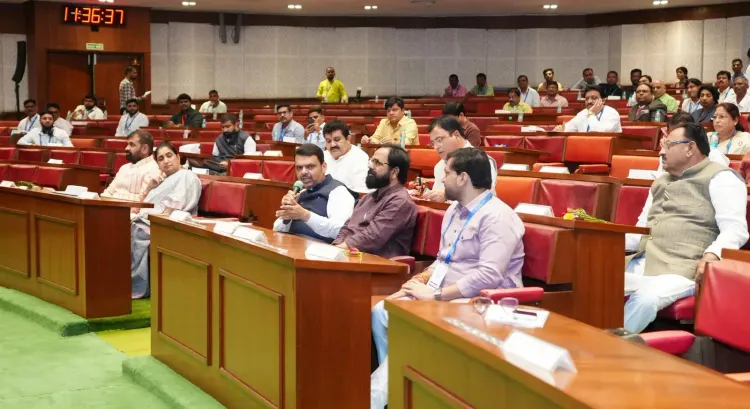
The Chief Minister's Office of Maharashtra announced on Wednesday, 8 July 2026 that Chief Minister Devendra Fadnavis presided over a workshop on the Maharashtra Employment Guarantee (Viksit Bharat — Guarantee for Rozgar and Ajeevika Mission (Gramin)), 2026 at Vidhan Bhavan, Mumbai, at 11.25 am.
Context
The workshop brought together a cross-section of Maharashtra's legislative leadership. Legislative Council Chairman Prof Ram Shinde, Deputy Chief Minister Sunetra Ajit Pawar, and Legislative Council Deputy Chairman Sachin Ahir were among the senior figures present alongside ministers and members of the legislature. The event signals a coordinated push by the state government to align rural employment policy with the central government's Viksit Bharat@2047 development vision.
Policy Backdrop
India's rural employment architecture has been anchored by the Mahatma Gandhi National Rural Employment Guarantee Act (MGNREGA), 2005, which guarantees up to 100 days of wage employment annually to rural households. Maharashtra has a parallel history of state-level employment guarantees, and the new 2026 mission appears to build on both frameworks by nesting state commitments within the Viksit Bharat umbrella — a national mission to make India a developed nation by 2047. The full scheme name, 'Maharashtra Rojgar Hami (Viksit Bharat — Rojgar va Ajeevika Hami Mission (Gramin)), 2026' ('Maharashtra Employment Guarantee — Viksit Bharat Rozgar and Livelihood Guarantee Mission (Rural), 2026'), underscores this dual federal alignment.
Workshops of this nature in Maharashtra have historically preceded the formal notification of mission guidelines, supplementary budget provisions, or the launch of pilot programmes in rural districts. The monsoon session of the Maharashtra legislature is considered a likely forum for any follow-up legislative or financial action.
Stakeholders and Impact
The primary beneficiaries of the proposed mission are rural households and agricultural labourers across Maharashtra, who face acute seasonal unemployment during non-harvest periods. By framing state employment guarantees within the Viksit Bharat mission, the government signals potential convergence of state and central funding streams, which could expand the scale and duration of livelihood support available to rural workers. The presence of the Deputy Chief Minister and the full spectrum of legislative leadership at the workshop indicates that the mission carries political priority for the ruling coalition.
What's Next
The workshop is widely expected to be followed by the formal notification of detailed mission guidelines and the announcement of any associated budget allocations. Observers will watch the next session of the Maharashtra legislature for supplementary demands or a policy statement on the mission's scope, funding mechanism, and district-level rollout plan. How the state reconciles this new guarantee with existing MGNREGA entitlements will be a key question for rural development administrators.
Point of View
Giving the ruling coalition a visible rural welfare credential ahead of potential electoral cycles. By convening legislative leadership — not just bureaucrats — the government is building political ownership of the mission across party lines within the alliance. The alignment with MGNREGA's established architecture could ease implementation, but the unresolved question of how a new state guarantee interacts with central entitlements will test administrative capacity. This event fits a broader pattern of BJP-led states using Viksit Bharat branding to frame state welfare spending as part of a national development narrative.
NationPress
8 Jul 2026
Frequently Asked Questions
What is the Maharashtra Employment Guarantee Viksit Bharat Mission 2026?
It is a state-level rural employment and livelihood initiative titled the 'Maharashtra Employment Guarantee (Viksit Bharat — Guarantee for Rozgar and Ajeevika Mission (Gramin)), 2026', designed to align Maharashtra's rural employment guarantees with the central government's Viksit Bharat@2047 development vision. Full details, funding, and guidelines are yet to be formally notified.
Who attended the Maharashtra rural employment workshop on 8 July 2026?
Chief Minister Devendra Fadnavis presided over the workshop. Also present were Legislative Council Chairman Prof Ram Shinde, Deputy Chief Minister Sunetra Ajit Pawar, Legislative Council Deputy Chairman Sachin Ahir, ministers, and members of the legislature.
How is this mission different from MGNREGA?
MGNREGA is a central law guaranteeing up to 100 days of wage employment to rural households across India. The Maharashtra 2026 mission is a state-level initiative that appears to complement and align with MGNREGA rather than replace it, operating under the Viksit Bharat umbrella. The exact relationship between the two schemes will become clearer once official guidelines are notified.
Where was the Maharashtra employment guarantee workshop held?
The workshop was held at Vidhan Bhavan, Mumbai, on 8 July 2026, beginning at 11.25 am.
What are the next steps after the Maharashtra rural jobs workshop?
The workshop is expected to be followed by formal notification of mission guidelines and possible supplementary budget allocations. The Maharashtra legislature's next session is likely to be the forum for any policy announcements or financial provisions related to the mission.