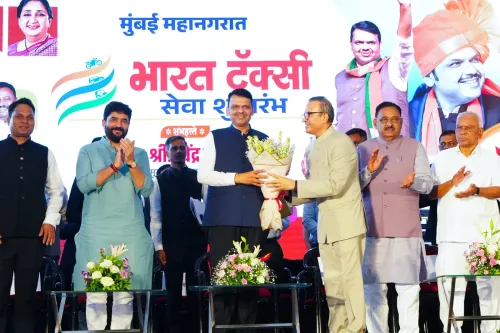
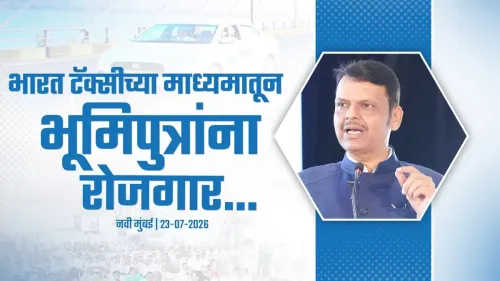
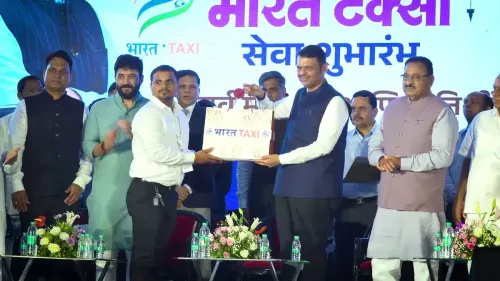
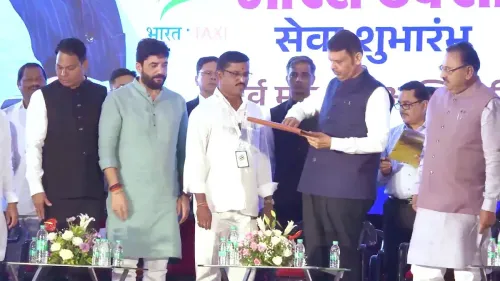
CM Fadnavis Launches Bharat Taxi for Bhumiputras in Navi Mumbai
Synopsis
Maharashtra CM Devendra Fadnavis inaugurated Bharat Taxi in Navi Mumbai on 23 July 2026 through an agreement with the Di. Ba. Patil Cooperative Transport Union, aiming to generate employment for local bhumiputras via an organised cooperative mobility platform.
Key Takeaways
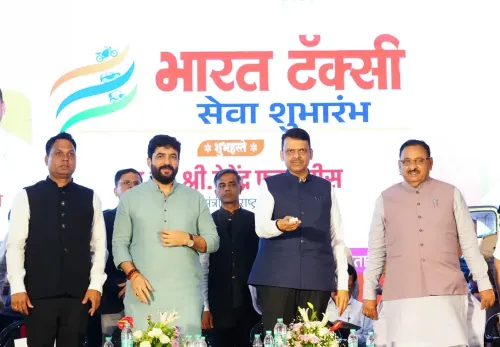
Bharat Taxi was officially launched in Navi Mumbai on 23 July 2026 by Maharashtra CM Devendra Fadnavis .
An agreement with the Swargiya Di.
Patil Sahakari Vahatuk Sangh forms the institutional backbone of the service.
The scheme is explicitly framed around providing employment to bhumiputras — local residents of the region.
The cooperative model allows drivers to collectively own and manage the taxi service, distinct from private aggregator platforms.
Navi Mumbai , a major planned city in the Mumbai Metropolitan Region, is the first launch city for the initiative.
Further rollout to other Maharashtra cities and job-creation data will be key indicators of the scheme's success.
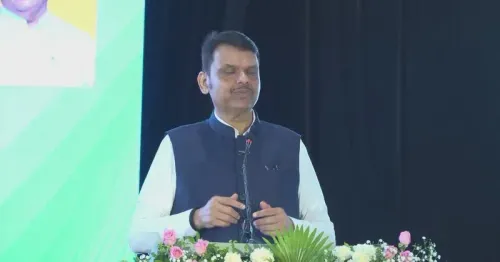
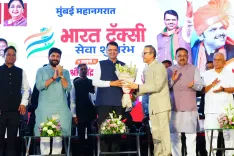
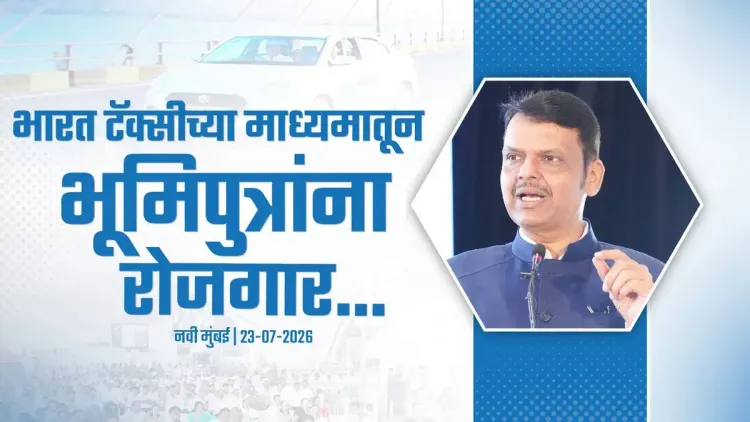
Maharashtra Chief Minister Devendra Fadnavis on Thursday, 23 July 2026, inaugurated the Bharat Taxi service in Navi Mumbai, announcing that an agreement with the Swargiya Di. Ba. Patil Sahakari Vahatuk Sangh (Late D.B. Patil Cooperative Transport Union) will open employment avenues for local residents — referred to as bhumiputras (sons of the soil) — through the new cooperative mobility platform.
Context
Posting in Marathi and Hindi on 23 July 2026, Fadnavis wrote that the agreement with the Swargiya Di. Ba. Patil Sahakari Vahatuk Sangh will make employment opportunities available to bhumiputras through 'Bharat Taxi' — 'भूमिपुत्रांना भारत टॅक्सीच्या माध्यमातून रोजगाराची संधी उपलब्ध होणार आहे' ('employment opportunities will be made available to sons of the soil through Bharat Taxi'). The launch event was held in Navi Mumbai and the official cooperative account @coopbharattaxi was tagged in the post.
The bhumiputra framework has long been a politically significant concept in Maharashtra, prioritising local residents for jobs and economic opportunities in their home regions. Tying a cooperative transport launch to this framework signals an intent to position the scheme as a grassroots employment initiative rather than a purely commercial mobility service.
Policy Backdrop
Maharashtra governments have periodically promoted cooperative societies in the transport sector as a means of generating organised, locally rooted employment. Cooperative transport unions allow drivers and operators to collectively own and manage services, offering an alternative to app-based aggregator platforms where earnings and working conditions are often set by private corporations.
The involvement of the Swargiya Di. Ba. Patil Sahakari Vahatuk Sangh — named after the late political figure D.B. Patil, who is closely associated with Navi Mumbai and the surrounding Raigad region — lends the initiative local cultural and political resonance. The cooperative model, under which the union has entered a formal agreement to operate Bharat Taxi, is intended to ensure that benefits flow directly to member drivers and their families.
Stakeholders and Impact
The primary beneficiaries are local residents seeking livelihoods in the organised transport sector in and around Navi Mumbai, a rapidly expanding planned city in the Mumbai Metropolitan Region. Cooperative membership typically provides drivers access to pooled insurance, maintenance support, and a formal income structure — advantages that informal or aggregator-dependent taxi operators often lack.
Existing cooperative transport unions in the region stand to gain institutional recognition and a structured partnership framework. Commuters in Navi Mumbai could benefit from an expanded, organised taxi network as the city's population and infrastructure continue to grow.
What's Next
Attention will now turn to the pace at which Bharat Taxi onboards drivers and begins commercial operations across Navi Mumbai. The Maharashtra government's stated ambition of prioritising bhumiputras will be measured against concrete job-creation figures as the service scales up.
Observers will also watch whether the cooperative taxi model is extended to other cities in Maharashtra — Pune, Nashik, and Aurangabad being natural candidates — as the state tests whether cooperative mobility can compete with established private aggregators in urban markets.
Point of View
A figure revered in Navi Mumbai and Raigad, Fadnavis ties employment delivery to local identity in a city that is both economically dynamic and politically competitive. The cooperative structure also offers the state a way to claim credit for organised job creation without direct fiscal outlay on salaries. Whether the initiative generates measurable employment at scale, or remains a symbolic launch, will determine its lasting political and policy value.
NationPress
23 Jul 2026
Frequently Asked Questions
What is Bharat Taxi in Navi Mumbai?
Bharat Taxi is a cooperative taxi service launched in Navi Mumbai on 23 July 2026 by Maharashtra CM Devendra Fadnavis, operated through an agreement with the Swargiya Di. Ba. Patil Sahakari Vahatuk Sangh to provide employment to local residents.
Who are bhumiputras and why does the Bharat Taxi scheme target them?
Bhumiputras — literally 'sons of the soil' — refers to local residents of a region in Maharashtra. The Bharat Taxi scheme targets them to ensure that employment generated by the cooperative taxi service benefits people from the local community rather than migrants or outside operators.
What is the Di. Ba. Patil Cooperative Transport Union?
The Swargiya Di. Ba. Patil Sahakari Vahatuk Sangh is a cooperative transport union named after the late D.B. Patil, a political figure associated with Navi Mumbai and the Raigad region. It has entered a formal agreement to operate the Bharat Taxi service.
How is Bharat Taxi different from Ola or Uber?
Unlike private aggregator platforms such as Ola or Uber, Bharat Taxi operates on a cooperative model where drivers and operators collectively own and manage the service, giving members greater control over earnings and working conditions.
Will Bharat Taxi expand to other cities in Maharashtra?
The current launch covers Navi Mumbai. Whether the service expands to cities like Pune, Nashik, or Aurangabad will depend on the scheme's operational success and the Maharashtra government's rollout plans, which have not yet been officially announced.