CM Fadnavis orders clarity on 7/12 co-share land sale rules
Synopsis
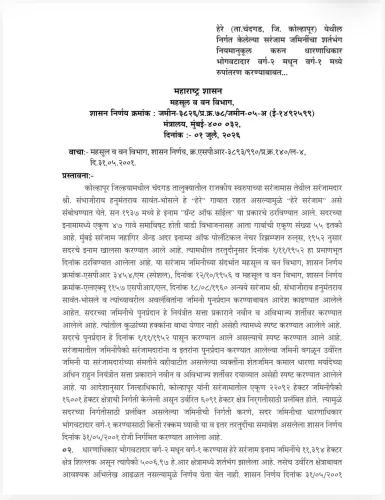
CM Devendra Fadnavis has directed Maharashtra's Revenue Department to issue a circular clarifying 7/12 co-share land sales: attach Bhumi Abhilekh's measurement 'Ka' copy and skip co-sharer NOCs, or produce written consent — a rule designed to slash registration disputes and court filings.
Key Takeaways
The Maharashtra Revenue Department issued a government circular on 22 October 2026 on CM Devendra Fadnavis's directions.
The circular covers registration of share sales on 7/12 joint-ownership land records .
If the seller attaches the Bhumi Abhilekh measurement 'Ka' copy to the deed, no co-sharer NOC or written consent is required.
Without the 'Ka' copy, registration cannot proceed without written consent or NOC from all co-sharers.
The move aims to reduce co-sharer disputes and court petitions arising from undivided land share transactions.
The circular builds on Maharashtra's participation in the Digital India Land Records Modernization Programme launched in 2008.
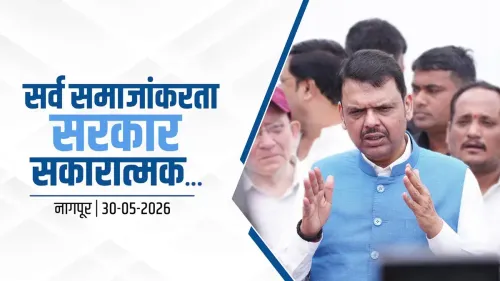
A long-standing pain point for Maharashtra's landowners just got a government-issued fix. Acting on directions from Chief Minister Devendra Fadnavis, the Maharashtra Revenue Department has issued a significant government circular on Thursday, 22 October 2026, bringing sharply defined rules to the registration of land share sales on 7/12 extract records held under joint ownership — a category that has historically been a breeding ground for co-sharer disputes and courtroom battles.
The 'Ka' copy rule that changes everything
The circular draws a clean, binary line. If a seller attaches the Bhumi Abhilekh (Land Records Department) measurement 'Ka' copy — a survey extract that demarcates the specific portion being transacted — to the sale deed, then written consent or a No-Objection Certificate (NOC) from other co-sharers is no longer required for registration. The document itself does the work of proving the boundaries of the share being sold.
But the flip side is equally firm. Without that 'Ka' copy, registrars cannot proceed with registration unless the seller produces written consent or an NOC from every other co-sharer. No document, no exception.
Why 7/12 joint-ownership has been a litigation trap
Maharashtra's 7/12 extract (saat-baara utara) is the foundational record of land ownership in the state — a combined record of rights and cultivation detail maintained at the taluka level. When a plot carries multiple names, any one co-sharer attempting to sell their undivided share has routinely triggered objections, injunctions, and civil suits from the others. Sub-registrar offices, caught without a clear procedural mandate, often either stalled registrations or allowed them through — inconsistently — generating a fresh wave of court petitions either way.
Maharashtra state administration has periodically attempted to plug these gaps, but the ambiguity around undivided-share sales persisted. The new circular, backed by the Chief Minister's direct directions, is the most structured attempt yet to standardise the process at the point of registration itself.
Fitting into Maharashtra's broader land-records reform push
The circular slots into a longer arc. India's Digital India Land Records Modernization Programme, launched in 2008, pushed states to digitise records precisely to reduce the friction — and corruption — around property transactions. Maharashtra has been an active participant, progressively digitising 7/12 extracts and linking them to Aadhaar. The Bhumi Abhilekh department's measurement 'Ka' copy is itself a product of that modernisation, making it a logical pivot for the new compliance requirement.
For the state's revenue officials and sub-registrars, the new rule is essentially a checklist item: Ka copy present — proceed; Ka copy absent — collect all co-sharer NOCs first. That clarity, if uniformly implemented across Maharashtra's hundreds of sub-registrar offices, could measurably cut both registration delays and the volume of property disputes entering district courts.
The real test will be in rollout. Consistency across sub-registrar offices — and awareness among rural landowners that a single survey document can now unlock a sale — will determine whether this circular becomes a genuine de-litigation tool or another reform that looks clean on paper and stalls at the counter.
Point of View
Maharashtra is choking dispute supply at the registration counter itself. For CM Fadnavis, it also reinforces a governance brand built on land-record transparency, an issue with direct electoral resonance among rural and semi-urban Maharashtra. The binary 'Ka-copy-or-NOC' design is deliberately simple, which is its strength — but uniform implementation across hundreds of sub-registrar offices will be the true measure. If the rollout holds, this could become a model other states cite when tackling their own 7/12-equivalent joint-ownership gridlocks.
NationPress
22 Oct 2026
Frequently Asked Questions
What is a 7/12 extract in Maharashtra?
A 7/12 extract ( saat-baara utara ) is a combined official land record maintained at the taluka level in Maharashtra that shows ownership rights and cultivation details for a plot. It is the primary document used in land transactions and legal disputes in the state.
What is the new Maharashtra rule for selling a share of jointly owned land?
Under the new Revenue Department circular, a co-sharer can sell their portion without obtaining written consent or an NOC from other co-sharers — provided they attach the Bhumi Abhilekh measurement 'Ka' copy to the sale deed. If that document is not attached, all co-sharer consent is mandatory before registration.
What is the Bhumi Abhilekh 'Ka' copy?
The 'Ka' copy is a measurement extract issued by Maharashtra's Land Records Department (Bhumi Abhilekh) that identifies and demarcates a specific portion of a plot. Attaching it to a sale deed now allows registration of a co-sharer's portion without requiring NOCs from the other joint owners.
Why do co-sharer land disputes happen so often in Maharashtra?
When multiple names appear on a 7/12 extract, any one person selling their undivided share can trigger objections from the others, leading to civil suits and court injunctions. Sub-registrar offices previously lacked clear procedural guidelines, leading to inconsistent decisions and more litigation.
Will this circular reduce court cases over land in Maharashtra?
The circular is designed to reduce co-sharer disputes and court petitions by setting a clear procedural rule at the point of registration. Whether it succeeds depends on consistent implementation across all sub-registrar offices in the state.