CM Fadnavis pays tribute to Vinoba Bhave on Smruti Din
Synopsis
Maharashtra Chief Minister Devendra Fadnavis paid solemn tribute to Bharat Ratna Acharya Vinoba Bhave on his Smruti Din, honouring the founder of the 1951 Bhoodan movement — a Gandhian campaign that sought voluntary land redistribution for India's landless farmers.
Key Takeaways
Maharashtra CM Devendra Fadnavis posted a tribute to Acharya Vinoba Bhave on his Smruti Din, 15 November 2026 .
Bhave founded the Bhoodan movement in 1951 at Pochampally, Telangana , advocating voluntary land donation to the landless.
The movement was rooted in Gandhian principles of non-violence and moral persuasion — no coercion or legislation involved.
Bhave was awarded the Bharat Ratna , India's highest civilian honour, for his transformative social contributions.
Bhave was born in Gagode, Maharashtra in 1895 , giving his legacy special significance in the state.
Seventy-five years after a Gandhian saint walked into a village in Telangana and asked its landlords to give away land — and they did — Maharashtra Chief Minister Devendra Fadnavis paused on Sunday, 15 November 2026 to honour the man who made that moment possible.
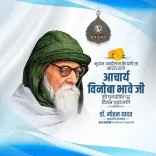
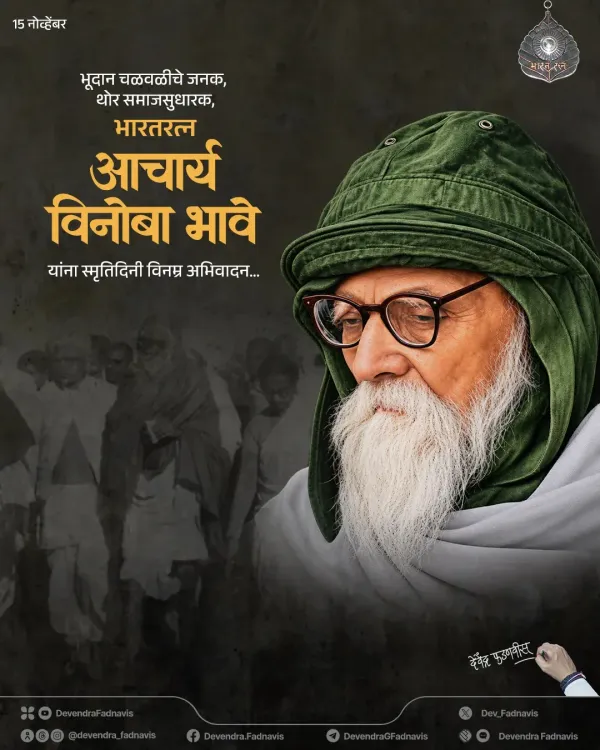
Posting on the occasion of Acharya Vinoba Bhave's Smruti Din (death anniversary), CM Fadnavis wrote: 'Humble tributes to the father of the Bhoodan movement, whose lifelong dedication to non-violence and social reform remains an enduring inspiration in the pursuit of a harmonious society.' In Marathi, he added, 'भूदान चळवळीचे जनक, थोर समाजसुधारक, भारतरत्न 'आचार्य विनोबा भावे' यांना स्मृतिदिनी विनम्र अभिवादन' — 'Humble salutations on the death anniversary of the father of the Bhoodan movement, great social reformer, Bharat Ratna Acharya Vinoba Bhave.'
The movement that asked landlords to give — and they listened
Vinoba Bhave launched the Bhoodan movement in 1951 at Pochampally, Telangana, drawing directly from Mahatma Gandhi's principles of non-violent social change. The idea was radical in its simplicity: walk from village to village across India and appeal to landowners' conscience to voluntarily donate a portion of their land to the landless. No coercion, no legislation — only moral persuasion.
Bhave eventually covered thousands of kilometres on foot across the subcontinent. The movement drew millions of acres in pledges, reshaping conversations about agrarian equity long before land reform became a standard policy vocabulary. The Government of India later conferred upon him the Bharat Ratna, the nation's highest civilian honour, in recognition of this transformative contribution.
Maharashtra's Gandhian thread
Vinoba Bhave was born in Gagode, Maharashtra in 1895, making his legacy particularly resonant in the state. As Chief Minister of Maharashtra, Fadnavis's tribute carries institutional weight — placing the state government's moral authority behind the values of voluntary reform and rural dignity that Bhave embodied. Indian political leaders across parties routinely mark such death anniversaries, but Bhave's standing as a Gandhian reformer with a concrete, documented mass movement gives these tributes a sharper context than most.
His legacy endures in Maharashtra's cultural and educational programmes that continue to cite Gandhian non-violence as a foundational value. For a state with significant agrarian communities, the memory of a man who moved land without force remains more than ceremonial.
Point of View
Making invocations of his legacy particularly pointed amid ongoing debates over rural land rights and farmer welfare. For the BJP in Maharashtra, honouring a figure associated with Congress-era Gandhianism also reflects the party's ongoing effort to claim a broad, cross-ideological nationalist heritage. The tribute is ceremonial in form but quietly stakes a position on the value of non-violent, consensus-based social reform.
NationPress
15 Nov 2026
Frequently Asked Questions
Who was Acharya Vinoba Bhave?
Acharya Vinoba Bhave was a Gandhian social reformer born in Gagode, Maharashtra in 1895. He is best known for founding the Bhoodan movement in 1951, which sought voluntary land donations from landlords to distribute to landless farmers across India. He was awarded the Bharat Ratna, India's highest civilian honour.
What is the Bhoodan movement?
The Bhoodan movement was launched by Vinoba Bhave in 1951 at Pochampally, Telangana. It was a non-violent land reform campaign in which Bhave walked across India appealing to landowners to voluntarily donate a portion of their land to the landless poor, drawing directly from Mahatma Gandhi's principles.
When is Vinoba Bhave's Smruti Din?
Vinoba Bhave's Smruti Din, or death anniversary, is observed on 15 November each year. Maharashtra Chief Minister Devendra Fadnavis paid tribute to him on this occasion in 2026.
Why did Devendra Fadnavis pay tribute to Vinoba Bhave?
CM Devendra Fadnavis paid tribute to mark Vinoba Bhave's Smruti Din, honouring his legacy as the founder of the Bhoodan movement and a Bharat Ratna recipient. Bhave was born in Maharashtra, making his memory especially significant for the state's leadership.
Where did the Bhoodan movement start?
The Bhoodan movement began in 1951 at Pochampally, a village in present-day Telangana, when Vinoba Bhave first appealed to local landlords to voluntarily donate land to the landless. He then walked thousands of kilometres across India continuing this appeal.