CM Gujarat Hails Jamnagar Engineer Behind Vikram-1 Rocket
Synopsis
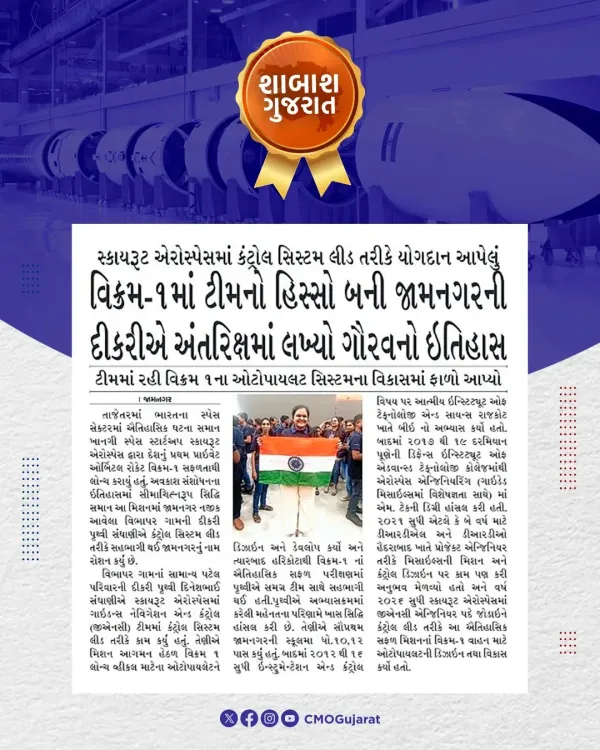
The Chief Minister's Office of Gujarat has celebrated Prithvi Sanghani, a young engineer from Vibhapar village in Jamnagar, for her role as Control System Lead on Vikram-1 — India's first private orbital rocket — calling her a symbol of Nari Shakti and national self-reliance in space.
Key Takeaways
The Chief Minister's Office of Gujarat posted on 20 July 2026 honouring Prithvi Sanghani from Vibhapar village, Jamnagar district .
Sanghani served as Control System Lead on Vikram-1 , described as India's first private orbital rocket .
She designed and developed the autopilot system for the Vikram-1 launch vehicle.
The CMO framed her achievement as advancing Atmanirbharta (self-reliance) in India's space sector.
The mission falls under the framework of IN-SPACe , established in 2020 to enable private sector participation in Indian space activities.
The post highlights the growing role of women engineers from non-metropolitan regions in India's space programme.
The Chief Minister's Office of Gujarat on Monday, 20 July 2026 lauded Prithvi Sanghani, a daughter of Vibhapar village in Jamnagar district, for her pivotal role as Control System Lead in India's first private orbital rocket mission, Vikram-1, calling her achievement a historic moment for the state and the nation.
What the CMO Said
Posting in Gujarati under the hashtag #શાબાશ_ગુજરાત ('Bravo, Gujarat'), the CMO wrote that under the leadership of Prime Minister Narendra Modi, the strength and progress of the nation's 'Nari Shakti' (women power) has reached new heights. It specifically credited Sanghani with designing and developing the autopilot system for the Vikram-1 launch vehicle, stating that her contribution has 'illuminated Gujarat's name across the country and the world.'
The post described Sanghani as 'Gujarat's true pride' and framed the rocket's historic flight as a new milestone in India's resolve for self-reliance — Atmanirbharta — in the space sector.
Context
Vikram-1 is developed by a private Indian aerospace firm as part of India's expanding commercial space ecosystem. The mission marks a significant step: no private Indian company had previously placed a rocket in orbit. Sanghani's role as Control System Lead placed her at the centre of one of the most technically demanding aspects of the mission — the autopilot guidance that steers the vehicle from launch through orbital insertion.
Her roots in Vibhapar, a small village in Jamnagar district, have made her story a symbol of how India's space ambitions are drawing talent from beyond traditional metropolitan hubs.
Policy Backdrop
The Vikram-1 mission sits within a broader structural shift in Indian space policy. The government established IN-SPACe (Indian National Space Promotion and Authorisation Centre) in 2020 to open the sector to private players, allowing startups to design, build, and launch rockets and satellites with regulatory oversight outside ISRO's direct mandate.
This liberalisation aligns with the Atmanirbhar Bharat initiative, also announced in 2020, which prioritises indigenous development across defence, space, and advanced technology. The success of ISRO's Chandrayaan-3 lunar mission in 2023 added momentum to India's space ambitions and raised the profile of private-sector participation in follow-on missions.
Stakeholders and Impact
For women engineers across India, Sanghani's recognition by the Gujarat government carries symbolic weight: a woman from a rural district leading the control systems of a nationally significant rocket mission challenges longstanding assumptions about who participates in cutting-edge aerospace work. Observers note that her profile could inspire STEM enrolment among young women in Gujarat and other states.
Private space startups stand to benefit from the visibility the Vikram-1 mission generates, potentially attracting investment and skilled talent. The CMO's post also reinforces Gujarat's positioning as a state that nurtures technology talent, a narrative the state government has cultivated alongside its industrial investment drives.
What's Next
Attention now turns to follow-on orbital missions by India's emerging private launch firms and to any new policy directions from IN-SPACe on technology transfer, funding mechanisms, and launch frequency. At the state level, Gujarat may look to formalise STEM outreach programmes for women — particularly in districts like Jamnagar — to build on the momentum that Prithvi Sanghani's achievement has generated.
Point of View
Gujarat's government aligns a genuine technological milestone with a national electoral and policy brand. The choice to spotlight a woman engineer from a small village — rather than the company or the mission itself — reflects a deliberate effort to humanise and democratise the space success story for a broad domestic audience. This pattern of state governments amplifying central policy wins through local human-interest angles has become a standard feature of Indian political communication. Longer term, the post raises expectations that Gujarat will back its rhetoric with concrete STEM investment in districts like Jamnagar.
NationPress
21 Jul 2026
Frequently Asked Questions
Who is Prithvi Sanghani and what did she do in the Vikram-1 mission?
Prithvi Sanghani is an engineer from Vibhapar village in Jamnagar district, Gujarat, who served as Control System Lead on Vikram-1, India's first private orbital rocket. She designed and developed the autopilot system that guided the launch vehicle during its historic flight.
What is the Vikram-1 rocket?
Vikram-1 is India's first private orbital rocket, developed by a domestic aerospace startup. Its mission represents a landmark in India's commercial space sector, which has been opened to private players through the IN-SPACe regulatory framework established in 2020.
Why did the Gujarat CMO post about Prithvi Sanghani?
The Chief Minister's Office of Gujarat posted on 20 July 2026 to celebrate Sanghani's contribution to the Vikram-1 mission, framing her as a symbol of Gujarat's talent and of the national Nari Shakti (women's empowerment) vision championed by Prime Minister Narendra Modi.
What is IN-SPACe and how does it relate to Vikram-1?
IN-SPACe, or the Indian National Space Promotion and Authorisation Centre, was established in 2020 to regulate and promote private sector participation in India's space activities. It provides the policy framework under which private firms like the Vikram-1 developer operate.
What does Atmanirbhar Bharat mean for India's space sector?
Atmanirbhar Bharat, meaning 'self-reliant India,' is a government initiative announced in 2020 that encourages indigenous development across strategic sectors including space. The Vikram-1 mission, with its domestically designed control systems, is cited as an example of this self-reliance goal being realised.