CM Rekha Gupta Hails Modi's Financial Inclusion Drive
Synopsis
Delhi Chief Minister Rekha Gupta on 8 June 2026 praised PM Modi's financial inclusion record under the #12YearsOfGaribKalyan banner, saying every Indian now has a bank account enabling direct access to government welfare schemes — a shift anchored in the 2014 Jan Dhan Yojana launch.
Key Takeaways
Delhi CM Rekha Gupta posted on 8 June 2026 under #12YearsOfGaribKalyan , crediting PM Modi with universal bank-account coverage in India.
She noted that India was once globally criticised for having crores of citizens without bank accounts — a situation she says has been fully reversed.
The Pradhan Mantri Jan Dhan Yojana , launched on 28 August 2014 , is the flagship scheme underpinning this financial inclusion drive.
The JAM trinity — Jan Dhan , Aadhaar , and Mobile — enabled the Direct Benefit Transfer system, routing welfare payments directly to beneficiaries.
The post is part of a broader BJP campaign marking 12 years of its welfare governance agenda ahead of potential new scheme announcements.
Delhi Chief Minister Rekha Gupta on Monday, 8 June 2026, credited Prime Minister Narendra Modi with transforming India's financial landscape, saying that a country once globally noted for its vast unbanked population now ensures every citizen holds a bank account — enabling direct access to government welfare schemes.
Posting under the hashtag #12YearsOfGaribKalyan, CM Gupta wrote in Hindi: 'किसी दौर में दुनिया में चर्चा होती थी कि करोड़ों भारतीयों के पास बैंक खाते तक नहीं हैं' ['There was a time when the world talked about how crores of Indians did not even have bank accounts'], adding that PM Modi's vision had changed the entire picture and that citizens can now directly avail countless government schemes.
Context
The post marks what the BJP is framing as 12 years of its welfare governance agenda under the 'Garib Kalyan' (welfare of the poor) banner. CM Gupta, as Delhi's chief minister and a senior BJP leader, has consistently amplified the central government's social-sector record. The hashtag signals a coordinated party effort to highlight a decade-plus of welfare delivery milestones.
Policy Backdrop
The foundation of the claim rests on the Pradhan Mantri Jan Dhan Yojana (PMJDY), launched on 28 August 2014, which set out to open bank accounts for every unbanked household in India. The scheme became the first pillar of the JAM trinity — Jan Dhan accounts, Aadhaar biometric identity, and Mobile linkage — a framework promoted from 2014 onward to channel welfare transfers directly to beneficiaries and reduce leakages in subsidy delivery.
The Direct Benefit Transfer (DBT) mechanism, built on top of PMJDY, has since been used across food, fuel, fertiliser, and pension schemes to shift from in-kind distribution to cash credits deposited straight into account holders' accounts. Successive central budgets have cited DBT as a tool for fiscal efficiency and anti-corruption in welfare administration.
Stakeholders and Impact
The primary beneficiaries of universal bank-account coverage are households that were previously excluded from formal finance — particularly rural, low-income, and migrant-worker families who had limited access to branches or documentation. For these groups, a Jan Dhan account opened pathways to receiving PM-KISAN instalments, LPG subsidies, MGNREGS wages, and pandemic-era cash transfers without intermediaries.
Critics of the broader Garib Kalyan framing have argued that account ownership does not automatically translate to active financial inclusion, pointing to dormant-account rates and the need for last-mile banking infrastructure. However, the government's position — reflected in CM Gupta's post — is that universal account access marks a structural shift in welfare architecture.
What's Next
The #12YearsOfGaribKalyan campaign is likely to intensify through June 2026 as the party marks the anniversary of its welfare governance record. Updated Jan Dhan account-opening figures and DBT volume data are expected to be cited in forthcoming official reports, which will provide a clearer picture of the programme's current scale. The political spotlight on financial inclusion also sets the stage for potential new targets or scheme expansions to be announced in the near term.
Point of View
Reinforcing the party's 'Garib Kalyan' brand ahead of what is likely a structured anniversary communications push. The framing of universal bank accounts as a civilisational shift — from global embarrassment to complete coverage — is a well-worn but politically potent narrative that ties PM Modi's identity directly to pro-poor reform. What is notable is the emphasis on 'direct' benefit access, which implicitly contrasts the current architecture with the pre-2014 leakage-prone system without naming it. As the BJP marks 12 years of welfare governance, such posts function less as news and more as political testimony, building a cumulative record that will be deployed in electoral messaging.
NationPress
22 Oct 2026
Frequently Asked Questions
What is the #12YearsOfGaribKalyan hashtag about?
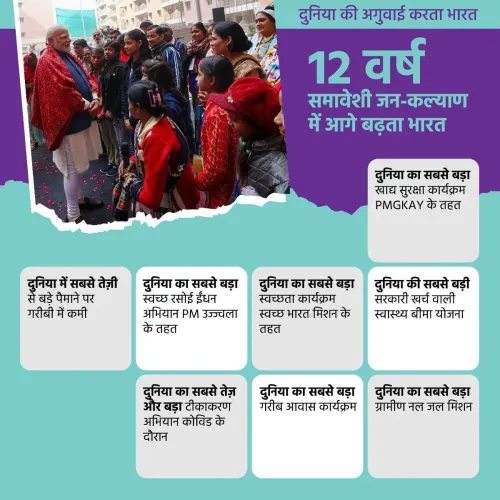
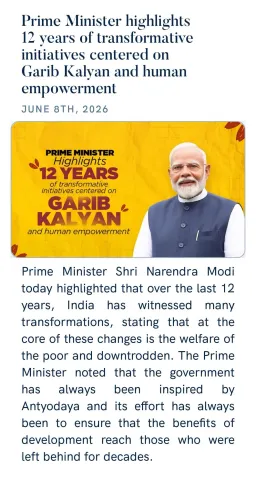
The #12YearsOfGaribKalyan hashtag marks 12 years of the BJP -led central government's welfare agenda under PM Modi, which began in 2014 . It is being used by party leaders to highlight achievements such as universal bank-account coverage, direct benefit transfers, and other social-sector programmes.
What is the Pradhan Mantri Jan Dhan Yojana?
The Pradhan Mantri Jan Dhan Yojana (PMJDY) is a national financial inclusion mission launched by PM Modi on 28 August 2014 to open zero-balance bank accounts for every unbanked household in India. It forms the foundation of the government's Direct Benefit Transfer architecture.
What did Delhi CM Rekha Gupta say about PM Modi and bank accounts?
Delhi CM Rekha Gupta said that while India was once globally noted for crores of citizens lacking bank accounts, PM Modi 's vision has changed the entire picture and every citizen now has an account, allowing them to directly avail countless government schemes.
How does Jan Dhan help welfare scheme beneficiaries?
A Jan Dhan account linked with Aadhaar and a mobile number allows the government to transfer subsidies and scheme benefits — such as PM-KISAN payments, LPG subsidies, and pension credits — directly into a beneficiary's account, cutting out intermediaries and reducing leakages.
What is the JAM trinity in Indian policy?
The JAM trinity stands for Jan Dhan accounts, Aadhaar biometric identity, and Mobile connectivity. Promoted from 2014 onward, it is the infrastructure backbone that enables Direct Benefit Transfers across food, fuel, fertiliser, and social-security schemes in India.