CM Himanta targets 10 lakh litres daily milk output for Assam
Synopsis
Assam Chief Minister Himanta Biswa Sarma has announced a daily milk production target of 10 lakh litres alongside direct subsidies for dairy farmers, framing the push as the foundation of a self-reliant Assam and a boost to rural nutrition and livelihoods.
Key Takeaways
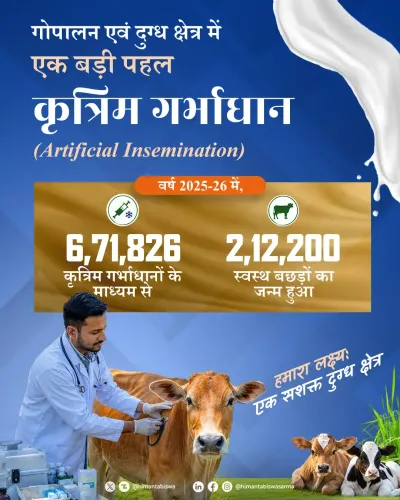
Assam CM Himanta Biswa Sarma has announced a daily milk production target of 10 lakh litres for the state.
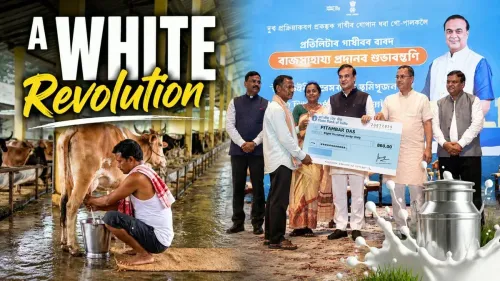
Direct subsidies for dairy farmers are being introduced alongside the production target to secure rural livelihoods.
The initiative aims to reduce Assam's dependence on milk imports from other states and strengthen the rural economy.
The plan aligns with national Atmanirbhar Bharat goals for food security and self-reliance in agriculture.
India's Operation Flood (1970) built the cooperative dairy model that raised national output from 21 million tonnes to over 200 million tonnes — the framework Assam now seeks to replicate at state scale.
State budget allocations for dairy and annual production data from the Assam Animal Husbandry department will be key indicators of implementation progress.
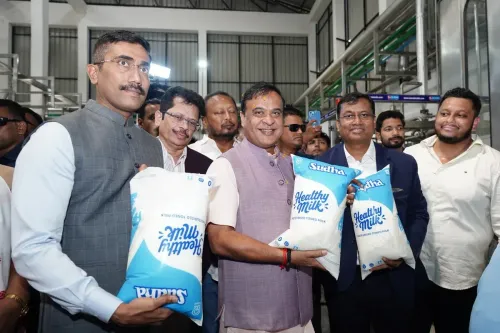
A daily milk production target of 10 lakh litres and direct subsidies for dairy farmers — Assam Chief Minister Himanta Biswa Sarma is betting on the white economy to rewire the state's rural heartland. The announcement, made on Friday, 30 October 2026, frames dairy not as a peripheral livestock concern but as the load-bearing pillar of a self-reliant Assam.
A production target that resets the baseline
Sarma's stated goal of 10 lakh litres of milk per day sets a concrete, measurable benchmark for a state that has historically depended on milk imports from neighbouring states to meet its urban demand. Assam, with a predominantly rural population whose livelihoods are tied to agriculture and allied sectors, has long had the livestock base to be a net producer — but fragmented infrastructure and low farm-gate prices kept that potential locked in. A production target of this scale, paired with direct subsidies to farmers, is designed to change that arithmetic.
How Operation Flood's legacy shapes Assam's ambition
India's dairy transformation has a well-documented blueprint. Operation Flood, launched in 1970, built the cooperative model that drove national milk output from 21 million tonnes that year to over 200 million tonnes by the 2020s — one of the most consequential agricultural revolutions in the country's history. Assam was among the states that received the programme's later extensions, but its dairy sector never scaled at the pace of Gujarat or Punjab. Sarma's current push — with its explicit subsidy mechanism and production floor — is an attempt to use the same cooperative-and-incentive logic to finally move the needle in the North-East.
Livelihoods, nutrition, and the Atmanirbhar thread
The Chief Minister linked the dairy push to three interlocking goals: 'better nutrition, secure farmer livelihoods and a more resilient rural economy'. Each is a pressure point in Assam — the state's rural districts carry significant nutritional deficiency burdens, smallholder farming incomes remain volatile, and the rural economy is vulnerable to commodity price swings. A stronger dairy sector addresses all three simultaneously: it raises protein availability, gives farmers a recurring daily income rather than a seasonal harvest cheque, and builds a commodity chain that keeps value inside the state. The framing also aligns neatly with the national Atmanirbhar Bharat agenda, positioning Assam's dairy ambition within a larger self-reliance story that the BJP has championed federally.
What to watch as the plan takes shape
The credibility of the target will be tested in the next budget cycle. State allocations for dairy subsidies and annual milk production data from the Assam Animal Husbandry department will be the clearest early signals of whether the political commitment is being backed by fiscal muscle. The direct subsidy mechanism — its design, the farmer eligibility criteria, and the price-support floor — will determine whether smallholders actually benefit or whether the gains concentrate in larger commercial operations. That detail is the difference between a policy and a transformation.
Point of View
A proven mobilisation tool. The real test is fiscal: direct subsidies are politically popular but budget-intensive, and Assam's finances have historically constrained ambition in the livestock sector. If the subsidy mechanism reaches genuine smallholders rather than commercial dairy operations, it could meaningfully shift income curves in rural districts — but that design detail is still to emerge.
NationPress
30 Oct 2026
Frequently Asked Questions
What is Assam's daily milk production target announced by CM Himanta?
Assam Chief Minister Himanta Biswa Sarma has announced a daily milk production target of 10 lakh litres, paired with direct subsidies for dairy farmers to achieve this goal.
Why is Assam focusing on dairy sector development?
Assam has historically imported milk from other states to meet urban demand. A stronger dairy sector is seen as a way to secure farmer livelihoods, improve nutrition, and build a more resilient rural economy while reducing dependence on outside supply.
What is Operation Flood and how does it relate to Assam's dairy push?
Operation Flood was a national dairy development programme launched in 1970 that created cooperatives and raised India's milk output from 21 million tonnes to over 200 million tonnes. Assam's current push draws on the same cooperative-and-incentive model to scale up production in the North-East.
What subsidies are being offered to Assam dairy farmers?
CM Sarma has announced direct subsidies for dairy farmers as part of the initiative, though the precise eligibility criteria and support mechanism are yet to be detailed in official public records.
How does Assam's dairy plan connect to Atmanirbhar Bharat?
The initiative aligns with the national Atmanirbhar Bharat goal of self-reliance in agriculture and allied sectors, positioning Assam as a state that produces, rather than imports, a key food commodity — a framing the BJP has championed both nationally and in the state.