CM Himanta Greets Assam on Rath Yatra, Cites Vaishnav Roots
Synopsis
Assam Chief Minister Himanta Biswa Sarma marked Rath Yatra on 16 July 2026 by invoking the state's Vaishnavite heritage and describing the chariot festival as a living symbol of India's Sanatan cultural consciousness, praying for peace and prosperity for all.
Key Takeaways
Assam Chief Minister Himanta Biswa Sarma posted Rath Yatra greetings on 16 July 2026 .
He described the festival as 'a living symbol of India's Sanatan cultural consciousness.' He highlighted Assam's Vaishnavite tradition , noting Lord Jagannath is worshipped as the 'sustainer of the universe.' The message connects Assam's regional devotional identity — rooted in the legacy of Srimanta Sankardev — to a pan-Indian Hindu cultural framework.
BJP-led governments in the Northeast routinely use such festival messaging to align regional traditions with a national cultural narrative.
State-level Rath Yatra processions across Assam and possible cultural infrastructure announcements are expected in the coming days.
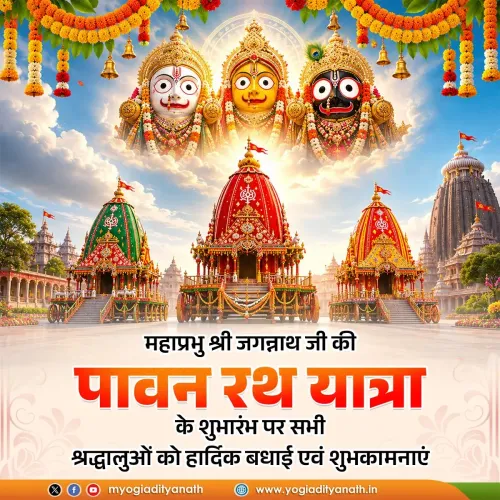
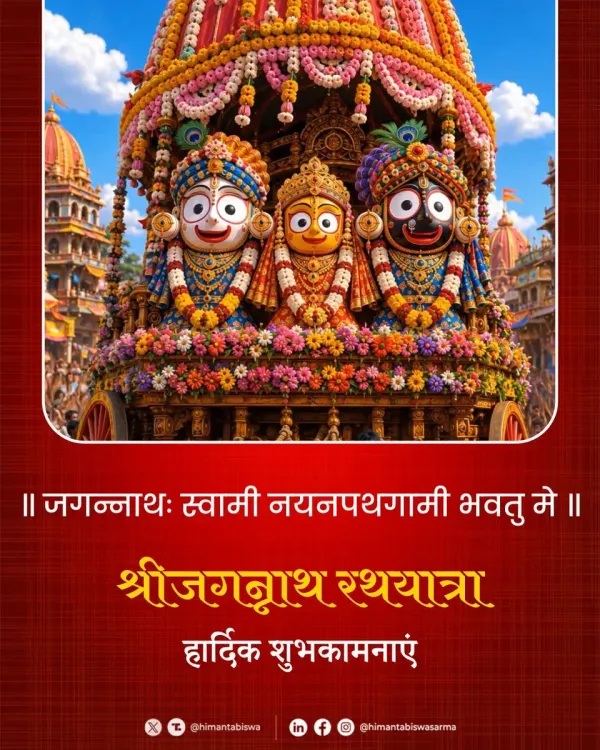
Assam Chief Minister Himanta Biswa Sarma on Thursday, 16 July 2026, extended greetings on the occasion of Rath Yatra, invoking Assam's Vaishnavite heritage and describing the festival as a living symbol of India's Sanatan cultural consciousness.
Posting in Hindi on X, the Chief Minister wrote: 'भगवान श्री जगन्नाथ जी की रथयात्रा भारत की सनातन सांस्कृतिक चेतना का जीवंत प्रतीक है' — 'The Rath Yatra of Lord Shri Jagannath is a living symbol of India's Sanatan cultural consciousness.' He added that in Assam's Vaishnavite tradition and public life, Lord Jagannath is reverently worshipped as the 'sustainer of the universe,' and prayed that by his grace, all may live lives filled with happiness, peace, and prosperity.
Context
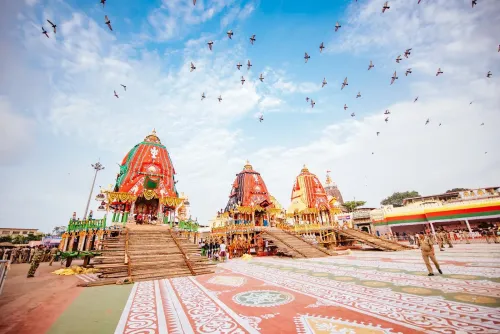
Rath Yatra is one of the oldest and most widely observed Hindu festivals in India, centred on the chariot procession of Lord Jagannath, his brother Balabhadra, and sister Subhadra. While the festival's most prominent observance is at the Jagannath Temple in Puri, Odisha, it is celebrated across the country, including in Assam, where Vaishnavite communities hold processions and prayers.
Sarma's message explicitly links Assam's regional religious identity to a pan-Indian Sanatan framework — a rhetorical bridge that connects the northeastern state's distinct devotional traditions to the broader national cultural narrative.
Policy Backdrop
Assam's Vaishnavite heritage traces its institutional roots to Srimanta Sankardev, the 15th–16th century saint-scholar who established the Ek Saran Nam Dharma movement and founded Sattras — monastic institutions that remain central to Assamese cultural and social life. This tradition gives Vaishnavism a distinctly Assamese character, separate from the Puri-centric mainstream.
The BJP-led government in Assam has, over the past decade, consistently emphasised this Vaishnavite heritage as a marker of indigenous Assamese identity. Public messaging on pan-Indian Hindu festivals has become a regular feature of the state administration's cultural outreach, positioning Assam's traditions within a national Hindu cultural continuum while also asserting their regional uniqueness.
Stakeholders and Impact
The message is directed primarily at Vaishnavite communities and Assamese devotees who observe Rath Yatra across the state. In Assam, the festival is observed at Sattras, temples, and community spaces, drawing participation from diverse sections of society.
By framing Lord Jagannath as 'jagat ke palankarta' — the sustainer of the world — the Chief Minister's message resonates with both the Odia devotional tradition and Assam's own Vaishnavite vocabulary, reinforcing cultural solidarity across state lines in the BJP's northeastern political base.
What's Next
State-level Rath Yatra processions are expected to be held across Assam in the days following the festival's commencement. Observers will watch whether the government follows the greeting with concrete announcements on cultural tourism, Sattra infrastructure, or temple development — areas where the Sarma administration has previously signalled intent. The festival season also typically marks a period of heightened cultural diplomacy between Assam and Odisha, given their shared devotion to Lord Jagannath.
Point of View
Long-running effort by the BJP in Assam to embed the state's Vaishnavite identity within a pan-Indian Sanatan cultural framework — a project that simultaneously asserts Assamese cultural distinctiveness and signals alignment with the party's national Hindu heritage narrative. By invoking Srimanta Sankardev's tradition in the same breath as a festival most associated with Puri, the Chief Minister reinforces the idea that Assam's religious culture is not peripheral but integral to India's civilisational mainstream. This kind of festival diplomacy also serves a practical political function: consolidating support among Vaishnavite communities who form a significant electoral constituency in the Brahmaputra valley. The message carries no new policy content, but its cultural signalling is consistent with the Sarma government's broader identity politics playbook ahead of any future electoral cycle.
NationPress
16 Jul 2026
Frequently Asked Questions
What is Rath Yatra and why is it significant in Assam?
Rath Yatra is an annual Hindu chariot festival honouring Lord Jagannath, celebrated most famously in Puri, Odisha, but also widely observed in Assam, where the Vaishnavite tradition established by saint-scholar Srimanta Sankardev in the 15th–16th century gives the festival deep cultural resonance.
What did Himanta Biswa Sarma say about Rath Yatra?
CM Himanta Biswa Sarma described Rath Yatra as 'a living symbol of India's Sanatan cultural consciousness' and said that in Assam's Vaishnavite tradition, Lord Jagannath is revered as the 'sustainer of the universe,' praying for happiness, peace, and prosperity for all.
Why does the BJP emphasise Vaishnavite heritage in Assam?
The BJP has positioned Assam's Vaishnavite heritage — rooted in the Sattra institutions of Srimanta Sankardev — as a marker of indigenous Assamese identity, linking it to a broader national Hindu cultural narrative while distinguishing the state from neighbouring Christian-majority hill states.
Who was Srimanta Sankardev and what is his connection to Rath Yatra in Assam?
Srimanta Sankardev was a 15th–16th century Assamese saint-scholar who founded the Ek Saran Nam Dharma movement and established Sattras — monastic institutions that remain central to Assamese culture — making Vaishnavism, including the veneration of Lord Jagannath, integral to Assam's public religious life.
Is Rath Yatra a public holiday in Assam?
Rath Yatra is widely observed across Assam with processions and prayers at Sattras and temples, though its status as a formal public holiday varies by district and institution.