CM Himanta Launches 1-Crore Sapling Drive for I-Day
Synopsis
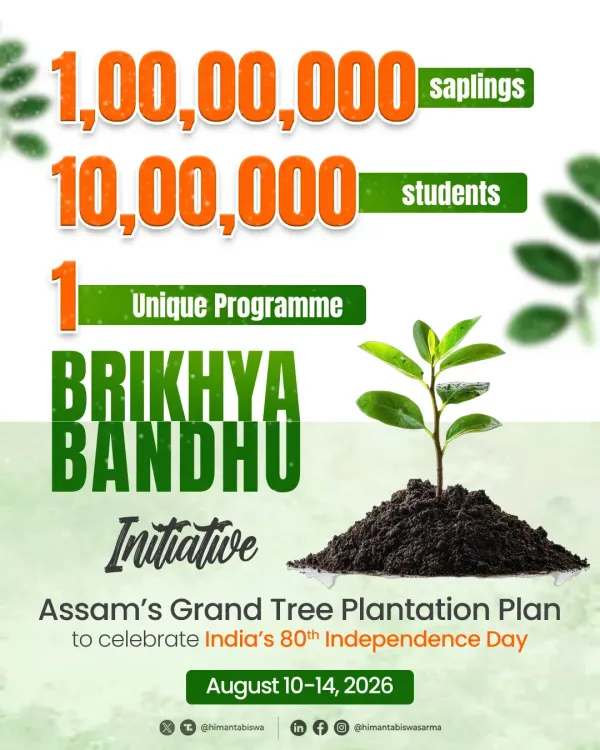
Assam Chief Minister Himanta Biswa Sarma has announced the Brikhya Bandhu initiative, under which 10 lakh students will plant and nurture 1 crore saplings to mark India's 80th Independence Day on 15 August 2027, scaling the state's decades-long afforestation tradition.
Key Takeaways
10 lakh students across Assam will participate in the Brikhya Bandhu plantation drive.
The target is 1 crore saplings to be planted and nurtured — not merely planted and left.
The drive is pegged to India's 80th Independence Day on 15 August 2027 .
CM Himanta Biswa Sarma announced the initiative via a post on X on 3 July 2026 .
The initiative builds on Assam's history of student-linked afforestation going back to Van Mahotsav drives since the 1950s.
Survival monitoring and funding mechanisms for Brikhya Bandhu have not yet been publicly detailed.
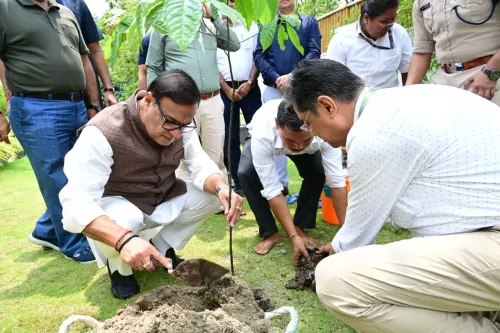
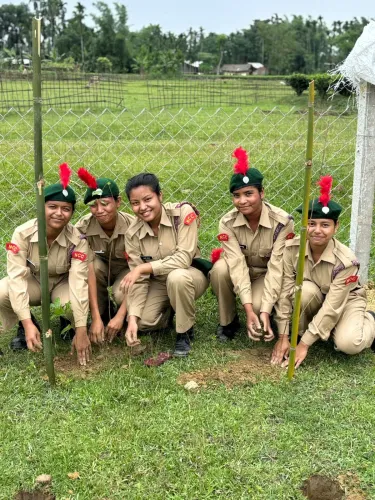
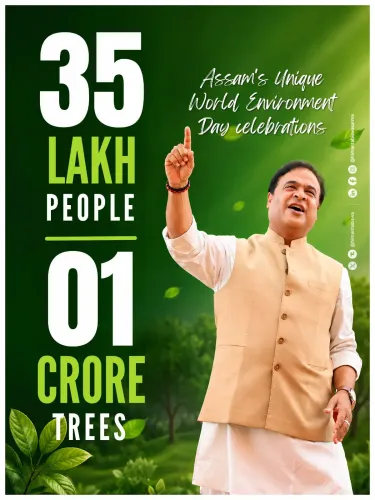
Assam Chief Minister Himanta Biswa Sarma announced on Friday, 3 July 2026 that the state will mobilise 10 lakh students to plant and nurture 1 crore saplings under the 'Brikhya Bandhu' initiative, tying the mass plantation drive to India's 80th Independence Day celebrations.
Context
Posting on X, CM Sarma framed the drive with a pointed contrast: 'While some chase green flags, Assam's students are expanding green forests.' The remark positions the initiative as a substantive environmental action rather than symbolic gesture, anchoring it to the national milestone of 15 August 2027. The Brikhya Bandhu scheme — the name translates roughly to 'Friend of Trees' — places students at the centre of both planting and long-term nurturing of the saplings.
Policy Backdrop
Assam has a long history of state-led afforestation, with the Van Mahotsav plantation festival dating to the 1950s and the National Mission for a Green India providing a central policy framework since 2014. The northeastern state faces compounding pressures on its forest cover from annual flooding, encroachment, and land-use change, giving large-scale plantation drives both ecological and political salience. The current BJP-led administration has continued this tradition while scaling ambition — linking student participation numbers and sapling targets to high-visibility national events.
State afforestation efforts also operate within the framework of the Compensatory Afforestation Fund Management and Planning Authority (CAMPA), which channels funds from forest land diverted for development back into plantation and conservation work. Tying a student-led drive to Independence Day allows the government to simultaneously meet awareness, labour, and optics objectives at relatively low administrative cost.
Stakeholders and Impact
The primary actors in the drive are school students across Assam and the Assam Forest Department, which will coordinate logistics at scale. If the 1 crore sapling target is met and survival rates are maintained, the drive could make a measurable contribution to the state's green cover — though survival monitoring mechanisms under Brikhya Bandhu have not yet been detailed publicly. Student participation at this scale also embeds environmental awareness into a generation of young Assamese citizens, an outcome that policymakers and conservationists have long advocated as essential for durable ecological change.
The initiative carries symbolic weight beyond Assam as well. As convenor of the North-East Democratic Alliance (NEDA), CM Sarma is a prominent regional voice, and a successful large-scale green drive could serve as a model for other northeastern states that share similar biodiversity and forest-cover challenges.
What's Next
The drive is pegged to 15 August 2027, giving the state administration roughly thirteen months to plan school-level coordination, sapling procurement, and site selection across Assam's districts. Observers will watch for official guidelines from the Assam Forest Department on how sapling survival will be tracked and whether Brikhya Bandhu will be integrated into school eco-club programmes or state budget allocations. The credibility of the initiative will ultimately rest on post-plantation monitoring — a step that has historically been the weakest link in India's mass afforestation drives.
Point of View
Student-led target to Independence Day, CM Sarma simultaneously advances Assam's afforestation obligations under central schemes and builds a visible grassroots narrative ahead of what is a politically significant year. The pointed phrasing — 'while some chase green flags' — signals a deliberate contrast with opposition rhetoric, suggesting the post is as much political communication as environmental announcement. The initiative's real test will be whether Brikhya Bandhu develops robust survival-tracking, the step where most mass plantation drives in India have historically fallen short.
NationPress
3 Jul 2026
Frequently Asked Questions
What is the Brikhya Bandhu initiative in Assam?
Brikhya Bandhu is an Assam government scheme under which 10 lakh students will plant and nurture 1 crore saplings to mark India's 80th Independence Day on 15 August 2027 .
Who announced the Brikhya Bandhu sapling drive?
Assam Chief Minister Himanta Biswa Sarma announced the drive on X on 3 July 2026 , framing it as a meaningful environmental action tied to the national independence anniversary.
When will the 1 crore sapling plantation happen in Assam?
The drive is linked to India's 80th Independence Day on 15 August 2027 , giving the state administration over a year to coordinate logistics across districts.
How many students will participate in Assam's Independence Day tree plantation?
10 lakh students from across Assam are set to participate in the Brikhya Bandhu plantation drive.
What is Assam's history with large-scale tree plantation drives?
Assam has conducted annual plantation drives including Van Mahotsav since the 1950s , and the state's efforts also align with the National Mission for a Green India approved in 2014 .