CM Himanta's Assam Brings Tea Land Into Farmer Registry
Synopsis
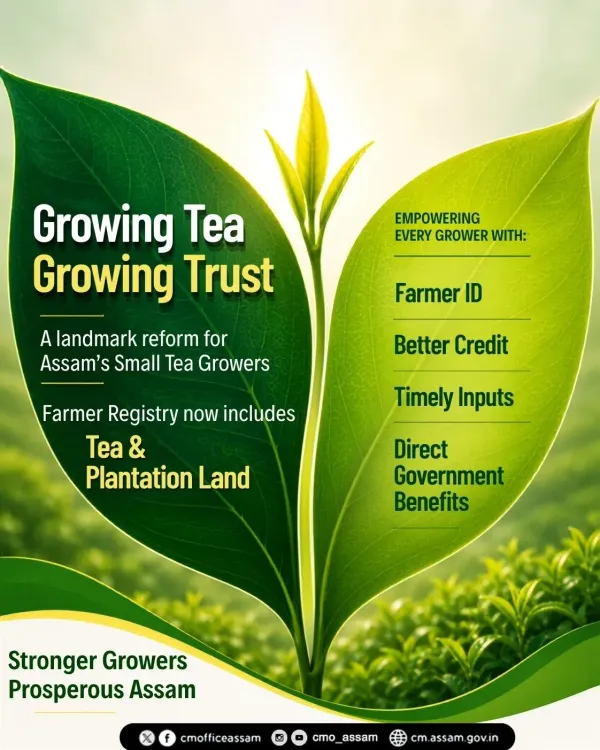
Assam's Chief Minister's Office announced that Tea and Plantation Land is now included in the state Farmer Registry under CM Himanta Biswa Sarma. Small tea growers can register for a Farmer ID, unlocking institutional credit, agricultural inputs, and direct government benefits — a significant step in formalising the state's large informal tea-cultivation sector.
Key Takeaways
Tea and Plantation Land has been added to Assam's Farmer Registry , covering small tea growers previously excluded from the formal agricultural database.
Eligible growers can now obtain a unique Farmer ID through a single registration process.
The Farmer ID unlocks access to institutional credit , subsidised agricultural inputs, and direct government benefit transfers.
The reform is driven under the leadership of Chief Minister Dr.
Himanta Biswa Sarma , who has held office since 2021 .
Assam is India's largest tea-producing state, with a significant population of small growers outside the organised estate system.
The move aligns with India's broader push — anchored by the PM-KISAN scheme since 2019 — to digitise land records and extend formal recognition to marginal cultivators.
The Chief Minister's Office of Assam announced on Saturday, 27 June 2026 that Tea and Plantation Land has been included in the state's Farmer Registry, a landmark reform that entitles every eligible small tea grower in the state to a unique Farmer ID and the basket of benefits tied to it.
Context
The CMO post, attributed to the leadership of Chief Minister Dr. Himanta Biswa Sarma, describes the move as delivering 'one registration and a stronger future for every tea grower.' Until now, small tea growers cultivating Tea and Plantation Land sat outside the formal Farmer Registry, leaving them ineligible for the direct government benefits and institutional credit lines that the database unlocks. The inclusion closes that gap with a single registration step.
Policy Backdrop
Assam is India's largest tea-producing state, and a substantial share of its output comes from small growers who operate outside the organised estate system. The state-level Farmer Registry is a digital database designed to issue unique Farmer IDs for the targeted delivery of credit, agricultural inputs, and government welfare transfers. The registry's architecture mirrors the logic of the PM-KISAN direct-benefit-transfer scheme launched nationally in 2019, which created the foundational push for states to build their own farmer databases and extend formal recognition to previously unregistered cultivators.
Dr. Himanta Biswa Sarma has served as Chief Minister since 2021 and has pursued incremental integration of marginal and informal farmers into digital agricultural systems. The inclusion of Tea and Plantation Land continues that arc, bringing a category of land-use that was historically classified outside mainstream crop registries into the formal fold.
Stakeholders and Impact
The primary beneficiaries are Assam's small tea growers — a community whose livelihoods depend on tea cultivation but who have historically lacked the formal documentation needed to access institutional credit from banks and cooperative lenders. With a Farmer ID now accessible through a single registration, eligible growers gain a verifiable identity within the state's agricultural system, making them eligible for timely supply of seeds, fertilisers, and other inputs routed through government channels.
Access to institutional credit is a particularly significant gain. Small growers without formal land registry status have typically relied on informal moneylenders at higher interest rates. Inclusion in the Farmer Registry opens pathways to subsidised agricultural loans and crop-insurance products that were previously out of reach. The broader Northeast region, where land-record digitisation has lagged behind other parts of India, stands to watch Assam's model as a potential template.
What's Next
The practical test of the reform will lie in uptake — how many small tea growers complete registration and receive their Farmer IDs, and whether the linked increase in bank credit disbursements materialises in subsequent state budget documents. Analysts will also watch whether the inclusion criteria for Tea and Plantation Land are clearly notified so that growers and local officials can implement the scheme without ambiguity. If the rollout is smooth, it could accelerate similar inclusions for other non-conventional crop categories in the state's registry.
Point of View
Not merely an administrative update. By attaching a Farmer ID to small tea growers, the state creates a verifiable identity layer that can channel credit, insurance, and input subsidies — tools that organised estate workers already enjoy but that smallholders have long been denied. The reform also signals that CM Himanta Biswa Sarma is using digital registry infrastructure as a political and policy lever to consolidate the loyalty of a numerically large and economically vulnerable constituency ahead of future electoral cycles. Whether the reform delivers on paper or on the ground will depend entirely on implementation speed and the clarity of eligibility criteria — factors the government has yet to publicly detail.
NationPress
27 Jun 2026
Frequently Asked Questions
What is the Assam Farmer Registry and how does it help tea growers?
The Assam Farmer Registry is a state-level digital database that issues unique Farmer IDs to registered cultivators. Tea and Plantation Land has now been included, meaning small tea growers who register receive an ID that qualifies them for institutional loans, agricultural inputs, and direct government benefit transfers.
Who are small tea growers in Assam?
Small tea growers are individual cultivators in Assam who grow tea on relatively small plots of land outside the organised estate or garden system. They form a large segment of the state's tea sector but have historically lacked formal documentation, limiting their access to credit and government schemes.
What benefits does a Farmer ID provide in Assam?
A Farmer ID in Assam serves as a verifiable agricultural identity that unlocks access to institutional credit from banks, timely supply of seeds and fertilisers, crop insurance products, and direct cash or in-kind transfers from state and central government welfare programmes.
How does this reform relate to PM-KISAN?
India's PM-KISAN direct-benefit-transfer scheme, launched in 2019 , created the national impetus for states to build digital farmer registries. Assam's Farmer Registry follows that model at the state level, and inclusion of tea growers extends the same logic of targeted, ID-linked benefit delivery to a previously excluded category of cultivators.
What will determine whether this Assam tea grower reform succeeds?
Success will depend on the number of small tea growers who complete registration and receive Farmer IDs, the clarity of eligibility criteria for Tea and Plantation Land, and measurable increases in bank credit disbursements to this community — data points likely to emerge in future state budget and agriculture department reports.