CM Majhi lays foundation for 630 model primary schools in Odisha
Synopsis
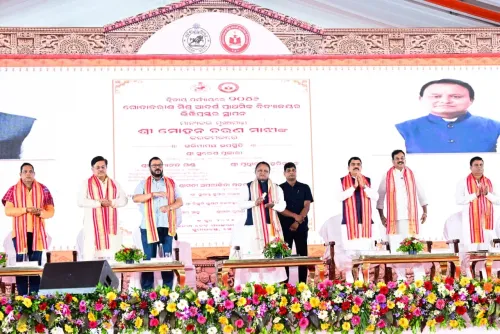
Odisha Chief Minister Mohan Charan Majhi launched Phase III of the Godabarish Mishra Adarsh Primary Vidyalaya Yojana from Kendujhar on 6 November 2026, simultaneously laying foundation stones for 630 new model primary schools to expand quality education access across rural Odisha.
Key Takeaways
630 model primary schools had their foundation stones laid simultaneously in a single event on 6 November 2026 .
The launch took place in Kendujhar , a mineral-rich but infrastructure-underserved district in northern Odisha.
This is Phase III of the Godabarish Mishra Adarsh Primary Vidyalaya Yojana , named after the renowned Odia educator and freedom fighter.
CM Mohan Charan Majhi framed the scheme as central to building a 'self-reliant and prosperous Odisha' through foundational education.
The programme targets rural talent and aims to close the urban-rural gap in school infrastructure and teaching quality.
Completion timelines, teacher recruitment, and enrolment data for the new schools remain the key metrics to watch.
A single day, 630 foundation stones — Odisha Chief Minister Mohan Charan Majhi launched Phase III of the Godabarish Mishra Adarsh Primary Vidyalaya Yojana from Kendujhar on Friday, 6 November 2026, pushing the state's most ambitious model-school drive deeper into its rural districts.
Posting in Odia, the Chief Minister framed the initiative in unambiguous terms: 'ପ୍ରାଥମିକ ଶିକ୍ଷାର ସୁଦୃଢ଼ ମୂଳଦୁଆ ହିଁ ଗଠନ କରିବ ଏକ ଆତ୍ମନିର୍ଭର ତଥା ସମୃଦ୍ଧ ଓଡ଼ିଶା' — 'A strong foundation in primary education alone will build a self-reliant and prosperous Odisha.' He added that his government is 'firmly committed to delivering quality education to every corner of the state and providing a fitting platform for rural talent.'
Who is Godabarish Mishra — and why the name matters
The scheme carries the name of Godabarish Mishra, one of Odisha's most revered educator-freedom fighters — a figure whose life fused the classroom with the independence movement. Naming a flagship primary-school programme after him is a deliberate signal: education, in this government's framing, is both a civic duty and a development strategy. The adarsh (model) tag sets a quality benchmark distinct from routine infrastructure expansion.
Kendujhar as the launch pad
Kendujhar, the mineral-rich district in northern Odisha where the foundation stones were laid, is emblematic of the state's development paradox — resource wealth sitting alongside infrastructure gaps in schooling and healthcare. Choosing it as the Phase III launch site is a pointed choice. It signals that the new schools are targeted precisely at areas where the gap between potential and opportunity is sharpest.
Phase III in the broader education push
The Godabarish Mishra Adarsh Primary Vidyalaya Yojana has expanded through successive phases since it was introduced as part of Odisha's post-2024 education agenda under Chief Minister Majhi. The scheme aims to upgrade school infrastructure, improve teaching quality, and reduce the urban-rural learning divide. Phase III's simultaneous laying of 630 foundation stones in a single event is designed to send a scale signal — this is not a pilot, it is a roll-out. The programme runs in parallel with central schemes such as Samagra Shiksha, which funds state-level school improvement plans.
What comes next matters as much as the groundbreaking. Completion timelines, teacher recruitment for the new schools, and enrolment figures will determine whether the brick-and-mortar ambition translates into measurable learning outcomes. A fourth phase has not yet been announced — but the momentum of three rapid phases suggests the government views this as an ongoing, scalable commitment rather than a one-time gesture.
Six hundred and thirty classrooms rising from Odisha's soil — the foundation has been laid. Whether they also raise the state's foundational literacy numbers will be the real test.
Point of View
In power since 2024, is staking its legacy partly on visible, scalable education infrastructure. Naming the scheme after a freedom-fighter educator and launching it from Kendujhar — a district where mineral royalties have historically not translated into social indicators — reinforces a 'development dividend' narrative. However, groundbreaking events are the easiest part of school-building programmes; the harder accountability test arrives when teacher vacancies, learning outcomes, and construction quality data become public. If Phase III delivers on its physical and pedagogical targets, it also strengthens the case for a fourth phase and positions primary education as a durable electoral asset for the party.
NationPress
6 Nov 2026
Frequently Asked Questions
What is the Godabarish Mishra Adarsh Primary Vidyalaya Yojana?
It is an Odisha government scheme to establish model primary schools with improved infrastructure and teaching quality across the state, named after the celebrated Odia educator and freedom fighter Godabarish Mishra. Phase III saw foundation stones laid for 630 new schools on 6 November 2026.
Where was Phase III of the scheme launched?
Chief Minister Mohan Charan Majhi launched Phase III from Kendujhar , a mineral-rich district in northern Odisha, laying foundation stones for 630 model primary schools simultaneously.
Who was Godabarish Mishra?
Godabarish Mishra was a prominent Odia educator, writer, and freedom fighter. The Odisha government named its flagship model primary school programme after him to honour his contributions to education and the independence movement.
How many schools are being built in Phase III?
Phase III involves the construction of 630 new Adarsh Primary Vidyalayas , with all foundation stones laid in a single event on 6 November 2026.
What is the goal of the Adarsh Primary Vidyalaya scheme in Odisha?
The scheme aims to deliver quality primary education to every corner of Odisha, particularly in rural and semi-urban areas, by upgrading school infrastructure and teaching standards — reducing the gap between urban and rural learning outcomes.