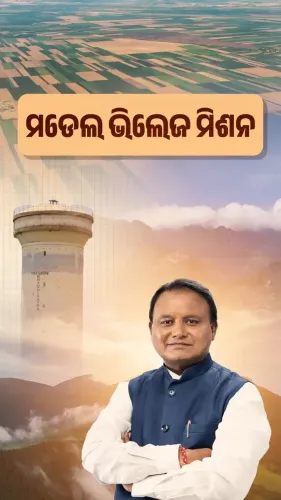
CM Majhi launches Model Village Mission for Odisha's 6,733 GPs
Synopsis
Odisha Chief Minister Mohan Charan Majhi has announced the Model Village Mission, targeting the headquarter villages of all 6,733 gram panchayats in the state with essential infrastructure and modern facilities, calling it a milestone for self-reliant rural governance.
Key Takeaways
CM Mohan Charan Majhi announced the Model Village Mission on 26 May 2026 .
The mission will cover headquarter villages of all 6,733 gram panchayats in Odisha .
Each covered village will receive essential infrastructure and modern facilities.
The scheme is positioned as a step toward self-reliant and self-governing villages.
It builds on a policy lineage that includes the national Sansad Adarsh Gram Yojana (2014) and post- 73rd Amendment Panchayati Raj programmes.
Detailed budget allocations and implementation guidelines are yet to be announced.
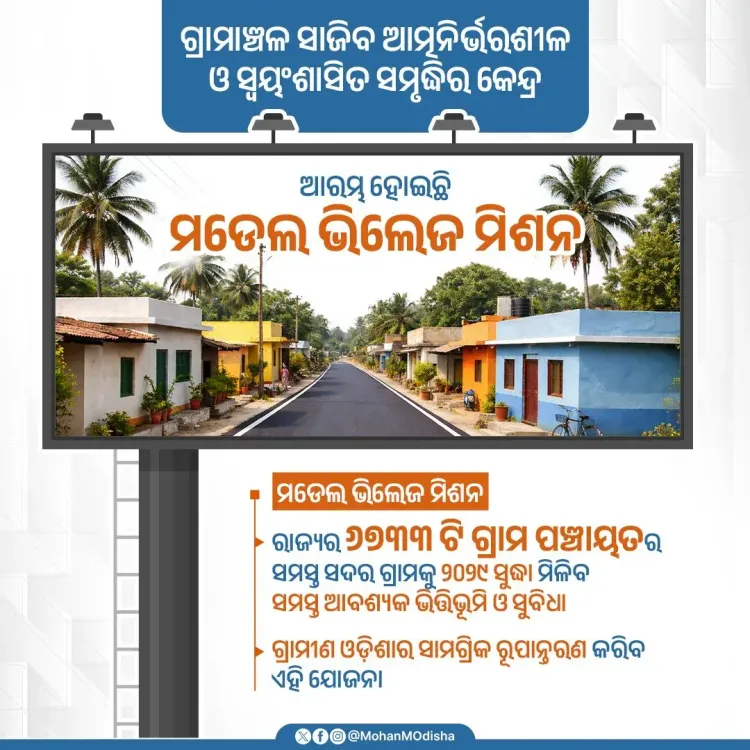
Odisha Chief Minister Mohan Charan Majhi on Tuesday, 26 May 2026, announced the Model Village Mission, a state initiative to provide essential infrastructure and modern facilities to the headquarter villages of all 6,733 gram panchayats across Odisha, framing it as a historic step toward self-reliant and self-governing villages.
Context
Posting in Odia, CM Majhi described the mission as 'ଲୋକଙ୍କ ସରକାରଙ୍କ ଆଉ ଏକ ଐତିହାସିକ ପଦକ୍ଷେପ' — 'another historic step by the people's government' — toward building 'ଆତ୍ମନିର୍ଭରଶୀଳ ଓ ସ୍ଵୟଂଶାସିତ ଗ୍ରାମ', meaning 'self-reliant and self-governing villages'. The announcement targets the headquarter village of every gram panchayat in the state as the unit of development, ensuring no panchayat is left without a model settlement at its core.
Majhi called the scheme a milestone — 'ମାଇଲଖୁଣ୍ଟ' — in the overall development and prosperity of rural Odisha. The post was accompanied by an image, signalling a formal programme rollout rather than a policy intent statement.
Policy Backdrop
The Model Village Mission draws on a lineage of rural transformation schemes at both the central and state levels. The Sansad Adarsh Gram Yojana, launched nationally in 2014, introduced the concept of parliamentarians adopting villages for holistic development, while Odisha's Panchayati Raj department has run successive rural infrastructure programmes since the 73rd Constitutional Amendment of 1992 institutionalised gram panchayats as the third tier of government.
What distinguishes the current announcement is its universal scope: rather than piloting select villages or tying development to political constituencies, the mission aims to cover all 6,733 gram panchayat headquarters in the state, attempting to standardise baseline infrastructure across rural Odisha at scale.
Stakeholders and Impact
Gram panchayats and the rural households they serve are the primary beneficiaries. Odisha has a large rural population, and village-level institutions have historically been the front line for delivering welfare, land records, health, and sanitation services. Upgrading headquarter villages with modern facilities is expected to strengthen the administrative and service-delivery capacity of each panchayat.
Convergence with central schemes such as PMAY-G (Pradhan Mantri Awaas Yojana – Gramin) and MGNREGA could amplify the mission's reach and funding, though detailed implementation guidelines and budget allocations are yet to be made public.
What's Next
Observers will watch the next state budget session for fund allocations, department-wise responsibilities, and convergence frameworks with centrally sponsored schemes. The credibility of the mission will rest on whether implementation guidelines are published promptly and whether panchayat-level timelines and accountability mechanisms are built into the programme architecture.
If executed at the announced scale, the Model Village Mission could set a benchmark for state-led universal rural infrastructure programmes in India, and will likely become a central plank of the BJP government's governance record ahead of future electoral cycles in Odisha.
Point of View
Which took office in mid-2024 and is now seeking to establish a distinct governance identity in Odisha's rural heartland. By targeting all gram panchayat headquarters rather than a curated subset, the scheme signals an intent to universalise development rather than concentrate it — a direct contrast to constituency-based models. The announcement fits a broader national BJP pattern of framing rural welfare through the lens of self-reliance and decentralised governance, echoing the 'Atmanirbhar Bharat' vocabulary at the state level. The mission's real test will be whether fund flows and accountability structures match the ambition of its scale.
NationPress
19 Sept 2026
Frequently Asked Questions
What is the Model Village Mission in Odisha?
The Model Village Mission is a state government scheme announced by Chief Minister Mohan Charan Majhi to provide essential infrastructure and modern facilities to the headquarter villages of all 6,733 gram panchayats in Odisha, aiming to build self-reliant and self-governing villages.
How many gram panchayats will benefit from Odisha's Model Village Mission?
All 6,733 gram panchayats in Odisha are covered under the mission, with each panchayat's headquarter village slated to receive infrastructure upgrades and modern amenities.
Who announced the Model Village Mission in Odisha?
Odisha Chief Minister Mohan Charan Majhi, a BJP leader who took office in June 2024, announced the mission on 26 May 2026 through a post on X.
How is the Model Village Mission different from Sansad Adarsh Gram Yojana?
Unlike the Sansad Adarsh Gram Yojana, which is tied to parliamentary constituencies and involves selective village adoption, the Model Village Mission targets all gram panchayat headquarters in Odisha universally, without dependence on individual MP sponsorship.
What facilities will villages get under the Model Village Mission Odisha?
The scheme promises essential infrastructure and modern facilities to each gram panchayat headquarter village; detailed guidelines on specific amenities and budget allocations are yet to be officially released.