CM Mann enacts strict law to curb sacrilege incidents in Punjab

Synopsis
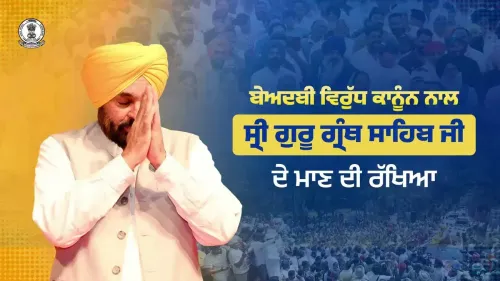
The Chief Minister's Office of Punjab announced on 28 May 2026 that CM Bhagwant Mann's government has enacted a strict new law to curb rising sacrilege incidents in the state, describing the legislation as a firm step to address a long-standing and sensitive issue.
Key Takeaways
The Punjab government has enacted a new strict law specifically targeting sacrilege incidents, announced on 28 May 2026 .
Chief Minister Bhagwant Mann personally shared the announcement, citing a pattern of recurring desecration incidents as the trigger.
The term beadbi (sacrilege) in the post refers primarily to incidents of desecration of religious texts, particularly the Guru Granth Sahib .
The move follows a precedent set after the 2015 Bargari sacrilege incidents , which caused major political and communal upheaval in Punjab.
The Aam Aadmi Party government, in power since March 2022 , frames the legislation as a decisive response to public sentiment in the state.
Specific provisions of the law and any subsequent legal challenges remain to be detailed and will be closely watched.
The Chief Minister's Office of Punjab announced on Thursday, 28 May 2026 that the Punjab government has enacted a strict new law to check the rising number of sacrilege incidents in the state. Chief Minister Bhagwant Mann shared the development, stating that such incidents had been occurring with troubling regularity and that firm legislative steps have now been taken to bring them under control.
Sharing the details, CM Mann said — 'ਪਹਿਲਾਂ ਅਕਸਰ ਬੇਅਦਬੀ ਦੀਆਂ ਘਟਨਾਵਾਂ ਸੁਣਨ ਨੂੰ ਮਿਲਦੀਆਂ ਸਨ' ['Earlier, incidents of sacrilege were frequently reported'] — but the government has now moved decisively to put a stop to them through stringent legal provisions.
Context
Sacrilege incidents — particularly those involving desecration of the Guru Granth Sahib — carry profound religious and political weight in Punjab, a state with a large and deeply devout Sikh population. Such incidents have historically triggered widespread protests, communal tension, and significant political fallout. The announcement by the Chief Minister's Office signals that the frequency of such incidents has reached a level the government considers unacceptable. The post uses the Punjabi term beadbi (ਬੇਅਦਬੀ), meaning 'disrespect' or 'sacrilege', a word that carries specific and charged meaning in the context of Sikh religious sentiment in the state.Policy Backdrop
The legislative move follows a well-established pattern in Punjab's governance. The most significant precedent was the 2015 Bargari sacrilege episode, in which desecration of the Guru Granth Sahib triggered mass protests and became a defining political crisis for the then Shiromani Akali Dal-BJP government. That episode demonstrated how sacrilege cases could destabilise an administration and galvanise public opinion across community lines. Successive Punjab governments have periodically strengthened legal provisions in response to such incidents, framing them as necessary measures to protect religious sentiments and maintain public order. The Aam Aadmi Party government under CM Bhagwant Mann, in power since March 2022, is now adding its own chapter to this legislative history.Stakeholders and Impact
The primary stakeholders are the Sikh community, Punjab Police, and the broader civil society of the state. For the Sikh community, the enactment of a strict law is likely to be received as a long-demanded measure that addresses a persistent grievance. For law-enforcement agencies, the new provisions will define the framework within which sacrilege cases are investigated and prosecuted. The announcement also carries political resonance. Punjab has historically seen sacrilege cases become flashpoints that test the credibility of whichever party is in government. By taking legislative action, the AAP government is positioning itself as proactive on an issue that cuts across religious and political lines in the state.What's Next
The immediate focus will be on the specific provisions of the new law — whether it involves amendments to existing state statutes, additions to criminal procedure, or an entirely new enactment. Legal experts and opposition parties are expected to scrutinise the text of the legislation for its scope, penalties, and safeguards against misuse. Any subsequent court challenges to the law's provisions, as well as early enforcement data and conviction rates, will be closely watched as indicators of whether the legislation delivers on its stated intent of curbing sacrilege incidents across Punjab.Point of View
This move is both a governance signal and a political one — it demonstrates responsiveness to a deeply felt community concern ahead of future electoral cycles. The reference to 'rising incidents' also subtly frames the new law as a departure from the perceived inaction of previous governments, reinforcing the AAP's positioning as a break from the political status quo. How robustly the law is implemented, and whether it withstands legal scrutiny, will determine whether it becomes a genuine policy achievement or a symbolic gesture.
NationPress
24 Sept 2026
Frequently Asked Questions
What is the new sacrilege law announced by the Punjab government?
The Punjab government has enacted a strict new law to check rising sacrilege incidents in the state, as announced by CM Bhagwant Mann on 28 May 2026. The specific provisions of the law are yet to be detailed publicly.
What does 'beadbi' mean in the context of Punjab politics?
'Beadbi' is a Punjabi word meaning disrespect or sacrilege, and in Punjab it specifically refers to incidents of desecration of the Guru Granth Sahib and other Sikh religious texts. Such incidents have historically triggered widespread protests and political crises in the state.
What happened in the 2015 Bargari sacrilege case?
The 2015 Bargari sacrilege episode involved the desecration of the Guru Granth Sahib in Punjab and triggered mass protests across the state. It became a major political crisis for the then Shiromani Akali Dal-BJP government and had lasting electoral consequences.
Which party governs Punjab and who is the Chief Minister?
Punjab is governed by the Aam Aadmi Party, which came to power after the February 2022 assembly elections. Bhagwant Mann has been the Chief Minister since March 2022.
Why are sacrilege laws politically significant in Punjab?
Punjab has a large Sikh population for whom the sanctity of religious texts is a deeply held value. Sacrilege incidents routinely generate mass protests and communal tension, making them a politically sensitive issue that tests the credibility of whichever party is in government.