CM Mohan Yadav announces UCC implementation in Madhya Pradesh
Synopsis
Madhya Pradesh Chief Minister Dr. Mohan Yadav announced on 1 July 2026 that the Uniform Civil Code will be implemented in the state, positioning MP as only the second BJP-ruled state after Uttarakhand to enact such legislation covering marriage, divorce, inheritance and adoption.
Key Takeaways
Madhya Pradesh Chief Minister Dr.
Mohan Yadav announced on 1 July 2026 that the Uniform Civil Code (UCC) is set to be implemented in the state.
Uttarakhand is currently the only Indian state to have enacted a UCC law, passing its bill in February 2024 .
The UCC would replace religion-specific personal laws on marriage, divorce, inheritance, and adoption with a single uniform code for all communities.
The BJP has included UCC as a manifesto commitment since 1996 ; Article 44 of the Constitution lists it as a Directive Principle.
Legal challenges before the Madhya Pradesh High Court and the Supreme Court are widely expected once a bill is formally introduced.
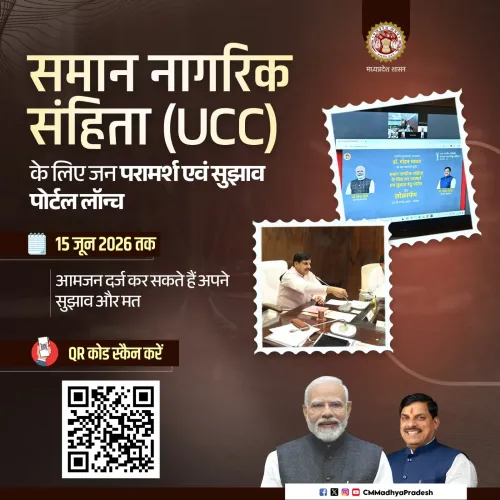
The next steps include drafting and tabling a bill in the Madhya Pradesh Legislative Assembly and initiating any public consultation process.
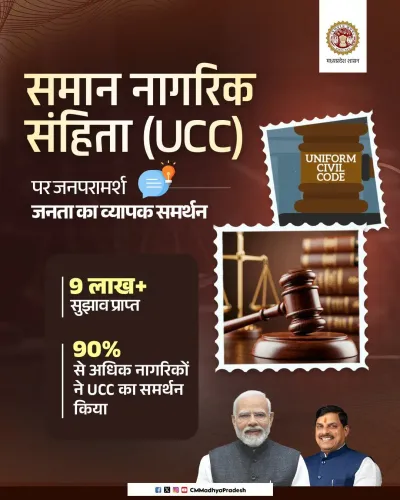
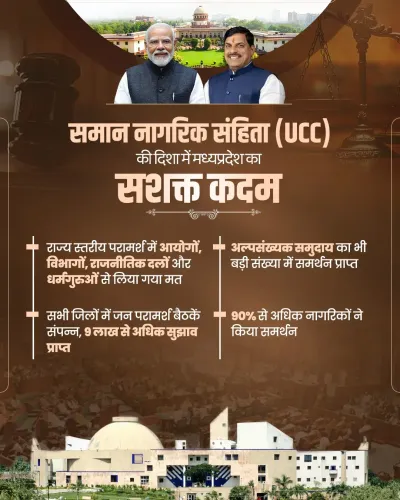
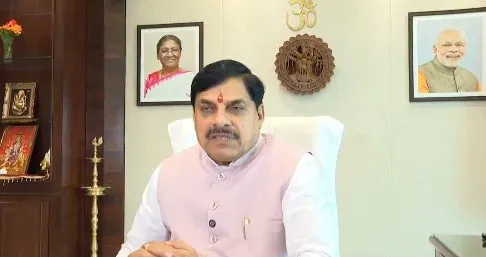
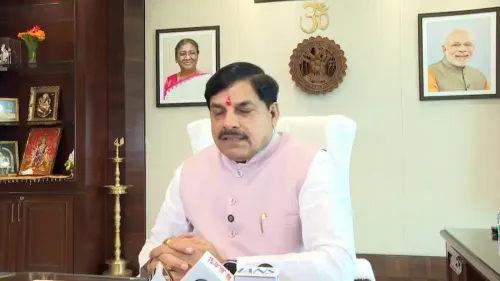
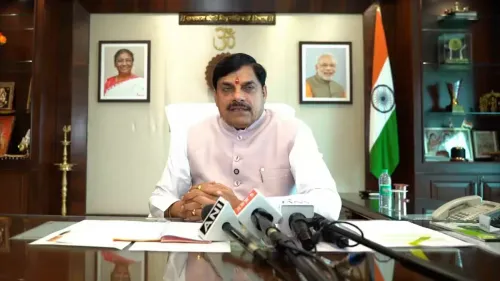
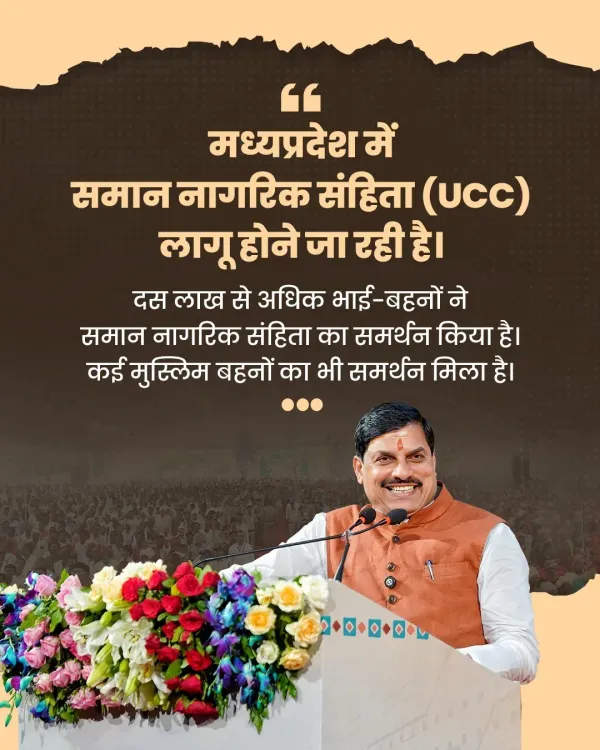
Madhya Pradesh Chief Minister Dr. Mohan Yadav announced on Wednesday, 1 July 2026 that the Uniform Civil Code (UCC) is set to be implemented in Madhya Pradesh, marking a significant policy move by the BJP-governed state.
In a post on X, the Chief Minister wrote: 'मध्यप्रदेश में समान नागरिक संहिता (UCC) लागू होने जा रही है' — 'The Uniform Civil Code is going to be implemented in Madhya Pradesh.' The announcement, brief but consequential, signals that the state intends to join Uttarakhand as only the second Indian state to enact such a code.
Context
The Uniform Civil Code refers to a single set of civil laws governing marriage, divorce, inheritance, and adoption uniformly across all religious communities, replacing religion-specific personal laws. Article 44 of the Indian Constitution lists it as a Directive Principle of State Policy, directing the State to work toward its realisation. The BJP has carried the UCC as a formal manifesto commitment since 1996.
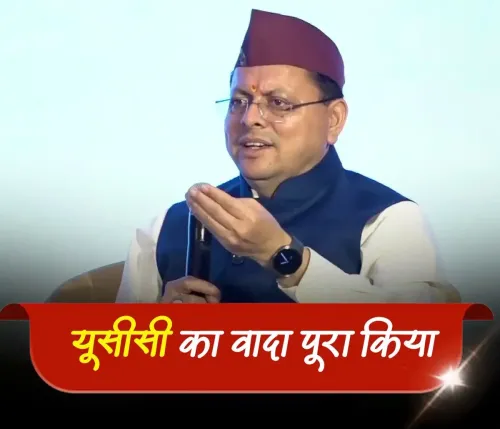
Uttarakhand became the first Indian state to pass a UCC law when its Legislative Assembly approved the bill in February 2024 under Chief Minister Pushkar Singh Dhami. Goa is separately cited as a working precedent, having retained a common civil code inherited from the Portuguese Civil Code of 1867. Dr. Yadav's announcement positions Madhya Pradesh as the next state to move on this agenda.
Policy Backdrop
Dr. Mohan Yadav took charge as Chief Minister of Madhya Pradesh in December 2023. Since then, the state government has aligned closely with central BJP policy priorities. A UCC in Madhya Pradesh would cover the state's population of roughly 8.5 crore people and apply uniformly across Hindu, Muslim, Christian, and other communities on matters of personal law.
The central government has so far not introduced a nationwide UCC bill, making state-level enactments the primary legislative pathway for the policy. Legal experts note that personal law reform at the state level can still be challenged on constitutional grounds, and any Madhya Pradesh bill is likely to face scrutiny before the Madhya Pradesh High Court and potentially the Supreme Court of India.
Stakeholders and Impact
Women's organisations supporting the UCC argue it would standardise protections around marriage age, divorce rights, and inheritance regardless of religion. Religious minority groups and opposition parties have consistently raised concerns that such legislation disproportionately targets Muslim personal law and risks communal tension. Legal practitioners point to the complexity of drafting a code that is constitutionally watertight and practically enforceable across a diverse population.
The announcement is expected to energise both supporters and critics of the policy, drawing responses from civil society, bar associations, and political parties across the state ahead of any formal legislative process.
What's Next
The immediate steps to watch include the introduction of a draft UCC bill in the Madhya Pradesh Legislative Assembly, any public consultation or law commission process the state government may initiate, and the timeline for gubernatorial assent and actual enforcement. Legal challenges at the High Court level are widely anticipated once a bill is tabled.
If enacted, Madhya Pradesh's UCC would represent a significant acceleration of the BJP's state-by-state strategy on personal law reform, and could increase pressure on other BJP-ruled states to follow suit before the next general election cycle.
Point of View
State-by-state strategy on the Uniform Civil Code — advancing a long-standing ideological goal without waiting for a central parliamentary bill. Following Uttarakhand's precedent, Madhya Pradesh's move signals that BJP chief ministers are increasingly willing to use state legislative power to push flagship cultural-nationalist policies. The timing, arriving in mid-2026, could also serve as a political signal ahead of future electoral cycles, energising the party's core voter base while forcing opposition parties to define their position on personal law reform. The real test will come in the drafting stage, where the government must balance constitutional requirements, minority rights concerns, and the practical complexity of a genuinely uniform code.
NationPress
1 Jul 2026
Frequently Asked Questions
What is the Uniform Civil Code and why is it significant in India?
The Uniform Civil Code (UCC) is a proposed single set of civil laws on marriage, divorce, inheritance and adoption that would apply to all citizens regardless of religion, replacing existing religion-specific personal laws. It is significant because India currently allows different communities to follow their own personal laws, and the UCC has been a long-standing and politically sensitive reform demand, especially by the BJP.
Which state first implemented the Uniform Civil Code in India?
Uttarakhand was the first Indian state to enact a Uniform Civil Code, with its Legislative Assembly passing the bill in February 2024 under Chief Minister Pushkar Singh Dhami.
Has Madhya Pradesh passed a UCC bill yet?
As of the announcement on 1 July 2026, Chief Minister Dr. Mohan Yadav has stated that the UCC will be implemented in Madhya Pradesh, but a formal bill has not yet been tabled in the state assembly. The draft bill introduction and legislative process are the immediate next steps to watch.
What does the Uniform Civil Code mean for Muslim personal law in India?
The UCC would replace Muslim personal law — along with Hindu, Christian, and other community-specific personal laws — with a single uniform code on civil matters. Critics, including minority organisations and opposition parties, argue this disproportionately affects Muslim practices around marriage and inheritance, while proponents say it advances gender equality for all communities.
Can an Indian state implement the Uniform Civil Code on its own?
Yes, Indian states can legislate on personal law matters under the concurrent list of the Constitution, as Uttarakhand demonstrated in 2024. However, such state-level UCC laws are subject to constitutional scrutiny and can be challenged before High Courts and the Supreme Court of India.