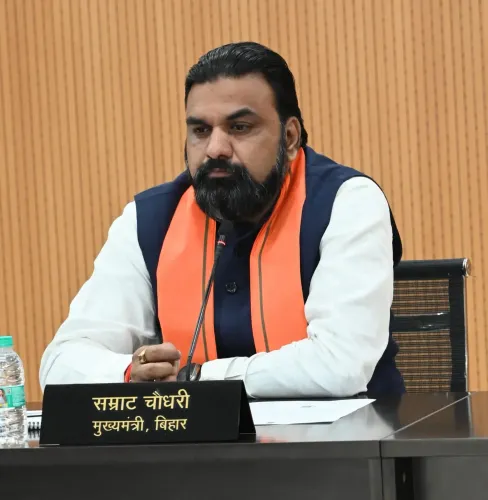
CM Nitish Kumar: New Criminal Laws to Strengthen Rule of Law in Bihar

Synopsis
Bihar's Chief Minister's Office quoted CM Nitish Kumar affirming that the new criminal laws — the BNS and BNSS — will strengthen rule of law in Bihar through improved coordination among the judiciary, police, and administration, ensuring time-bound and transparent justice.
Key Takeaways
The Chief Minister's Office of Bihar quoted CM Nitish Kumar on 4 July 2026 on the implementation of new criminal laws.
Kumar stated that effective rollout of the new laws will 'further strengthen the rule of law in Bihar.' He emphasised that better coordination among the judiciary, police, and administration is key to ensuring timely and transparent justice.
India's three new criminal laws — Bharatiya Nyaya Sanhita, Bharatiya Nagarik Suraksha Sanhita , and Bharatiya Sakshya Adhiniyam — replaced colonial-era statutes and took effect from 1 July 2024 .
Bihar has identified inter-institutional coordination as its primary implementation priority under the new legal framework.
State-level SOPs for FIR registration, charge-sheet timelines , and e-FIR integration in Bihar are expected to follow.
The Chief Minister's Office of Bihar, on Saturday, 4 July 2026, quoted Chief Minister Nitish Kumar as affirming that the effective implementation of India's new criminal laws will further consolidate the rule of law in Bihar, with better coordination among the judiciary, police, and administration ensuring timely, transparent, and effective justice.
The post, a reply to @samrat4bjp, carried the Chief Minister's statement in Hindi: 'नए आपराधिक कानूनों के प्रभावी क्रियान्वयन से बिहार में कानून का राज और अधिक सुदृढ़ होगा।' ['The effective implementation of the new criminal laws will further strengthen the rule of law in Bihar.'] He added that improved coordination among the judiciary, police, and administration would ensure a time-bound, transparent, and effective justice system.
Context
India's Parliament passed three landmark criminal laws in December 2023 — the Bharatiya Nyaya Sanhita (BNS), the Bharatiya Nagarik Suraksha Sanhita (BNSS), and the Bharatiya Sakshya Adhiniyam — replacing the colonial-era Indian Penal Code, the Code of Criminal Procedure, and the Indian Evidence Act respectively. These laws came into effect nationwide from 1 July 2024. The Union Ministry of Home Affairs subsequently issued implementation guidelines and training schedules to all state governments.Policy Backdrop
Chief Minister Nitish Kumar has consistently placed law-and-order and administrative reform at the centre of Bihar's governance agenda since he first took office in 2005. The new criminal framework introduces mandatory timelines for investigations and trials, provisions for e-FIR registration, and mechanisms to reduce pendency in courts. Bihar has publicly identified inter-institutional coordination — between district police, the state judiciary, and the revenue administration — as its foremost priority in rolling out these laws. The BNSS, in particular, mandates that charge-sheets be filed within stipulated deadlines and that victims be informed of case progress, representing a significant procedural shift from the earlier CrPC regime. States are required to retrain police personnel, update FIR-registration software, and align court processes with the new statutory timelines.Stakeholders and Impact
Bihar Police, the state judiciary, and district administrations are the primary institutional actors responsible for operationalising the new laws on the ground. For ordinary citizens — particularly those filing complaints or awaiting trial outcomes — the reforms promise faster resolution of cases and greater transparency at each procedural stage. Civil-society groups tracking criminal-justice reform have noted that the success of the new laws will depend heavily on consistent training and digital infrastructure at the district level across states like Bihar.What's Next
Attention will now turn to state-level standard operating procedures governing FIR registration, charge-sheet timelines, and e-FIR integration in Bihar in the months ahead. The degree to which the three pillars — judiciary, police, and administration — can achieve the 'better coordination' that CM Nitish Kumar has outlined will be the practical test of the state's commitment to the new criminal-justice framework. Implementation benchmarks and any state-specific training programmes announced by the Bihar government will be closely watched by both legal practitioners and citizens across the state.Point of View
Police, and administration, Kumar is signalling that Bihar's approach is institutional rather than merely procedural, a framing that carries political weight in a state where law-and-order credibility has long been central to his electoral identity. The emphasis on 'time-bound and transparent' justice also maps onto a growing citizen demand for accountability in the criminal-justice system, particularly in states with high case pendency. How effectively Bihar translates this political commitment into ground-level implementation will serve as an early indicator for other large states still calibrating their own rollout strategies.
NationPress
4 Jul 2026
Frequently Asked Questions
What are the new criminal laws CM Nitish Kumar is referring to?
CM Nitish Kumar is referring to the Bharatiya Nyaya Sanhita (BNS) , the Bharatiya Nagarik Suraksha Sanhita (BNSS) , and the Bharatiya Sakshya Adhiniyam, which replaced the Indian Penal Code, CrPC, and Indian Evidence Act respectively and came into force on 1 July 2024 .
What did Bihar CM Nitish Kumar say about law and order?
CM Nitish Kumar stated that the effective implementation of India's new criminal laws will further strengthen the rule of law in Bihar, and that improved coordination among the judiciary, police, and administration will ensure a time-bound, transparent, and effective justice system.
How is Bihar implementing the new criminal laws?
Bihar has identified better inter-institutional coordination among the judiciary, police, and district administration as its primary implementation strategy, with state-level standard operating procedures for FIR registration and charge-sheet timelines expected to be issued.
When did the Bharatiya Nyaya Sanhita come into effect?
The Bharatiya Nyaya Sanhita and the other two new criminal laws passed by Parliament in December 2023 came into effect across India from 1 July 2024 .
What is the role of Bihar Police in the new criminal law framework?
Bihar Police is a key stakeholder responsible for operationalising the new laws, including retraining personnel, updating FIR-registration systems, and meeting the mandatory investigation and charge-sheet timelines prescribed under the BNSS .