CM Bhupendra Patel Marks 12 Years of Modi's Welfare Mission
Synopsis
Gujarat Chief Minister Bhupendra Patel marked 12 years of PM Narendra Modi's governance on June 8, 2026, spotlighting the Swachh Bharat Abhiyan, Pradhan Mantri Ujjwala Yojana, and Jal Jeevan Mission as pillars of welfare delivery to India's poorest citizens and women.
Key Takeaways
Gujarat CM Bhupendra Patel posted on June 8, 2026 to mark 12 years of PM Narendra Modi 's welfare governance under the hashtag #12YearsOfGaribKalyan .
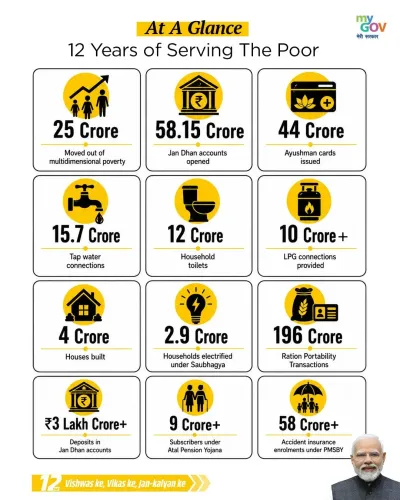
The post highlights three flagship schemes: Swachh Bharat Abhiyan (toilets), Jal Jeevan Mission (tap water), and Pradhan Mantri Ujjwala Yojana (LPG connections).
Swachh Bharat Abhiyan was launched on 2 October 2014 ; Ujjwala Yojana in May 2016 ; Jal Jeevan Mission announced in the 2019 Union Budget.
Primary beneficiaries cited are rural poor households and women from below-poverty-line families .
The schemes are positioned within the Atmanirbhar Bharat self-reliance framework announced in May 2020 .
Updated coverage data from the Ministry of Jal Shakti and Ministry of Petroleum is expected alongside the 12-year milestone communications.
Gujarat Chief Minister Bhupendra Patel on Monday, June 8, 2026, marked the completion of 12 years of Prime Minister Narendra Modi's welfare-focused governance, highlighting landmark schemes that have delivered basic amenities to the country's poorest citizens and, in particular, to women.
Context
Posting under the hashtag #12YearsOfGaribKalyan, Chief Minister Patel described PM Modi's tenure as a 'sevayagya' — a service-sacrifice — aimed at bringing 'dignified, positive change' to the lives of the poor, the marginalised, and nari shakti (women). The post underlines the ruling party's consistent effort to frame welfare delivery as a moral and civilisational mission, not merely a policy exercise.
PM Modi assumed office on 26 May 2014, making June 2026 the occasion for marking over 12 years of continuous governance at the Centre. Chief Minister Patel, who leads the BJP government in Gujarat, is among the party's senior voices amplifying this milestone nationally.
Policy Backdrop
The three schemes singled out in the post represent the backbone of the Centre's last-mile welfare architecture. The Swachh Bharat Abhiyan, launched on 2 October 2014, drove household toilet construction across India with the stated goal of eliminating open defecation. It is widely credited with transforming sanitation access in rural India, though independent assessments of sustained usage have varied.
The Pradhan Mantri Ujjwala Yojana, inaugurated in May 2016, provided LPG cooking-gas connections to women from below-poverty-line households, replacing biomass-burning stoves linked to serious indoor air pollution. The Jal Jeevan Mission, announced in the 2019 Union Budget, set an ambitious target of piped tap-water connections to every rural home, later extended to urban areas under a parallel programme.
Together, these initiatives are positioned within the broader Atmanirbhar Bharat (self-reliant India) framework outlined in May 2020, which links direct welfare delivery to long-term economic self-sufficiency at the household level.
Stakeholders and Impact
The primary beneficiaries of the schemes cited are rural poor households and women from below-poverty-line families — the constituencies CM Patel explicitly names in his post. Access to clean cooking fuel, running water, and household sanitation directly reduces the burden on women who have historically borne the cost of their absence, through time spent collecting firewood or water, or health risks from open defecation and smoke inhalation.
For the BJP, the 12-year mark is a political milestone as much as a governance one. Communicating welfare reach to these constituencies is central to the party's electoral strategy, and state-level leaders like CM Patel serve as force-multipliers for that message. Gujarat, as the Prime Minister's home state, carries particular symbolic weight in such commemorations.
What's Next
Updated coverage statistics from the Ministry of Jal Shakti and the Ministry of Petroleum and Natural Gas are expected to accompany the 12-year commemorations, providing fresh data on tap-water and LPG penetration. Any Gujarat-specific integration announcements — linking state schemes to central welfare programmes — will be closely watched as an indicator of how the BJP intends to build on this narrative ahead of future electoral cycles. The government's ability to demonstrate last-mile delivery, particularly in tribal and remote districts, will shape how the 12-year record is ultimately judged.
Point of View
Elevating policy into a moral register that resonates with the party's core voter base. The choice of three specific schemes targeting women and the rural poor signals that the BJP continues to treat last-mile welfare infrastructure as its most durable electoral asset. Marking 12 years, rather than waiting for a round-number anniversary, suggests the party is keen to sustain momentum on this narrative ahead of upcoming political cycles.
NationPress
19 Sept 2026
Frequently Asked Questions
What is the #12YearsOfGaribKalyan hashtag about?
The hashtag marks 12 years of PM Narendra Modi's governance since May 2014, with BJP leaders highlighting welfare schemes like Swachh Bharat Abhiyan, Ujjwala Yojana, and Jal Jeevan Mission that targeted poor and marginalised communities.
What is the Pradhan Mantri Ujjwala Yojana?
Pradhan Mantri Ujjwala Yojana is a central government scheme launched in May 2016 that provides free LPG cooking-gas connections to women from below-poverty-line households, replacing biomass-burning stoves.
What is the Jal Jeevan Mission?
Jal Jeevan Mission is a central scheme announced in the 2019 Union Budget with the goal of delivering piped tap-water connections to every rural household in India, later extended to urban areas as well.
Who is Bhupendra Patel?
Bhupendra Patel is the Chief Minister of Gujarat and a senior BJP leader who has held the post since September 2021. He is known for aligning state communications closely with central government policy messaging.
What is Swachh Bharat Abhiyan?
Swachh Bharat Abhiyan is a nationwide sanitation mission launched on 2 October 2014, aimed at eliminating open defecation across India through household toilet construction and behavioural change campaigns.